
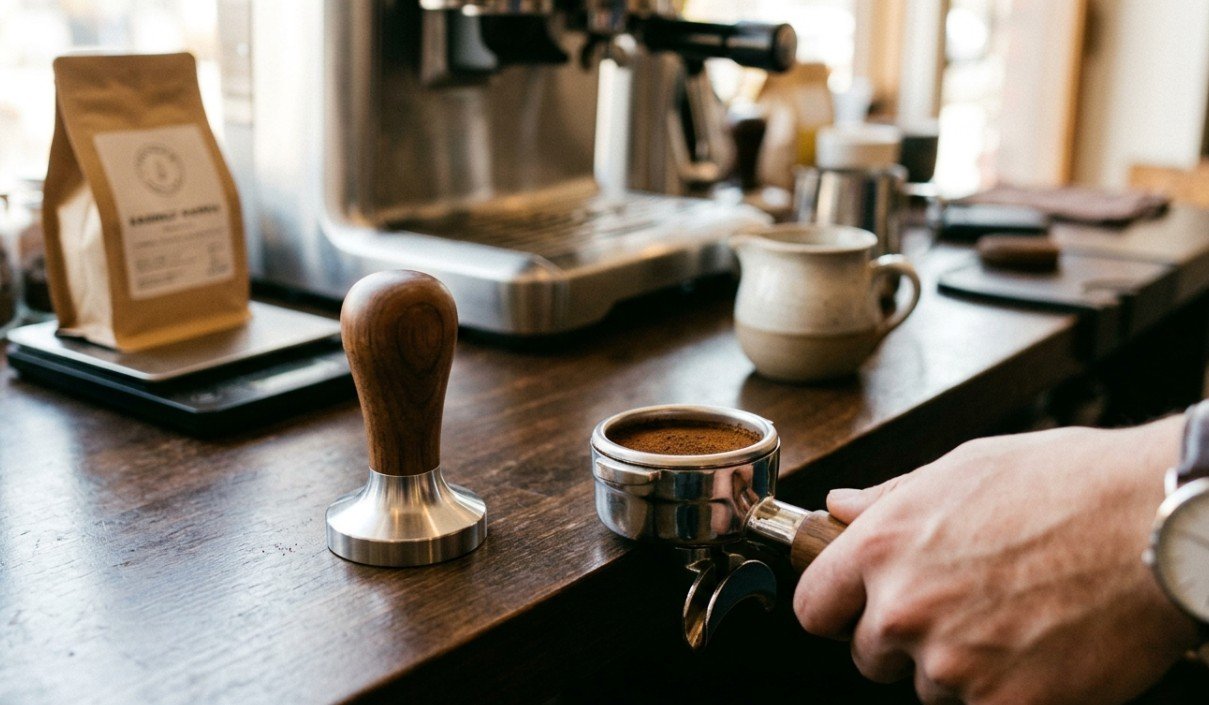
A coffee tamper is the small handheld tool baristas and home espresso owners use to compress ground coffee evenly inside a portafilter basket before locking it into the group head. Get the best coffee tampers in Australia matched to your machine and the puck compacts evenly, water flows through it at a consistent rate, and the shot pulls the way the grinder setting intended. Get the fit wrong and no amount of good beans will fix an espresso that channels down one side of the basket.
Tampers split into a few real categories, not just brand names. Base shape is flat, convex (a gentle dome, popular with baristas who like a slightly rounded compaction), or calibrated spring-loaded, where an internal spring stops the tamp at a fixed pressure so technique cannot over- or under-compress the puck. Handles run from solid timber to stainless steel to composite or resin. Base size is the part people get wrong most often, and it is not a style choice.
The number that actually matters here is base diameter in millimetres, not price or brand reputation. Australian machines commonly use 58mm baskets (most prosumer and commercial-style machines, including Breville’s higher-end range), 54mm (Breville and Sage’s single-boiler machines such as the Barista Express and Barista Pro), and 51mm (Sage’s Bambino range). A CoffeeSnobs thread discussing tamper fit for a Breville Dual Boiler was specific about this: the tamper should sit within roughly -0.25mm to -0.15mm of the actual basket measurement, tight enough to compact evenly without grounds escaping up the sides, loose enough that it does not bind against the basket wall.
This guide covers espresso tampers currently sold in Australia across the common sizes and base types, built from real Australian enthusiast-forum discussion (CoffeeSnobs and home-barista.com) instead of manufacturer marketing copy, cross-checked against specialty Australian retailers for current stock and naming. It does not cover coffee machines themselves; see the buying guide for choosing a coffee machine for that side of the equation.
The Pullman BigStep leads this list on the strength of consistent, detailed Australian enthusiast-forum praise (and the fact that it is made in Adelaide), but the right tamper for most home owners is simply whichever one matches their basket size to within a fraction of a millimetre, not the most expensive option on the shelf.
The Best Coffee Tampers in Australia Compared
| Product | Size | Best For | Key Spec |
|---|---|---|---|
| Pullman BigStep | 58.55mm (also 58mm/54mm bases) | Australian-made precision and fit | Stepped-edge flat base, modular handle/spacer system |
| Reg Barber Classic | 58.3mm / 54mm bases | Everyday flat-base tamping | Balanced weight, mix-and-match handles and bases |
| Espro Calibrated | 58mm (51mm/54mm also sold) | Learning consistent pressure | Spring-loaded, factory-set click at a fixed force |
| Bogav Craftsman | 58.5mm | Australian-made alternative | Lightweight flat base, local small-batch handles |
| Normcore V4 | 54mm (51mm/58.5mm also sold) | Budget calibrated for Breville/Sage | Spring-loaded with 3 swappable springs |
| Rattleware Classic | 58mm (57mm also sold) | Budget non-calibrated classic | Solid stainless base, no spring mechanism |
How I Compared It
I went looking for Australian consumer review data the same way as every other post in this series, starting with productreview.com.au. It came up close to empty: there is no dedicated coffee-tamper listing on the site with any real review volume, which is not surprising for a low-cost accessory that most owners buy once and never think about again. Reddit could not be fetched directly in this research pass (r/espresso and r/Coffee both returned access errors), so the enthusiast-consensus layer here leans on CoffeeSnobs and home-barista.com forum threads that were read directly, including a Breville Dual Boiler tamper-fit thread, a long-running CoffeeSnobs “tamper recommendations” thread, and a home-barista.com calibrated-tamper comparison thread.
Every model below is confirmed currently sold by at least one specialty Australian coffee equipment retailer (Coffee Parts, Barista Warehouse, Talk Coffee, or the brand’s own Australian storefront), checked purely to confirm the product is real and current, never linked as a citation. Coffeelab, a tamper praised in one CoffeeSnobs thread as the most-used tamper at a particular cafe, was researched but dropped from this list because no current Australian retail stockist could be confirmed. Metallurgica Motta was also researched (several Australian specialty roasters stock it) but excluded from a full entry because the sweep did not turn up a CoffeeSnobs or home-barista thread with direct owner sentiment on it, only retailer product descriptions and brand marketing claims about competition use, which is not independent evidence under this site’s rules.

1. Pullman BigStep Tamper – Best for Australian-Made Precision and Fit
Pullman is made in Adelaide, and the BigStep base is the product a lot of Australian enthusiast conversation circles back to. In a detailed CoffeeSnobs “tamper recommendations” thread, owners praised the adjustable handle height, the balance in the hand, and how closely the base tolerance matches basket walls; one owner specifically noted it “fulfils all of my requirements” including a convex option and close basket clearance. Greg Pullman himself has weighed into that thread over the years, explaining that the Barista range targets commercial baristas doing hundreds of tamps a day while the Deluxe range is built for home use, which is a level of direct manufacturer engagement with real owner feedback you do not see from most brands on this list.
The trade-off is how Pullman sells it: base, handle, and spacers are separate purchases rather than one boxed unit, so building the exact combination you want (Adelaide made, remember, so postage and stock are not the issue local buyers of overseas brands sometimes hit) costs more in total than a single-piece tamper of similar quality once you have picked a base, a handle, and enough spacers to get the height right for your hand. One CoffeeSnobs owner running a Pullman Nexus with a matched Pullman basket put it plainly: “you get what you pay for.” Fair. It is also the reason this is a considered purchase, not an impulse add-on at checkout.
Pros
- Made in Adelaide with serial-numbered bases
- Extensively praised across Australian forum threads for balance and basket fit
- Manufacturer actively engages with owner feedback on CoffeeSnobs
Cons
- Base, handle and spacers are bought separately, so a full set-up costs more than it first looks
- Premium pricing puts it well above the budget tampers on this list
Anyone running a Breville with a 54mm basket should check the sizing table in the guide to using a Breville coffee machine (Barista Express) before ordering a Pullman base, since Pullman sells matching bases across all three common Australian sizes and it is easy to order the wrong one.

2. Reg Barber Classic Tamper – Best for Everyday Flat-Base Tamping
Reg Barber has been a reference point in espresso forums for long enough that a 2013 home-barista.com thread on lesser-known tamper makers used it, alongside Pullman and Rattleware, as the yardstick other “not common” boutique makers were being compared against. That kind of staying power counts for something. The same CoffeeSnobs thread that praised Pullman also covered Reg Barber directly: owners described the weight as “even” and the tamper as “great for home use” thanks to its balanced construction.
The honest complaint from that same thread was that it runs “a little big and heavy for huge volumes,” meaning a cafe pulling hundreds of shots a shift might find the heft tiring, but that is precisely the opposite of a problem for a home kitchen doing a handful of shots a morning. Reg Barber also sells bases and handles as separate components, similar to Pullman, in flat and curved options and in a wide range of materials down to brass and powder-coated aluminium handles.
Pros
- Long, well-documented reputation in Australian and international forums
- Balanced weight, praised specifically for home use on CoffeeSnobs
- Wide range of handle and base material combinations
Cons
- Owners doing very high shot volumes report it feels heavy over a long session
- No calibrated version, so consistency still comes down to the user’s own technique

3. Espro Calibrated Tamper – Best for Learning Consistent Pressure
A calibrated tamper has an internal spring that stops travelling once a fixed pressure is reached, usually with an audible or tactile click, so a beginner cannot accidentally under-tamp one shot and lean on the next. That is the whole pitch of the Espro, and Coffee Parts and Barista Warehouse both stock the 58mm convex version as a current line. It removes one variable while you are still learning grind and dose, which matters more than it sounds; inconsistent tamping is a surprisingly common reason a home shot tastes different every single day even when nothing else has changed.
The same CoffeeSnobs thread that covered Pullman and Reg Barber also reviewed the Espro directly, and the feedback was mixed rather than glowing: useful “for sampling different coffees and cutting out variables,” but “a little heavy” for repeated commercial use, and one experienced barista found it “less comfortable than alternatives after extended testing.” A separate home-barista.com calibrated-tamper thread treats Espro as one option among several, not the automatic pick, with the Force Tamper and the Bravo also getting real support in the same discussion. That is worth knowing before paying calibrated-tamper prices for a single-preset device.
Pros
- Removes tamping pressure as a variable while learning
- No recalibration needed for typical home use
- Useful for comparing beans without a technique variable getting in the way
Cons
- CoffeeSnobs feedback specifically flags it as heavy and less comfortable over extended sessions
- Not universally preferred among calibrated-tamper users, who also rate the Force Tamper and the Bravo highly

4. Bogav Craftsman Tamper – Best Australian-Made Alternative to Pullman
Bogav is a smaller Australian maker, stocked through Talk Coffee in Melbourne’s inner north and through the Australian Roasted Coffee Company, and it turns up in its own dedicated CoffeeSnobs thread, not just a passing mention. The brand has even done a limited run of handles made from repurposed skateboard decks, which is a proper Australian small-batch touch you will not find on an imported tamper.
A separate CoffeeSnobs “info/review of tampers” thread gave specific, real feedback rather than marketing language: owners liked the lightweight design and how comfortably it sat in smaller hands, but flagged the base as shallow, meaning technique needs a small adjustment (a slightly firmer, more deliberate press) to compact evenly compared with a deeper base like the Pullman or Reg Barber. It is neither a dealbreaker nor a reason to skip it, just a real, sourced difference worth knowing before it arrives.
Pros
- Small-batch Australian maker with a dedicated CoffeeSnobs following
- Lightweight and specifically praised for comfort in smaller hands
- Distinctive recycled-material handle options
Cons
- Shallow base means technique needs a small adjustment compared with deeper-base tampers
- Smaller maker, so stock and colour/handle options vary by retailer

5. Normcore V4 Spring-Loaded Tamper – Best Budget Calibrated Pick for Breville and Sage
Normcore’s V4 is sized and marketed specifically at 54mm, the exact basket size on Breville and Sage’s single-boiler range (Barista Express, Barista Pro and the like), and it is stocked by both Coffee Parts and Barista Warehouse as a current line. A CoffeeSnobs thread comparing new baskets and tampers describes it plainly as “a more budget-friendly option compared to the Force Tamper,” which is a useful, honest way to think about where it sits: an actual spring-loaded, click-feedback tamper, just priced and built to a lower spec than the calibrated tampers enthusiast forums treat as the benchmark.
It ships with three interchangeable springs so the tamping pressure can be adjusted instead of locked to one factory setting, which is a real point of difference from the Espro above. For anyone who bought a Breville Barista Express and is still using the plastic tamper that came in the box, as covered in the Breville Barista Express usage guide, this is the size-matched, low-cost first upgrade most CoffeeSnobs and home-barista threads point toward before spending Pullman or Espro money.
Pros
- Sized specifically for Breville and Sage 54mm baskets
- Three swappable springs instead of one fixed pressure
- Named directly in Australian forum discussion as the budget calibrated pick
Cons
- Forum comparison explicitly positions it below the Force Tamper on build feel, not just price
- Stainless handle gets cold and slightly slippery with wet hands, a minor but real everyday niggle

6. Rattleware Classic Tamper – Best Budget Non-Calibrated Classic
Rattleware is a long-running commercial coffee-equipment brand and, like Reg Barber, it was named as one of the “common” reference-point tampers in that same 2013 home-barista.com thread on boutique alternatives, which says something about how long it has sat in the market without needing a redesign. Barista Warehouse carries it in Australia as a current 57mm and 58mm flat stainless line.
Owner sentiment specifically for this model was the thinnest of any tamper in this sweep. Neither the CoffeeSnobs threads nor the home-barista.com thread read directly for this post carried a detailed, sourced review of the Rattleware Classic itself, only its name recognition as an established brand. It earns its spot here on confirmed current Australian stock and a simple, durable reputation built over decades, not a page of forum praise, which is worth saying plainly instead of dressing it up as something it is not.
Pros
- Long-established commercial brand with proven market longevity
- Confirmed current Australian stock at more than one specialty retailer
- Simple one-piece design with nothing to recalibrate or wear out
Cons
- Weakest evidence base of any tamper on this list; no detailed Australian forum review surfaced in this sweep
- No calibrated option in the range
How to Choose the Right Coffee Tamper for Your Machine
Match the base to your basket first, everything else second. This is the one step that actually determines whether a tamper works, and it is also the one people skip because size feels like an afterthought next to handle looks. Check your machine’s basket diameter, most commonly 58mm, 54mm or 51mm in Australia, before looking at a single review.
Decide between flat, convex and calibrated only after size is settled. Flat bases are the traditional choice and the easiest to learn on. Convex bases suit baristas who prefer a slightly domed compaction and are common on commercial-style machines. Calibrated spring-loaded tampers remove pressure inconsistency entirely, which is especially useful while you are still building technique, though more than one forum thread in this research made the same point: once tamping technique is solid, the calibrated click stops mattering as much as it did in week one.
Handle material is a comfort and climate question, not just a style one. Timber handles feel warmer in the hand and look better on a bench, but they need a light oil wipe now and then in humid coastal cities. Stainless and composite handles need none of that and are the lower-maintenance pick for anyone who would rather not think about it.
Australian owner reviews on productreview.com.au’s coffee machines category are worth a browse for the machine side of this equation, since a mismatched grind will undo a good tamp faster than a good tamp will fix a mismatched grind. Beginners who are still working out grind size, dose and distribution alongside tamping might get more value out of the beginner’s guide to using a coffee machine before comparing tamper brands, since a mismatched grind will undo a good tamp faster than a good tamp will fix a mismatched grind. And if the machine itself is still an open question and not just the accessory, the roundup of the best espresso machines covers basket size for each model in its own specs.
Keep the Rest of Your Setup in Shape
A tamper has no filter, no boiler and nothing to descale, so it does not fit neatly into a maintenance checklist the way a machine does. What it does affect, directly, is how well the rest of the gear around it keeps working, so this section links out to the upkeep tasks that actually matter for a consistent shot.
Grinder: a tamper only ever compacts what the grinder hands it, and stale, oily grind residue inside the burrs will throw off dose and distribution no matter how good the tamp is. The guide to cleaning a coffee grinder covers how often that actually needs doing.
Machine: scale build-up inside a boiler changes water temperature and flow, which changes how a correctly tamped puck actually extracts, so a well-tamped shot on a badly scaled machine still will not taste right. The generic guide to descaling a coffee or espresso machine covers frequency by Australian water hardness.
Machine choice: for anyone still deciding which machine the tamper needs to fit in the first place, the buying guide to choosing a coffee machine is the right starting point before spending on accessories.
Frequently Asked Questions
What size coffee tamper do I need for my espresso machine?
Check your portafilter basket’s diameter first. Most Breville and Sage single-boiler machines (Barista Express, Barista Pro) use 54mm baskets, Sage’s Bambino range uses 51mm, and most other prosumer and commercial-style machines use 58mm. Buying by brand name before confirming this measurement is the most common tamper-buying mistake, and a tamper that does not match the basket will never compact the puck evenly no matter how good it otherwise is.
What is the difference between a flat and a convex tamper base?
A flat base compacts the puck evenly across the whole surface and is the easiest style to learn correct technique on. A convex base has a gentle dome that some baristas prefer for how it compacts coffee toward the centre of the basket. Neither is objectively better; it comes down to what technique you learn on and, to a lesser extent, personal preference once you have some experience under your belt.
Are calibrated spring-loaded tampers worth it for a beginner?
Generally yes. A calibrated tamper stops travelling at a fixed pressure with a click, which removes inconsistent tamping as a variable while a beginner is still learning grind size and dose. Enthusiast forum discussion suggests the benefit matters less once technique is solid, so it is most useful in the first few months, not a permanent requirement for good espresso.
Does a tamper need to match the basket size exactly, or is close enough fine?
It needs to be close, not exact to the micron. Australian forum discussion on fitting a tamper to a Breville Dual Boiler basket suggested a tolerance of roughly -0.25mm to -0.15mm below the basket’s actual measurement, tight enough to compact evenly without a gap for grounds to escape up the sides, loose enough that the tamper does not bind or scrape against the basket wall on the way down.
Does a timber tamper handle need special care in Australia?
Timber handles benefit from an occasional wipe with food-safe mineral oil, and how often depends heavily on where you live. Humid coastal and tropical areas dry timber out faster than drier climates, so a handle kept in Brisbane or Darwin generally needs oiling more often than one in Perth or Adelaide. Stainless steel or composite handles avoid this altogether if it sounds like more upkeep than you want.
How much pressure should I actually use when tamping?
Enough to compact the grounds into a firm, level puck with no loose coffee on top, applied straight down, not on an angle. Many baristas use roughly 13 to 18 kilograms of downward force as a rough guide, but consistency between shots matters more than hitting an exact number, which is exactly the inconsistency a calibrated tamper removes for anyone still building that consistency.
Verdict
The Pullman BigStep leads, but the Normcore V4 is the sharper buy for most Breville and Sage owners.
The Pullman BigStep earns the top spot on detailed, repeated Australian forum praise and its Adelaide manufacturing, and it is worth the extra cost for anyone tamping daily and building a real setup piece by piece. For most home owners, though, especially anyone with a Breville or Sage machine still using the tamper that shipped in the box, the Normcore V4 at 54mm is the more sensible first upgrade, and the Espro Calibrated is worth the jump for a beginner who specifically wants pressure taken out of the equation while they learn. There is no single correct answer here, only the one that matches your basket.
