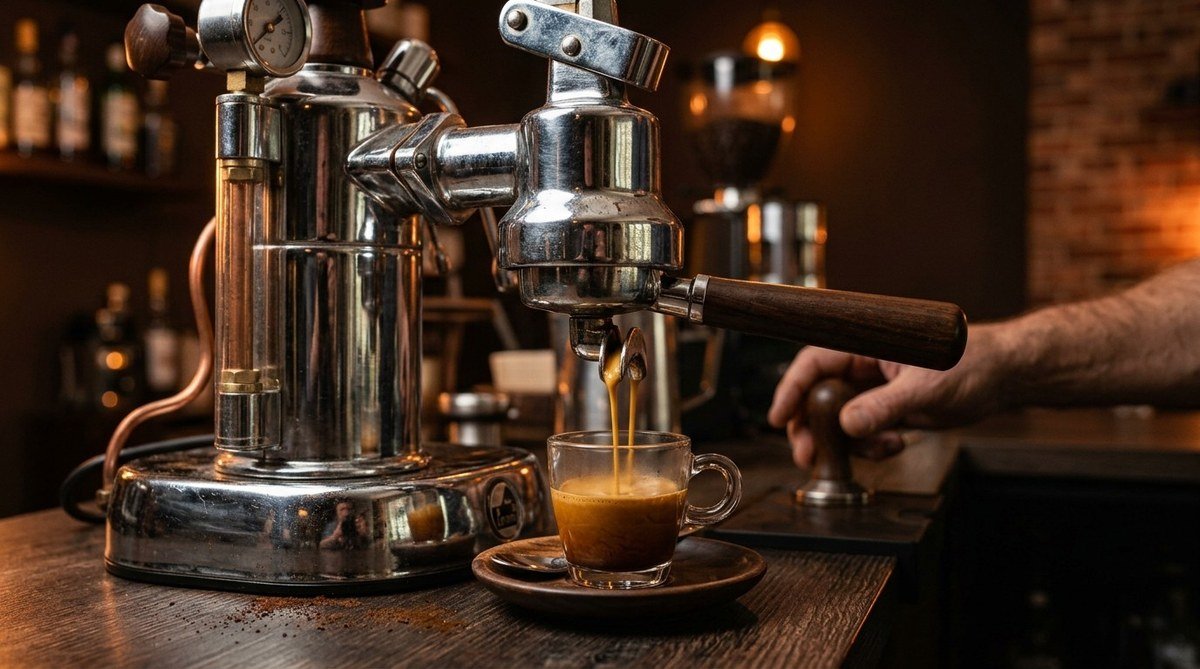
A manual or semi-automatic espresso machine is the kind where you do the work: grind the beans (or buy a grinder separately), dose and tamp the portafilter, lock it in and start the shot yourself. That is the whole distinction that matters if you have landed here searching for the best espresso machine Australia sells, versus landing on my fully automatic coffee machine guide instead: a fully automatic machine grinds, tamps and brews on its own at the press of one button, while every machine on this list still asks something of you. If you want to actually learn real espresso technique rather than press a button and walk away, you are in the right place; if one-button convenience matters more, the automatic guide is a better starting point.
This list covers nine manual and semi-automatic machines currently sold in Australia, from a no-frills entry point through to a commercial-grade machine enthusiasts keep for fifteen years. Some have a built-in grinder (the “all in one” approach), while some deliberately leave grinding to you so you can pick your own burr grinder instead. A reader searching “best manual espresso machine” or “best semi-automatic espresso machine” is asking the same underlying question this whole post answers: whether you tamp with a machine holding your hand through the process or one that leaves every decision to you.
The number worth knowing before you read a single spec sheet: real extraction only happens at roughly 9 bar, no matter what pump pressure is printed on the box. Every machine on this list is rated between 15 and 19 bar, and that number exists to guarantee the pump can sustain 9 bar under load, not because a higher rating pulls a better shot. What actually separates a good machine from a mediocre one is temperature stability shot to shot and how consistently the pump holds pressure over months of real use, exactly the pattern that shows up in owner reviews, not on a spec sheet.
Every machine below made this list on real Australian owner evidence, mostly productreview.com.au ratings and written reviews, cross-checked against Reddit, Whirlpool Forums and, for two machines with a thinner formal Australian review base, enthusiast sources like home-barista.com. CHOICE’s own testing programme backs up several of these findings independently. One brand dominates this particular list more than usual, and that gets addressed plainly in “How I Compared It” below rather than glossed over. If you want automatic and pod options in the comparison too, my full home coffee machine roundup covers every type side by side.
The Breville Barista Express BES870 is the best espresso machine in Australia for most people starting out: it holds a 4.2/5 rating from 835 reviews on productreview.com.au, the largest and steadiest Australian review sample of any machine on this list, with a built-in grinder that removes the biggest up-front cost of learning real espresso.
Best Espresso Machine Australia: How the 9 Compare
| Product | Type | Best For | Key Spec |
|---|---|---|---|
| Breville Barista Express BES870 | Semi-automatic, built-in grinder | Best Overall | 4.2/5 from 835 reviews |
| Sunbeam Barista Max EM5300 | Semi-automatic, built-in grinder | Best Budget | 58mm group head, ~3.2/5 from 193 reviews |
| Breville Duo-Temp Pro BES810BSS | Semi-automatic, no grinder | Best No-Grinder Pick | 4.1/5 from 115 reviews |
| DeLonghi Dedica EC685 | Manual, no grinder | Best Compact | ~4/5 across ~145 combined reviews |
| Breville the Barista Touch BES880 | Semi-automatic, touchscreen | Best Touchscreen Semi-Automatic | 3.7/5 from 64 reviews |
| Breville Barista Pro BES878 | Semi-automatic, built-in grinder | Best Fast Heat-Up | ThermoJet 3-second heat-up |
| Breville Bambino Plus BES500 | Semi-automatic, compact | Best Ultra-Compact | 3-second heat-up, smallest footprint |
| Gaggia Classic E24 | Fully manual | Best for Espresso Purists | Brass boiler, approx 1.7C stability |
| Rancilio Silvia | Semi-automatic, enthusiast-grade | Best Built to Last | Commercial-grade build |
How I Compared It
I checked productreview’s ratings and written reviews, Reddit threads in r/espresso and r/Breville, and Whirlpool Forums discussions for manual and semi-automatic espresso machines currently sold in Australia, then filtered out discontinued models and near-identical rebadges. For two machines with a thinner formal Australian review base, the Gaggia Classic E24 and the Rancilio Silvia, I leaned on enthusiast sources like home-barista.com and aggregated Reddit sentiment instead, and said so plainly in each entry instead of presenting that evidence as equivalent to a large productreview.com.au sample.
One honest pattern needs stating outright: Breville accounts for five of the nine machines on this list, well above the 40 percent brand-diversity ceiling this site normally applies. That is not padding. It reflects real depth of Australian review evidence across Breville’s semi-automatic lineup specifically, the same pattern my own home coffee machine hub post found when it ran the same sweep. Where a brand clearly dominates real consensus in a narrow category, the honest move is to say so rather than swap in a weaker pick just to hit a quota. I also excluded the DeLonghi La Specialista EC9335M despite it carrying the single largest review sample checked in this entire sweep, 149 reviews, because its rating sits at just 2.8/5. Reviewers report inconsistent grind and flow rate, water not pushing through properly, grinder failures within the first month on some units and tray leaks after about a month of use; it is a heavily marketed flagship with real Australian sentiment well below its market profile.

1. Breville Barista Express BES870 – The Default Recommendation for a Reason
Ask an enthusiast forum, a Whirlpool thread or a coffee-parts specialist which machine to buy first and the Barista Express comes up more often than anything else on this list. It holds a 4.2/5 rating from 835 reviews on productreview.com.au, easily the largest and steadiest sample of any machine checked for this category. The built-in conical burr grinder means you are not shopping for a separate grinder on day one, and the PID-controlled thermocoil holds temperature through the shot instead of drifting as the group heats and cools.
It is not without real wear points. Reviewers report inconsistent pump pressure on some units, group-head seal failures that eventually need replacing, and occasional tank leaks. The steam-wand dial can feel stiff out of the box, and a few reviewers who have owned more than one Barista Express say recent production runs feel a step down in build quality from older ones. None of that erases the review base behind it, but it is worth going in with eyes open.
If tamping and dosing your own shot sounds like the wrong hobby to take on, the Breville Barista Touch further down this list automates more of that process for you, at a real cost premium. For most people starting out with real espresso, though, this is still where to begin.
Pros
- Built-in conical burr grinder, no separate grinder purchase needed
- PID-controlled thermocoil holds temperature through the shot
- Largest, steadiest Australian review sample of any machine on this list (835 reviews)
Cons
- Inconsistent pump pressure reported on some units
- Group-head seal failures that eventually need replacing
- Stiff steam-wand dial and occasional tank leaks
Regular descaling protects the thermocoil and keeps pressure consistent. My Breville descaling guide covers the process for the Barista Express step by step.
2. Sunbeam Barista Max EM5300 – Best Budget
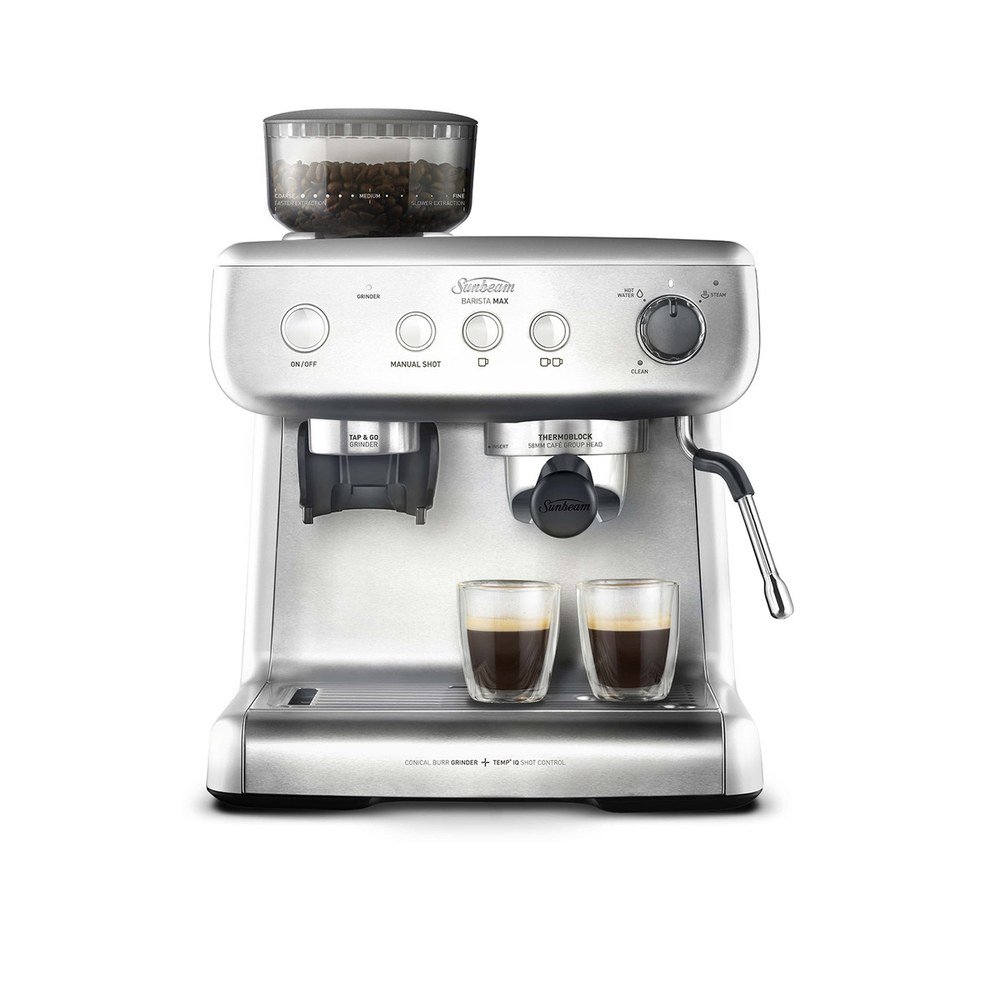
The Barista Max undercuts the Breville lineup while still packing a real 58mm cafe-sized group head and an integrated Tap & Go grinder, two things budget machines usually skip. Reviewers who have owned one alongside a pricier machine say the extraction quality is closer than the price gap would suggest, and the full-size steam wand produces properly textured milk instead of the thin foam some cheaper machines manage.
The honest read on reliability is mixed instead of clean. It sits at roughly 3.2/5 from 193 reviews, with recurring reports of group-head and steam-wand leaks, some appearing within the first month. Set against that is a real cohort of owners who report years of satisfied daily use with no issues at all. That is not a comfortable pattern to summarise: unit-to-unit consistency looks like the actual problem here, not a single design flaw everyone hits.
If budget is the main constraint and you can live with that inconsistency risk (or you are comfortable exercising a warranty claim if a leak shows up early), this is the cheapest serious path into real espresso on this list.
Pros
- Real 58mm cafe-sized group head at the budget end of the market
- Integrated grinder and full-size steam wand rarely seen at this price
- A real cohort of owners report years of trouble-free daily use
Cons
- Recurring group-head and steam-wand leak reports, some within the first month
- Reliability reads as inconsistent unit-to-unit instead of a single clear fault
- 3.2/5 from 193 reviews, a mixed signal instead of a clean recommendation
No Sunbeam-specific guide exists on this site yet. My general descaling guide covers the same underlying process for the Barista Max. Weighing it against the Barista Express? My Sunbeam vs Breville comparison covers warranty, owner ratings and where each range stops.
3. Breville Duo-Temp Pro BES810BSS – Best No-Grinder Pick
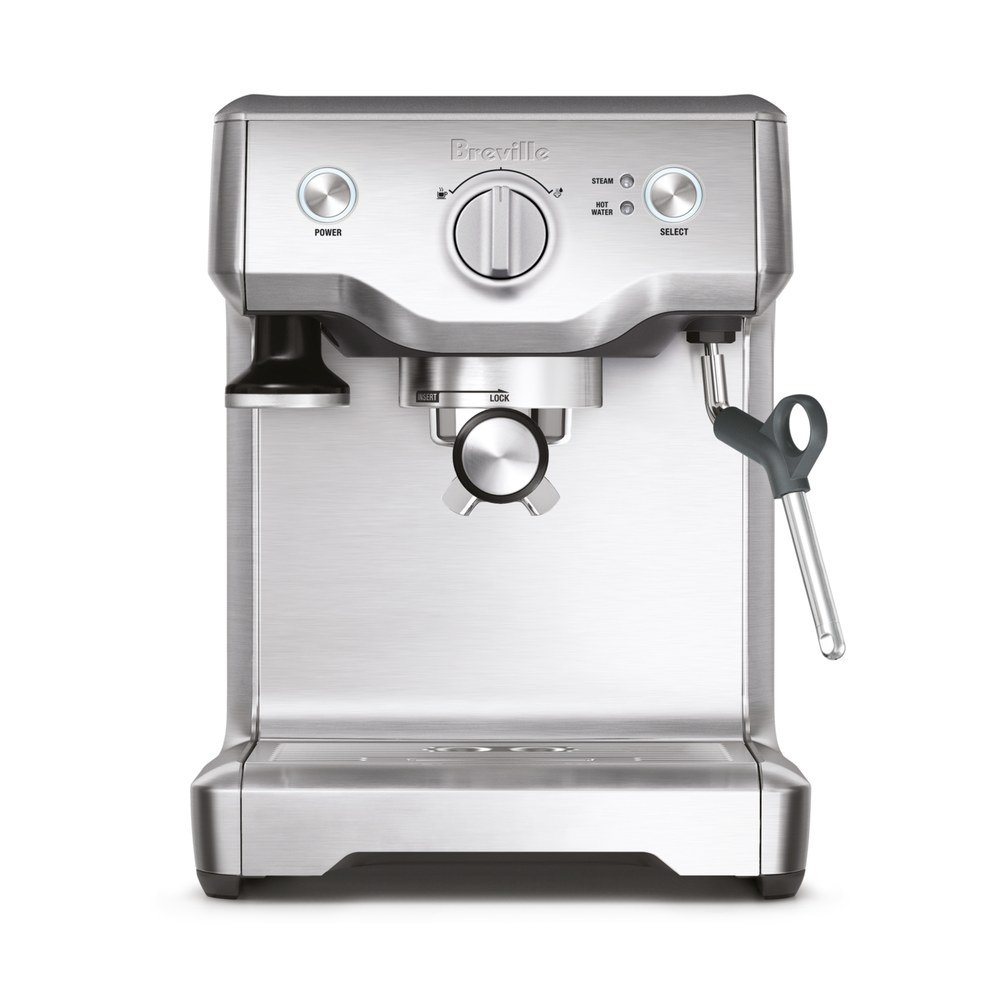
The Duo-Temp Pro skips the built-in grinder entirely, and that is the whole point of including it here: if you already own a grinder you like, or you would rather buy a dedicated one separately instead of accepting whatever burr set is bundled with an all-in-one machine, this is the Breville built for that. It holds a 4.1/5 rating from 115 reviews, and reviewers consistently describe the extraction as reliable and consistent instead of needing constant adjustment. The water filter helps hold off scale build-up, and multiple reviewers specifically mention pulling a great latte “every time,” not just on a good day.
Real complaints do turn up. One reviewer’s pump lasted only 17 months before failing. Another measured the actual extraction temperature and found it fell short of the 93 degree figure Breville quotes, which is worth knowing if you are chasing a specific target temperature instead of trusting the dial. At least one reviewer also describes customer service as unhelpful and somewhat condescending when they raised an extraction-quality complaint.
Compare it directly to the Barista Express at the top of this list: same brand, similar footprint and price bracket, but the Express bundles a grinder and this one deliberately does not. Buy this one if you already have grinding sorted.
Pros
- Reliable, consistent extraction reviewers describe directly
- Water filter helps prevent scale build-up
- Multiple reviewers report great lattes on demand
Cons
- One reviewer’s pump lasted only 17 months
- Actual extraction temperature reportedly fell short of the claimed 93C
- At least one report of unhelpful customer service around an extraction complaint
Skipping descaling is what usually causes a temperature drift like the one some reviewers report. My Breville cleaning and maintenance guide is the place to start.
4. DeLonghi Dedica EC685 – Best Compact
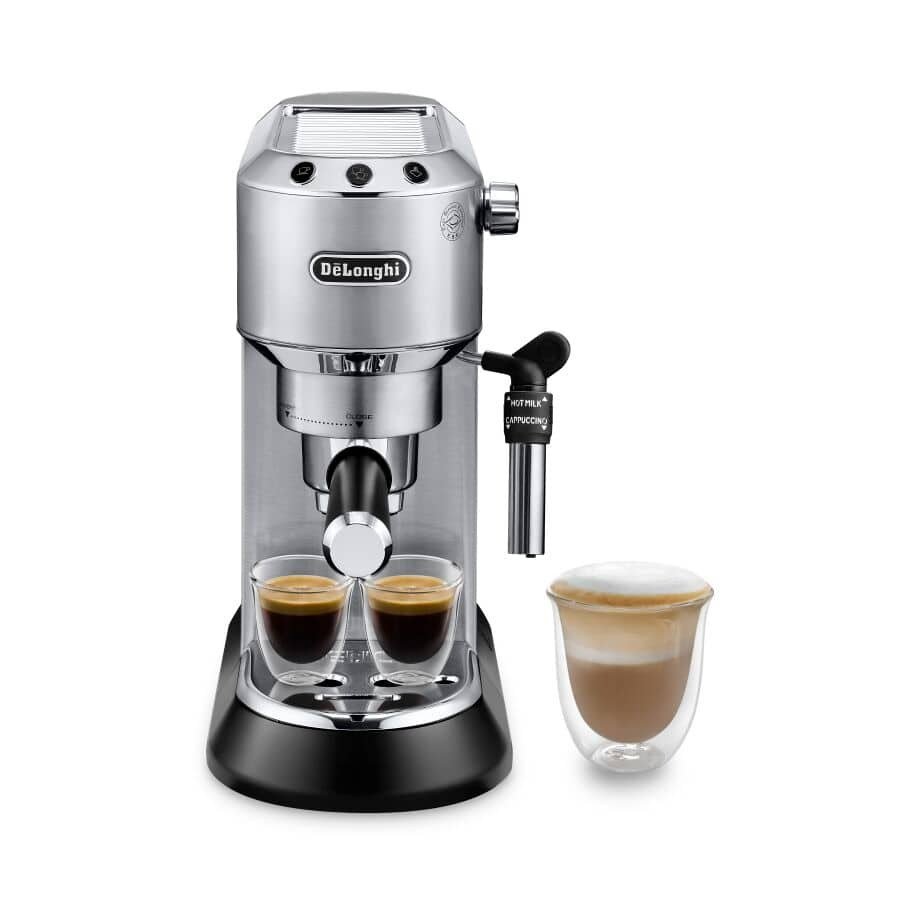
The Dedica solves a problem none of the Brevilles above even try to: bench space. It is truly one of the narrowest espresso machines sold in Australia, a real consideration if you are working with a share-house kitchen or an apartment bench instead of a dedicated coffee station. Both colourways (black and silver) sit around 4 out of 5 across roughly 145 combined reviews on productreview.com.au. Heat-up is quick, the steam wand punches above its size, and one reviewer reported it “near faultless” for two years with four adults in the house using it daily.
The documented fault pattern is worth naming plainly instead of downplaying: several reviewers describe the power and steam buttons needing repeated flicking on and off, with a flashing yellow warning light, before the machine responds at all. One reviewer went through three replacement units within 12 months from repeated pump failures and a slow repair turnaround each time. There is also a report of a unit that “melted from within” under normal use, and separate reports of extraction abruptly stopping mid-shot from water pressure issues.
As with the Duo-Temp Pro above, there is no built-in grinder here, so budget for one separately or start with pre-ground. For a compact bench and light daily use, the size trade-off is real; just know the reliability pattern going in.
Pros
- Truly narrow footprint, one of the most compact machines sold in Australia
- Quick heat-up and strong steam-wand pressure for its size
- One reviewer reported near-faultless performance over two years of heavy daily use
Cons
- Power/steam buttons reportedly need repeated flicking with flashing warning lights
- One reviewer needed 3 replacement units within 12 months from pump failures
- Reports of extraction stopping mid-shot from water pressure issues
Descaling matters even more on a compact thermoblock machine like this. My DeLonghi descaling guide covers the Dedica specifically. If a Breville is also on your shortlist, my DeLonghi vs Breville head-to-head sets the Dedica against the Bambino Plus.

5. Breville the Barista Touch BES880 – Best Touchscreen Semi-Automatic
The Barista Touch adds a touchscreen and a built-in grinder on top of the Barista Express formula, and reviewers single out the auto-milk-froth feature specifically: it produces smooth microfoam instead of the loose “clouds” a manual wand can leave you with if your technique is still developing. Coffee temperature is adjustable, and it holds a 3.7/5 rating from 64 reviews.
One important scope note, since it is easy to confuse with a fully automatic machine: you still tamp and insert the portafilter yourself here. That is the exact line this whole post draws. Its auto-tamping “Impress” sibling belongs in my fully automatic machine guide, not this one, because that variant removes the tamping step entirely.
Real complaints from reviewers: there is a real learning curve around tamping, dosing and extraction that the touchscreen does not remove, the drip tray is described as too small for regular use, and with no wheels underneath, it is heavy to reposition once it is on the bench.
Pros
- Auto-milk-froth feature produces smooth microfoam, reviewers say
- Built-in grinder plus a guided touchscreen interface
- Adjustable coffee temperature
Cons
- Real learning curve around tamping, dosing and extraction remains
- Drip tray described as too small
- No wheels underneath; heavy to reposition on the bench
A machine with this many components needs a proper maintenance routine. My step-by-step descaling process applies here as much as to any simpler machine.

6. Breville Barista Pro BES878 – Best Fast Heat-Up
The Barista Pro swaps the Express’s thermocoil for Breville’s ThermoJet element, and the difference is not subtle: it gets to brewing temperature almost instantly instead of the minute-plus wait some thermocoil machines need. It also carries an upgraded grinder over the standard Express, and the 1-cup and 2-cup buttons let you manually adjust water volume instead of accepting fixed presets. It holds a 3.6/5 rating from 60 reviews.
Owners report grounds scattering around the machine during dosing, and the grinder runs noticeably noisy. The portafilter basket can stick on removal and spill grounds when it finally releases. If you steam milk until the tank runs dry, the wand can suck up and solidify residual milk if it is not cleared before it dries, a maintenance trap worth knowing about. The grouphead is also very tight to turn on some units, and at least one long-time Breville owner feels overall build quality has slipped compared to the older Barista Express.
Set directly against the Barista Express at the top of this list: same brand, similar footprint, but the Pro trades a little of the Express’s review-base certainty for a real jump in heat-up speed and a better stock grinder.
Pros
- ThermoJet heating reaches temperature almost instantly
- Upgraded grinder over the standard Barista Express
- Manual water-volume adjustment on the cup buttons
Cons
- Coffee grounds scatter during dosing; grinder runs noisy
- Portafilter basket can stick on removal and spill
- At least one reviewer feels build quality has slipped versus the older Express
Clearing the steam wand before it dries is a maintenance habit worth building early. My Breville cleaning guide covers the daily routine.
7. Breville Bambino Plus BES500 – Best Ultra-Compact
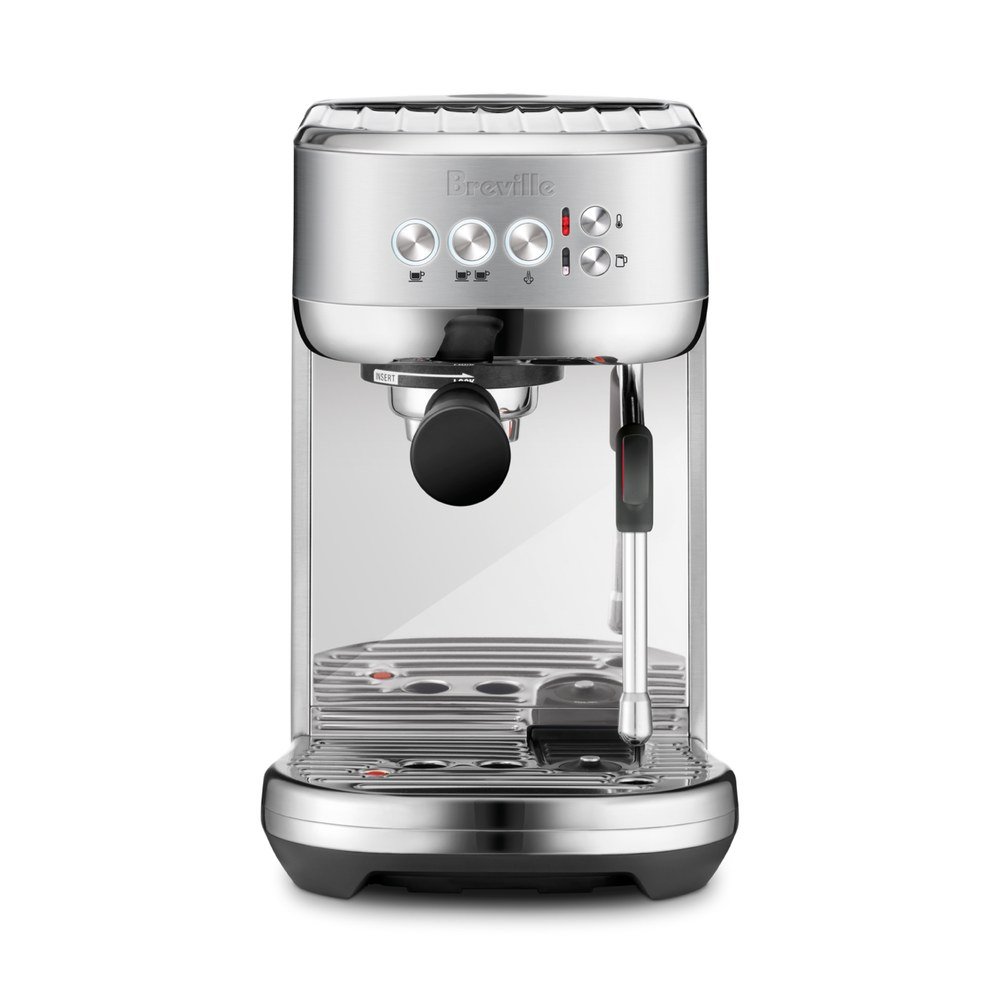
The Bambino Plus is the smallest Breville footprint on this list, and reviewers consistently call it out as the pick for a truly tiny kitchen bench where even the Dedica above feels like too much machine. The drip tray is praised specifically for being easy to keep clean, and the 3-second ThermoJet heat-up matches the pricier Barista Pro further up this list.
Two separate durability patterns show up in reviews instead of one. One reviewer’s frothing system partially failed by the two-year mark despite what they describe as meticulous maintenance. Another had a steam wand fail within a month of purchase, and again within a month of the warranty replacement arriving, which is not a great sign for that specific unit’s quality control. Reviewers also describe Breville’s service authorisation and booking process as slow and repetitive when something does need fixing.
If footprint is the deciding factor and you are willing to accept some of the same Breville wear patterns seen across this list, it is hard to beat for a truly small kitchen.
Pros
- Smallest Breville footprint here, truly tiny-kitchen friendly
- Drip tray specifically praised for being easy to keep clean
- 3-second ThermoJet heat-up
Cons
- One reviewer’s frothing system partially failed around the 2-year mark
- Another reviewer’s steam wand failed within a month, then again after replacement
- Service booking process described as slow and repetitive
Its compact build makes descaling even more important since there is less internal tolerance for scale. My Breville descaling walkthrough covers the Bambino Plus too.

8. Gaggia Classic E24 – Best for Espresso Purists
Every machine above this one automates at least part of the process. The Classic E24 automates none of it, deliberately, and that is exactly why enthusiast forums keep recommending it as the standard “real” entry point alongside Rancilio’s Silvia below. Sold in Australia under the “Gaggia Classic E24” name (not “Classic Pro”, an easy mix-up with its US naming), it was found in independent testing to hold temperature fluctuation to around 1.7 degrees Celsius through a shot, a notably tight range that rivals machines costing considerably more. The newer brass boiler is a real fix for a documented complaint about older aluminium-boiler models flaking with age.
The formal Australian review count is thinner than for the Brevilles above, which is worth saying plainly instead of papering over. What exists is strong specialty and enthusiast consensus instead of a large productreview.com.au sample. Once dialled in, it is forgiving of small variances in grind and dose, but heat-up is slow and there is no automatic functionality of any kind, which is the entire point of the machine instead of something missing from it. It also ships with minimal accessories (no milk jug or cleaning kit included), so budget for those separately.
This is the pick for someone who actually wants to learn manual espresso technique from the ground up, and possibly modify the machine later, instead of someone who wants a guided or assisted process. The Breville entries above hold your hand more; this one does not, by design.
Pros
- Independent testing found tight temperature stability rivalling pricier machines
- Newer brass boiler fixes a documented aluminium-boiler flaking complaint
- Forgiving of minor grind and dose variance once dialled in
Cons
- Thinner formal Australian review count than the Breville entries above
- Slow heat-up and zero automatic functionality, by design
- Ships with minimal accessories; no milk jug or cleaning kit included
No Gaggia-specific guide exists on this site yet. My general descaling guide covers the same process for the Classic E24.
9. Rancilio Silvia – Best Built to Last
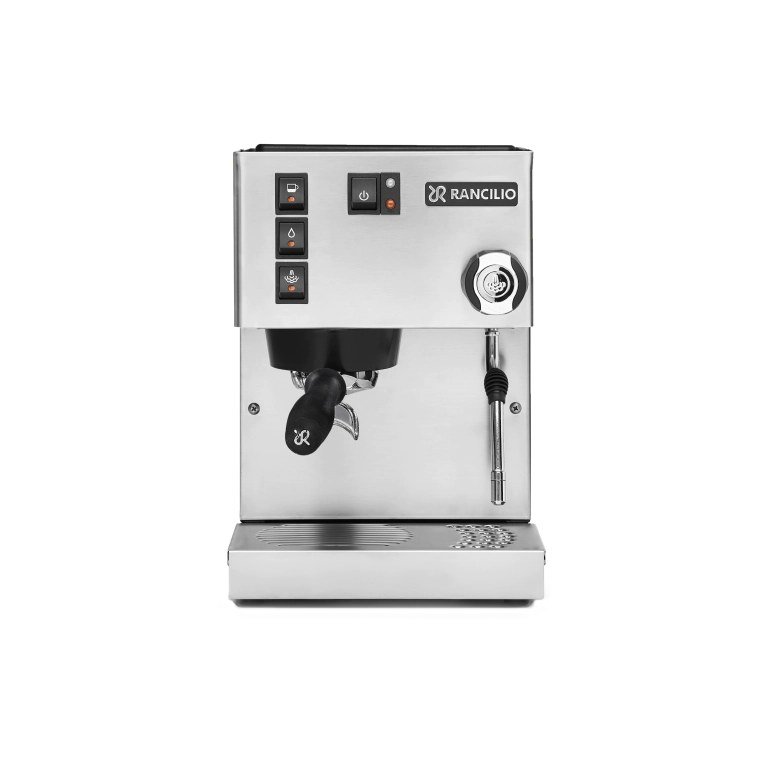
The evidence behind the Silvia is a distinctly different type from every other entry on this list, which is worth flagging honestly before the praise. Instead of a large productreview.com.au sample, this is an enthusiast and specialty pick: a home-barista.com flash review and Reddit-aggregated sentiment reporting roughly 46 positive, 5 neutral and 7 negative mentions. That Reddit figure is a secondary aggregation instead of a directly read thread, a weaker evidence tier than the direct productreview.com.au numbers used elsewhere in this list, so treat it accordingly.
What that enthusiast consensus consistently says: commercial-grade build quality, with multiple owners reporting 15-plus years of reliable service alongside a decent grinder. It is a common starting point for a two-machine home setup among people who take coffee seriously. The one real complaint that surfaces is almost comically minor next to that: the glue holding the rubber feet can come unstuck over time, leaving the machine wobbling on the bench.
It also is not the easiest machine for a first-time buyer; it rewards patience with technique instead of handing you a good result on day one.
Pros
- Commercial-grade build quality across enthusiast sources
- Multiple owners report 15+ years of reliable service
- A common two-machine setup starting point among home-barista enthusiasts
Cons
- Rubber foot glue can come unstuck over time, causing wobble
- Not the easiest machine for a first-time buyer
- Evidence here is enthusiast/secondary-tier, not a mass-market review sample
Even a commercial-grade boiler needs regular descaling to protect it long-term. My descaling guide covers the process for machines like the Silvia.
How to Choose an Espresso Machine
Decide whether you want a built-in grinder or not. Breville’s Barista Express, Barista Touch, Barista Pro, Bambino Plus and the Sunbeam Barista Max all bundle a grinder, while the Duo-Temp Pro, Dedica, Gaggia and Silvia leave grinding to you. Buying a separate grinder costs more up front but lets you choose exactly the burr set you want instead of accepting whatever ships in the box.
Bench space rules out options before price does. The DeLonghi Dedica and Breville Bambino Plus both exist specifically to solve a narrow bench or a small kitchen, and reviewers on both machines specifically call this out as the reason they bought one over a bigger Breville.
Decide how much of the process you actually want to do. The Gaggia Classic E24 and Rancilio Silvia hand you nothing: no automation, no guided screen, just a boiler, a pump and your own technique. The Breville Barista Touch sits at the opposite end with a guided touchscreen and automatic milk texturing, while still asking you to tamp and load the portafilter yourself.
Water hardness still applies here the same way it does for automatic machines. Perth and Adelaide both run harder mains water than Melbourne or Sydney, and a manual machine’s boiler scales up just as fast as an automatic’s. If you want one button and no ritual at all instead of what this list covers, my fully automatic coffee machine guide is the better starting point.
Keep Your Machine Running
Five of the nine machines on this list are Breville, and all of them need the same core descaling attention to protect the boiler and pump. My step-by-step Breville descaling guide covers the Barista Express, Duo-Temp Pro, Barista Touch, Barista Pro and Bambino Plus.
Cleaning is a separate job from descaling, and it is what stops milk residue building up in the steam wand and group head. My Breville cleaning guide walks through the daily and weekly routine.
The DeLonghi Dedica has its own descaling cycle worth following exactly. My DeLonghi descaling guide covers it end to end, and my DeLonghi cleaning guide covers the steam wand and drip tray in between descales.
For the Sunbeam Barista Max, Gaggia Classic E24 and Rancilio Silvia, none of which have a brand-specific guide on this site yet, my general descaling guide covers the same underlying process.
Frequently Asked Questions
What is the difference between a manual and a semi-automatic espresso machine?
A fully manual machine, like the Gaggia Classic E24, gives you direct control over water flow with no assistance. A semi-automatic machine still needs you to grind, dose and tamp, but automates the shot timing or volume, like the 1-cup and 2-cup buttons on a Breville. Both still require you to handle the portafilter yourself, unlike a fully automatic machine.
Do I need a separate grinder?
Only if you buy a machine without one, like the Breville Duo-Temp Pro, DeLonghi Dedica, Gaggia Classic E24 or Rancilio Silvia. Pre-ground coffee stales within days of opening, so a separate grinder is worth budgeting for if your chosen machine does not include one. Machines with a built-in grinder, like the Barista Express, remove that extra purchase.
How often should you descale a semi-automatic espresso machine?
Most manufacturers suggest every two to three months under normal use, but Australian mains water varies a lot by city. In Perth or Adelaide, where the water runs harder, four to six weeks is a safer interval. Skipping descaling is behind many of the pressure and temperature complaints that show up in owner reviews.
Is a built-in grinder as good as a separate one?
It depends on the machine and the price point. Breville’s built-in conical burr grinders on the Barista Express and Barista Pro get real praise from reviewers, but a dedicated standalone grinder at a similar price generally out-performs any grinder squeezed into an all-in-one machine. It is a real trade-off between convenience and outright grind quality.
How long does it take to learn to use a semi-automatic espresso machine well?
Reviewers across this list consistently describe a real learning curve around dosing, tamping and dialling in grind size, typically a few weeks of regular use before shots come out consistently. Machines with more guidance, like the Barista Touch, shorten that curve slightly. Fully manual machines like the Gaggia and Silvia take longer but reward the extra effort with more control.
What is a fair price range for a properly good espresso machine in Australia?
This list spans the Sunbeam Barista Max and DeLonghi Dedica at the affordable end through to the Rancilio Silvia and Breville Barista Touch at the top. Spending more generally buys you a better grinder, faster heat-up or more guided milk texturing, not necessarily a better-tasting shot once a machine is properly dialled in.
The Barista Express is still the place to start, with two real alternatives depending on what you value
For most people learning real espresso, the Breville Barista Express BES870 is still the pick: the largest, steadiest Australian review base of any machine here and a built-in grinder that removes the first big extra purchase. If budget is the deciding factor, the Sunbeam Barista Max gets close for a lot less money with a real reliability trade-off attached. If you want to learn manual technique properly and are prepared to buy a separate grinder, the Gaggia Classic E24 or Rancilio Silvia are the picks enthusiast consensus keeps coming back to, commercial-grade machines built to outlast several of the Brevilles above.
