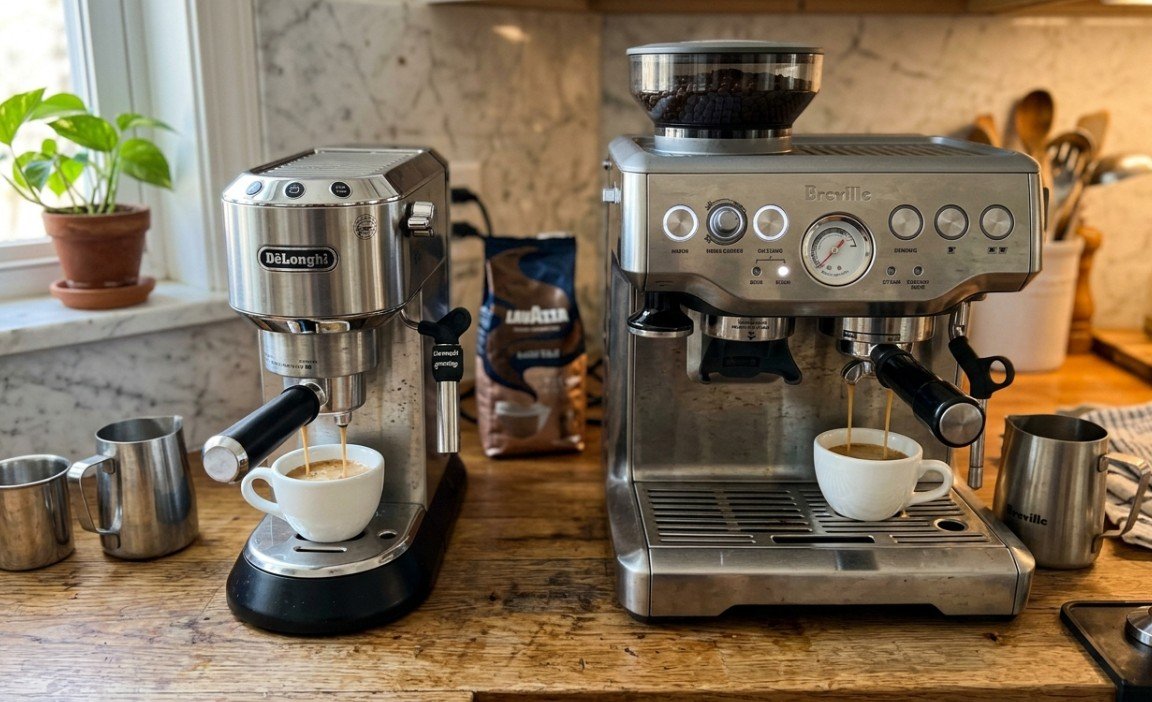
Choosing between a DeLonghi vs Breville coffee machine mostly comes down to machine type. Breville’s strength is portafilter espresso machines, from the compact Bambino up to the premium Oracle machines. DeLonghi sells manual machines too, plus nine families of fully automatic bean-to-cup models, a category Breville doesn’t make at all. If you want to learn to pull your own shots, Breville’s built-in-grinder models have the stronger owner record. If you want coffee at the press of a button, DeLonghi is the brand to shortlist.
Both brands are stocked by the big Australian appliance retailers, and both span entry, mid and premium tiers. Breville was founded in Sydney, and its current range runs from the Bambino BES450 through the Barista Express, Barista Pro and Barista Touch lines to the Oracle Jet, Oracle Touch and Oracle Dual Boiler. DeLonghi, an Italian company, covers the entry end with the Stilosa and Dedica, the mid tier with La Specialista, and the automatic end with the Magnifica, Rivelia, Eletta, PrimaDonna and Maestosa ranges.
One number decides more of this comparison than any bar-pressure figure on the box: portafilter size. Breville’s entry and mid machines use a 54mm portafilter, and its Dual Boiler and Oracle machines step up to 58mm, the size most cafe machines use. DeLonghi’s Dedica and La Specialista Arte use 51mm. A bigger basket isn’t automatically better, but it gives more room to grow once you start weighing doses and dialling in fresh beans.
To keep things fair, I’ve matched models by price tier rather than setting one brand’s flagship against the other’s budget machine. The evidence comes from CHOICE brand results, Canstar Blue’s 2026 satisfaction survey, productreview.com.au owner ratings and Whirlpool Forums threads. Neither brand is paying for this page and there are no shopping links on it. If you’re still working out which type of machine you need, start with my guide to choosing the best coffee machine.

DeLonghi

Breville
Pick Breville for a portafilter machine with a built-in grinder, where the Barista Express BES870 holds 4.2/5 from 835 owner reviews against 2.7/5 from 23 for its nearest DeLonghi rival. Pick DeLonghi for push-button coffee, because Breville sells no bean-to-cup machine in Australia.
DeLonghi vs Breville Coffee Machine at a Glance
The table lines up the differences that change a buying decision. The shaded cell in each row marks the brand with the edge, and the rounds below explain each call.
| Feature | DeLonghi | Breville | Edge |
|---|---|---|---|
| Fully automatic bean-to-cup | Nine current families, Magnifica to Maestosa | None sold; the Oracle range automates a portafilter instead | DeLonghi |
| Entry machine owner rating | Dedica: 3.9/5 from 296 reviews | Bambino Plus: 3.5/5 from 65 reviews | DeLonghi |
| Built-in grinder, mid tier | La Specialista Arte: 2.7/5 from 23 reviews | Barista Express BES870: 4.2/5 from 835 reviews | Breville |
| Portafilter size | 51mm on the Dedica and Arte | 54mm entry and mid, 58mm Dual Boiler and Oracle | Breville |
| Automatic milk texturing | LatteCrema on the automatics | Auto MilQ on the Bambino Plus, Touch and Oracle | Tie |
| CHOICE reliability / satisfaction | 84% / 86% | 82% / 89% | Tie |
| Canstar Blue 2026 award | Most Satisfied Customers | Second place | DeLonghi |
| Written warranty | 2 years on manual and automatic machines | Set per model; 1 year on the base Bambino | DeLonghi |
Round 1: What Each Brand Actually Makes
Most comparisons skip the biggest difference of all. Breville doesn’t sell a fully automatic bean-to-cup machine in Australia. It does call the Oracle Jet an automatic machine, and that model grinds, doses and tamps for you, but the coffee still goes into a 58mm portafilter you lock into the group head yourself (Breville’s own specs confirm it). A DeLonghi Magnifica or Rivelia works differently: beans go in the top, a finished drink comes out of the spout, and there’s no handle to knock out.
DeLonghi sells both kinds. Its Australian range lists nine fully automatic families, from the Magnifica Start up to the Maestosa, alongside the manual Dedica and La Specialista lines. The Rivelia adds a touch that shared kitchens will appreciate: two swappable 250g bean hoppers, so a decaf and a dark roast never end up in the same grinder.
Round call: DeLonghi, for covering both machine types when Breville covers one.
Round 2: Entry Machines – Bambino vs Dedica
At the small, cheaper end, the natural pair is Breville’s Bambino or Bambino Plus against DeLonghi’s Dedica. Both are slim enough for a rental kitchen bench. Neither has a grinder, so budget for pre-ground coffee or a separate grinder from day one.
Speed and milk favour Breville here. The Bambino’s ThermoJet heater is ready in about three seconds, and the Bambino Plus adds Auto MilQ, which textures milk in the jug at a chosen temperature with no steaming skill required. The Dedica uses a thermoblock heater and a manual steam wand, so milk drinks depend on your technique.
Owner ratings lean the other way. The Dedica sits at 3.9/5 across 296 productreview.com.au reviews, praised for its size and value. The Bambino Plus has 3.5/5 from a smaller pool of 65, with complaints about a forced cleaning cycle and a confusing button layout. Build quality is the Dedica’s weak spot: in one Whirlpool thread, an owner who’d had both a Dedica and a Barista Express pointed to the Dedica’s heavy use of plastic.
Round call: a narrow edge to the Dedica on its larger, steadier owner sample. If you’d rather not learn to steam milk, the Bambino Plus is worth the trade. More compact options sit in my list of the best espresso machines in Australia.
Round 3: Built-In Grinder Machines – Barista Express vs La Specialista Arte
This is the tier where most first-time espresso buyers land, and it’s where the brands sit furthest apart. The Breville Barista Express BES870 pairs a conical burr grinder with a 54mm portafilter and PID temperature control. It holds 4.2/5 from 835 reviews, the largest owner sample of any machine in this comparison. Owners praise cafe-quality coffee, and some report units still running after seven to seventeen years. The negative reviews centre on pump and pressure failures and slow warranty handling.
DeLonghi’s matching model, the La Specialista Arte EC9155, uses a thermoblock with three temperature profiles, a 51mm portafilter and a manual My LatteArt steam wand. Its score is 2.7/5 from only 23 reviews, many describing failures within the first few months. Tom’s Coffee Corner put the pair head to head in a YouTube comparison, and its written review found the Arte’s grinder and steam wand a step behind the Express.
The picture shifts one step up. Tom’s Coffee Corner also compared the Barista Express Impress with DeLonghi’s La Specialista Opera, both with assisted tamping, and called the result a toss-up: one person in the household preferred the DeLonghi and the other the Breville. So DeLonghi’s grinder machines aren’t a write-off, but the Arte specifically is hard to recommend over the Express. If a lower price matters more than the badge, my Sunbeam vs Breville breakdown covers a cheaper grinder machine with a 58mm basket.
Round call: Breville, by the widest margin of any round here.
Round 4: Automation – Oracle vs DeLonghi Bean-to-Cup
For buyers who want the machine to do the work, the two brands take different routes. Breville’s Oracle Jet and Oracle Touch automate grinding, dosing and tamping into a 58mm basket, then texture milk with Auto MilQ. You still lock in and knock out the handle, and in return you get a shot pulled the way a cafe would pull it. DeLonghi’s automatics hide every step inside the machine.
Price makes this an uneven pair, and that’s worth knowing before reading any ratings. The Oracle range is Breville’s premium tier, while a Magnifica Start or Evo is one of the cheaper ways into bean-to-cup. At Oracle money, the better-matched DeLonghi rivals are the Eletta and PrimaDonna.
The Oracle Touch rates 3.7/5 from 125 reviews, liked for its ease of use and marked down for internal steam leaks and costly repairs. DeLonghi’s long-running Magnifica S has the strongest record of any automatic here at 4.1/5 from 334, with one owner logging more than 38,000 brews, though it no longer appears in DeLonghi’s current Australian range. The Magnifica Evo, a current model, has 2.9/5 from just 29 reviews, with early failures and milk-froth problems.
Coffee quality is where manual fans push back. In a Whirlpool thread weighing a Barista Express against a Magnifica S, most replies steered the poster towards the Breville for better espresso and a better grinder, while conceding that entry-level automatics are convenient. For the wider automatic field, including Jura and Philips, see my fully automatic coffee machine guide.
Round call: DeLonghi takes it for true one-touch coffee, which Breville simply doesn’t offer. If you want automation and still want a portafilter, the Oracle stands alone.
What Owners Say About Each
Brand-level surveys put DeLonghi slightly ahead. CHOICE named DeLonghi its best espresso machine brand with Breville close behind: DeLonghi scored 84% for reliability to Breville’s 82%, while Breville led on owner satisfaction, 89% to 86%. Canstar Blue’s latest survey of 405 buyers of bean and ground coffee machines gave DeLonghi its 2026 Most Satisfied Customers award, ahead of Breville and then Philips.
Model ratings are messier. DeLonghi’s best-rated machines on productreview.com.au are the older Magnifica S and the Dedica, while Breville’s is the Barista Express. Several newer models from both brands sit below 3.8, often on small samples. Both brand-wide pages score poorly too (1.8/5 for Breville, 1.5/5 for DeLonghi), and most of those complaints are about customer service and repairs rather than the coffee. Treat that as a reason to keep your receipt and register the machine, not as proof that one badge is worse.
CHOICE’s lab testing adds one more caution: price is no guarantee. In its blind taste testing, Breville’s top-end Oracle Dual Boiler scored 50% and was beaten by a budget Kmart machine.
Round call: DeLonghi by a whisker, though the gap is small enough that the specific model matters more than the brand.
Round 6: Warranty, Service and Running Costs in Australia
DeLonghi’s Australian warranty is two years on new manual and fully automatic machines, dropping to one year for refurbished units or commercial use. Its service hubs are in every capital city. Breville’s warranty page doesn’t give a single term and points you to each product instead. Most current Brevilles carry two years, but the entry-level BES450 has been listed with one, so confirm the term for your model before paying. For a major fault after the written warranty ends, the Australian Consumer Law guarantees may still entitle you to a repair or replacement.
Day-to-day running costs come out about even. Breville’s ClaroSwiss filter page gives a 90-day replacement interval, and the Barista Express manual sets a two-month reminder for its filter, sooner in hard water. DeLonghi’s DLSC002 filter is due every two months or when the machine prompts. Neither brand has a clear edge on filters and descaler. The bigger risk to your budget is an out-of-warranty repair, and in the Whirlpool thread above, one regular argued an extended warranty is worth having on any consumer machine.
Round call: DeLonghi, for a clearer written warranty and a named national service network.
Which Should You Buy?
DeLonghi wins more rounds, but the right pick depends on how you like to make coffee. Match yourself to one of these.
Learning espresso and mostly drinking milk coffee? Go with the Breville Barista Express BES870. It has the deepest owner record here, and its 54mm basket and steam wand leave plenty of room to improve as your technique does.
After one-touch coffee for a busy household? Choose a DeLonghi bean-to-cup model such as the Magnifica Start, or the Rivelia if two people drink different beans. Breville has nothing in this category.
Tiny bench, tight budget? The Dedica is the safer bet on owner feedback. Switch to the Bambino Plus if having milk textured for you matters more than the rating gap.
Want automation without giving up the portafilter? Look at Breville’s Oracle Jet or Oracle Touch, and set money aside for servicing, since repair costs are the main complaint from Oracle owners.
Living well outside a capital city? Find your nearest authorised repairer for either brand before you buy. A machine that has to be posted away for every fault costs you time as well as money.
Keep It Running
Regular cleaning heads off most of the pressure and temperature faults owners complain about. On a Breville, my Breville descaling guide walks through the Clean/Descale cycle, and the Breville cleaning steps cover the group head, steam wand and grinder.
On a DeLonghi, follow my DeLonghi descaling walkthrough when the alert lights up, and use the DeLonghi cleaning guide for the brewing unit and milk system. New owners can start with the setup basics for using a Breville machine or using a DeLonghi machine.
Frequently Asked Questions
Does Breville make a fully automatic bean-to-cup coffee machine?
Not in Australia. Breville’s most automated models, the Oracle Jet and Oracle Touch, grind, dose and tamp for you, but they still brew through a 58mm portafilter that you lock in and empty yourself. If you want a machine where beans go in and a finished drink comes out with no handle at all, that means a bean-to-cup brand such as DeLonghi, Jura or Philips.
Which brand is more reliable, Breville or DeLonghi?
The brand surveys are close. CHOICE gives DeLonghi 84% for reliability and Breville 82%, a gap too small to decide a purchase on its own. Individual models vary far more than the brands do, so check the owner rating and review count for the exact model you are considering, and favour models with a large, steady sample of reviews over new releases.
How long do Breville and DeLonghi coffee machines last?
It varies widely by model and by how well the machine is cleaned. Some Barista Express owners on productreview.com.au report machines still working after more than a decade, and one Magnifica S owner has logged over 38,000 brews. Other owners of both brands describe failures inside two to five years. Regular descaling, fresh filters and an extended warranty all improve the odds.
Which brand is easier for a beginner?
For zero learning curve, a DeLonghi bean-to-cup machine is the easiest option, since it handles grinding, tamping and milk at the press of a button. For someone who wants to learn real espresso, Breville’s Barista Express or Bambino Plus are friendlier starting points than DeLonghi’s manual machines, with more owner guidance and tutorials available online.
How long is the warranty on Breville and DeLonghi coffee machines in Australia?
DeLonghi offers two years on new manual and fully automatic machines, or one year if the machine is refurbished or used commercially. Breville sets the term per product, and while most current models carry two years, the BES450 Bambino is the exception at one year. Australian Consumer Law guarantees can apply beyond either written warranty for major faults.
Do Breville and DeLonghi make Nespresso machines?
Yes, both build machines for Nespresso. Breville makes models such as the Creatista range, and DeLonghi makes the Lattissima range among others. Because they run on Nespresso capsules, choosing between them is really a choice of Nespresso system and milk features rather than a Breville or DeLonghi decision, and warranty support usually runs through the maker listed on the box.
How I Compared These
This is a research comparison. I matched models by tier using the current Breville and DeLonghi Australian ranges and product pages, then checked productreview.com.au ratings for twelve models, CHOICE’s brand results, the Canstar Blue survey, two Whirlpool Forums threads and two Tom’s Coffee Corner comparisons. I also searched the ACCC product safety recalls database and found no recalls for either brand’s coffee machines.
My DeLonghi vs Breville Verdict
Breville for a portafilter machine, DeLonghi for push-button coffee
DeLonghi takes more rounds, helped by a wider range, a clearer warranty and a slim lead in brand surveys. Breville’s one win, though, is in the category most espresso buyers shop: nothing DeLonghi makes with a built-in grinder comes close to the Barista Express BES870’s owner record. If you want to make espresso yourself, start with Breville. If you want a machine that does everything at one touch, start with DeLonghi’s Magnifica Start or Rivelia, because Breville doesn’t make a rival.
