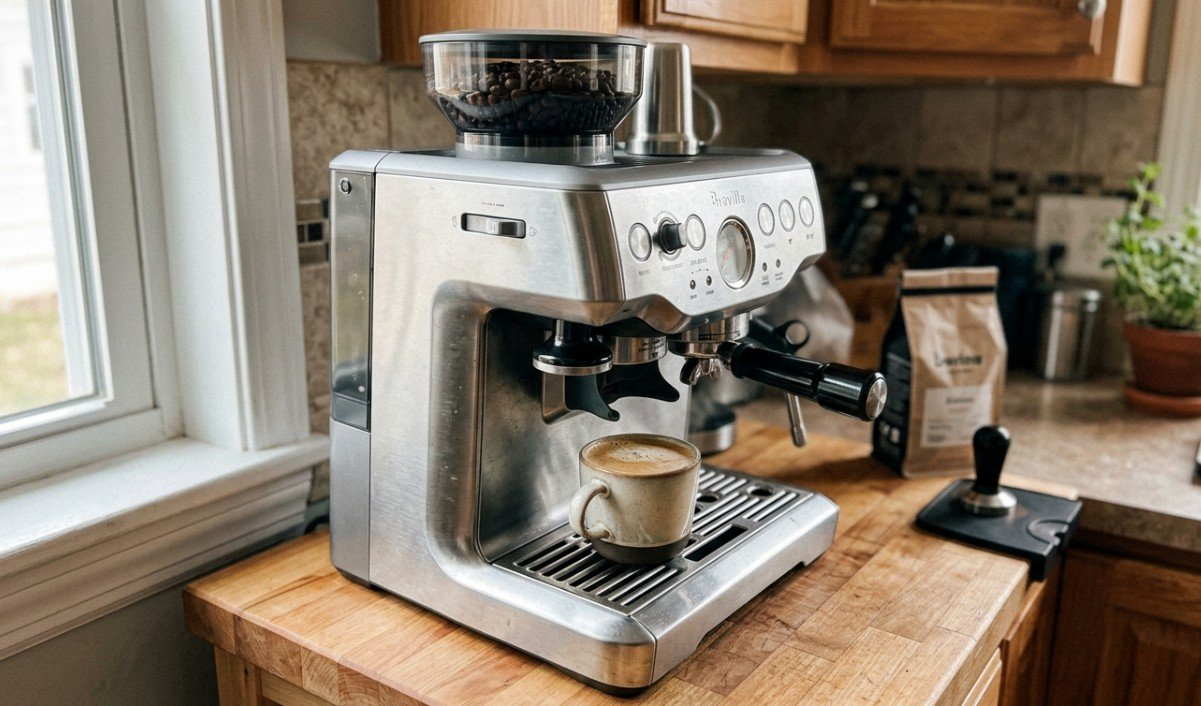
A coffee machine with a built-in grinder means whole beans go in one end and ground, dosed coffee comes out the other, with no separate grinder to buy, calibrate or find bench space for. That single feature splits into two distinct machine types: semi-automatic machines that grind and dose for you but still need a human to tamp and pull the shot, and fully automatic bean-to-cup machines that grind, brew and often froth milk at the press of one button. This list covers real, currently sold Australian models from both types, not just one.
The grinder itself is the deciding factor most buyers overlook. Almost every machine here uses a conical or flat steel or ceramic burr, hopper-fed rather than single-dose, and grind consistency, clogging and noise vary far more between models than most spec sheets let on. A machine’s espresso quality is only ever as good as what its grinder actually delivers into the basket, which is why this list weighs grinder-specific evidence as heavily as the machine’s overall reputation.
The number worth anchoring to is grind setting count, typically 15 to 30 steps across the machines below, since finer control over grind size is what actually lets you dial in a specific bean rather than accepting whatever the factory default happens to produce. A wider adjustment range matters more day to day than almost any other spec on this list.
Every machine below made this list on real evidence: mostly productreview.com.au ratings and written reviews, cross-checked against CoffeeSnobs forum threads where they exist, with every grinder-specific praise or complaint named by source rather than invented. Where a product line showed wildly inconsistent ratings across its own sub-models, that inconsistency is called out directly rather than smoothed into one verdict. Already have a separate grinder in mind instead? My guide to choosing the best coffee machine covers that decision too.
For most buyers wanting fresh-ground coffee without a separate grinder, the Breville Barista Pro remains the strongest evidenced pick: its grinder is repeatedly praised as more stable than the entry-level Express, backed by a solid 60-review productreview.com.au sample. Anyone leaning fully automatic instead should treat “Barista Touch” and “PrimaDonna” as families with markedly inconsistent sub-model quality, not a single safe name to buy on.
The 10 Best Coffee Machines with a Grinder in Australia Compared
| Product | Type | Best For | Key Spec |
|---|---|---|---|
| Breville Barista Pro (BES878) | Semi-automatic, integrated grinder | The most stable Breville grinder | 3.6/5, 60 reviews, 30 grind settings |
| Breville Barista Express (BES870) | Semi-automatic, integrated grinder | Budget entry to grind-and-brew | 4.2/5, 835 reviews |
| Breville Oracle (BES980) | Fully automatic, auto-grind and tamp | Largest review sample of any premium pick | 4.2/5, 705 reviews |
| Jura E8 | Fully automatic bean-to-cup | Professional-grade P.A.G.2 grinder | 3.8/5, 92 reviews |
| Sunbeam Origins range | Semi-automatic, tap-and-go grinder | Fast, low-mess single-dose feel | Praised as faster, less mess than a separate grinder |
| Philips 2200 LatteGo Series | Fully automatic bean-to-cup | Budget-mid easy-adjust grinder | 4.2/5, 5 reviews (thin sample) |
| DeLonghi Magnifica Evo | Fully automatic bean-to-cup | Mid-tier with a praised grinder | 2.9/5, 29 reviews |
| Sunbeam Barista Max (EM5300K) | Semi-automatic, integrated grinder | Cheapest true grind-and-brew entry | CoffeeSnobs-documented grind consistency issues |
| Breville Barista Touch / Touch Impress | Fully automatic, touchscreen | Inconsistent across sub-models, check which one | 3.4-3.7/5 depending on variant |
| Gaggia Anima Prestige | Fully automatic bean-to-cup | Ceramic grinder, hopper design needs care | 2.2/5, 3 reviews (thin sample) |
How I Compared It
I checked productreview.com.au ratings and written reviews for every current Australian grind-and-brew model I could find, cross-referenced grinder-specific complaints against CoffeeSnobs forum threads and Whirlpool Forums discussion where they existed, and confirmed current Australian availability and naming against manufacturer pages.
Reddit and Whirlpool searches largely returned retail deal noise rather than quotable owner threads for this specific grinder-focused angle, so CoffeeSnobs was the strongest independent forum source found. Where a product line (Breville’s Barista Touch family and DeLonghi’s Maestro/Prestigio family specifically) showed one sub-model rated well above or below another, that inconsistency is treated as a real finding rather than averaged away, and thin review samples (under roughly 20 reviews) are flagged rather than presented as settled consensus.
1. Breville Barista Pro (BES878) – Best Overall Grinder Stability

1. Breville Barista Pro (BES878)
The Barista Pro carries the most consistent grinder-specific praise of any Breville model checked. Reviewers repeatedly describe it as more stable and better aligned than the entry-level Express, which owners characterise as “a bit crude” by comparison, which points to an actual step up rather than a marketing claim.
Its 30 grind settings give real dial-in range, and its 3.6 out of 5 from 60 productreview.com.au reviews is a reasonably solid sample size for this category: large enough to trust the pattern rather than a handful of outlier reviews.
The trade-offs are noise and a real learning curve. Reviewers consistently flag it as loud enough that “neighbours know you’re having a shot,” and one reviewer reported using half a kilogram of beans just to dial in their first proper setting. One reported grinder motor failure at three months was resolved under warranty.
Pros
- Repeatedly praised as more stable and better aligned than the entry-level Express grinder
- 30 grind settings give useful fine-tuning range for different beans
- A reasonably solid 60-review sample size supports the pattern rather than a handful of outliers
Cons
- Consistently described as loud enough to notice from other rooms
- A steep dial-in learning curve: expect to burn through a real quantity of beans getting it right
2. Breville Barista Express (BES870) – Best Budget Entry

2. Breville Barista Express (BES870)
The Express carries the largest review sample of any semi-automatic machine on this list, 4.2 out of 5 from 835 productreview.com.au reviews, which is strong volume-backed evidence for a budget-tier entry point into grind-and-brew.
Its conical steel burr grinder is hopper-fed and widely used, but the most consistent complaint theme is dose inconsistency, described as “requiring manual measurement” rather than trusting the machine’s own dosing, and many experienced owners end up single-dosing manually rather than relying on the hopper by default.
Burrs are also reported to go noticeably blunt after around 12 months of regular use, which is worth factoring into the real cost of ownership beyond the purchase price, and enough owners upgrade to a separate dedicated grinder eventually that it is worth going in with realistic expectations about the ceiling here.
Pros
- The largest and strongest review sample of any machine on this list at 835 reviews
- An accessible entry point into grind-and-brew for the price
Cons
- Dose inconsistency is a recurring, named complaint; many owners hand-measure rather than trust the hopper
- Burrs are reported to dull noticeably after roughly a year of regular use
3. Breville Oracle (BES980) – Another Grind-and-Brew Option
3. Breville Oracle (BES980)
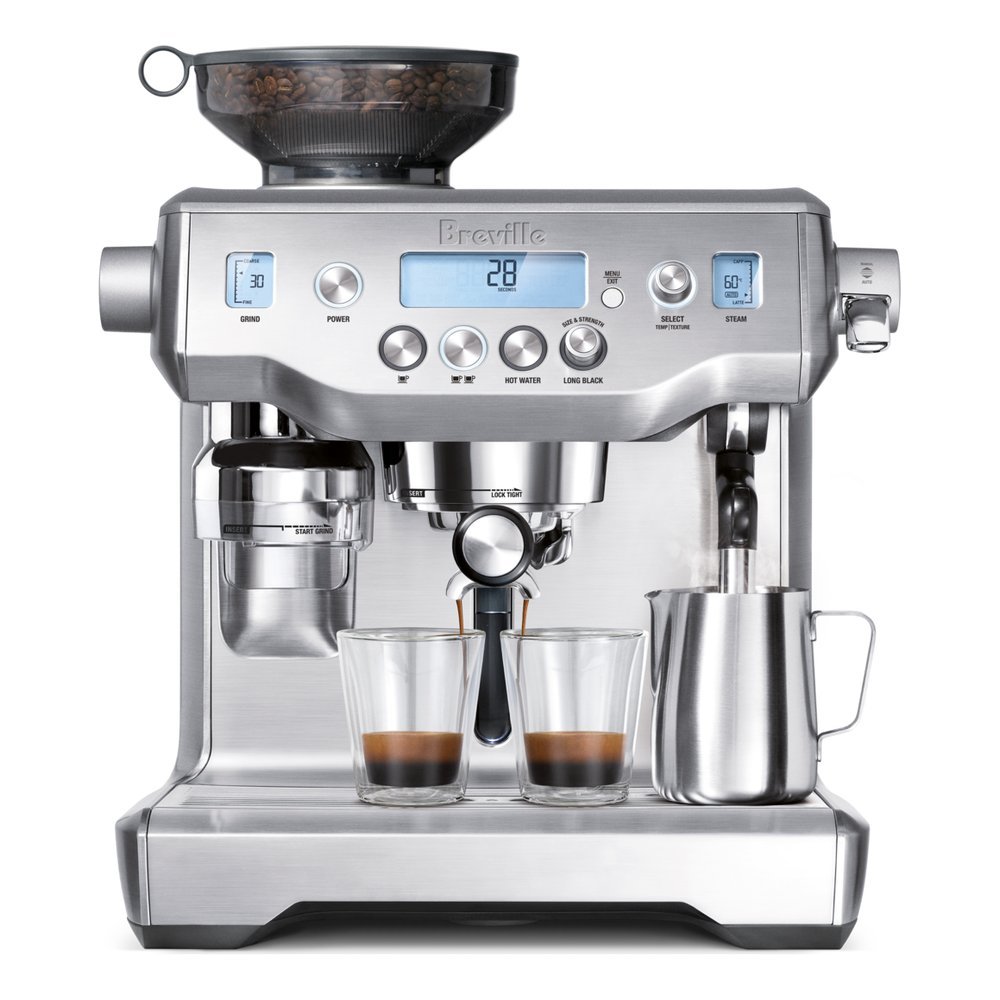
The Oracle automates both grinding and tamping, and carries the largest review sample of any premium machine checked in this sweep (4.2 out of 5 from 705 productreview.com.au reviews), which is strong evidence at this price tier.
That volume comes with an honest caveat worth stating plainly: one detailed review reported shot-to-shot particle consistency as “terrible,” citing 3 to 7 percent retention variance, and said better results came from switching to a separate external single-dose grinder instead of relying on the Oracle’s own auto-grind and auto-tamp system.
A second, more basic complaint is that the grinder does not auto-stop when the hopper runs dry. It will keep grinding air rather than detecting the empty hopper, so it is worth getting into the habit of checking bean levels rather than assuming the machine will catch it.
Pros
- The largest review sample of any premium pick in this list, well evidenced at 705 reviews
- Automated grinding and tamping removes two manual steps entirely
Cons
- A detailed owner review reports meaningful shot-to-shot particle consistency variance despite the automation
- No auto-stop when the bean hopper empties, so it will keep grinding with nothing in it
4. Jura E8 – Best Professional-Grade Grinder

4. Jura E8
The E8 uses Jura’s P.A.G.2 grinder, a flat, professional-grade design that resets its position every cycle specifically to protect long-term consistency. That reflects real engineering intent rather than a marketing label, and it holds a reasonable 3.8 out of 5 from 92 productreview.com.au reviews.
Reviews are mixed on the grinder specifically: one owner called it “a clunking grinder” that runs “noisier than I’d like,” while a reviewer identifying as an ex-barista or technician said plainly “the grinder is good” and directed their criticism elsewhere at the milk system instead.
General sources note ceramic-adjacent Jura grinders can clog with oily dark-roast beans over time and need occasional manual cleaning of trapped grounds, a real maintenance habit to build in rather than a one-off setup task.
Pros
- A professional-grade grinder design that resets position each cycle to protect long-term consistency
- A reasonable 92-review sample gives more confidence than many premium bean-to-cup listings
Cons
- Owner sentiment on grinder noise is mixed, and some call it noticeably loud
- Oily dark-roast beans are reported to clog ceramic-adjacent Jura grinders over time without regular cleaning
For a wider automatic bean-to-cup comparison beyond the grinder question alone, see my fully automatic coffee machines roundup.
5. Sunbeam Origins range (Classic, Sense, Dual) – Best Tap-and-Go Feel

5. Sunbeam Origins range (Classic, Sense, Dual)
The Origins range uses an integrated tap-and-go grinder feeding straight into the group head, single-dose in feel even though it is hopper-fed, and general reviews describe it as “much faster, far less mess” than running a separate standalone grinder alongside a machine.
The Dual model in particular is described by reviewers as “surprisingly very quiet,” a clear point of difference from most of the Breville range above, where noise is one of the most consistent complaint themes.
The honest gap here is that this sweep could not independently confirm specific productreview.com.au star ratings for the Origins range by direct fetch. The praise found is real and repeated, but treat it as a promising, well-regarded option rather than one backed by the same review volume as the Barista Express.
Pros
- Tap-and-go single-dose feel reduces mess compared to a separate standalone grinder
- The Dual model is specifically praised as unusually quiet for this category
Cons
- Specific productreview.com.au star ratings could not be independently confirmed in this research
- Less third-party forum discussion exists for this range compared to the Breville Barista family
6. Philips 2200 LatteGo Series (EP2231/40) – Best Easy-Adjust Budget Grinder
6. Philips 2200 LatteGo Series (EP2231/40)
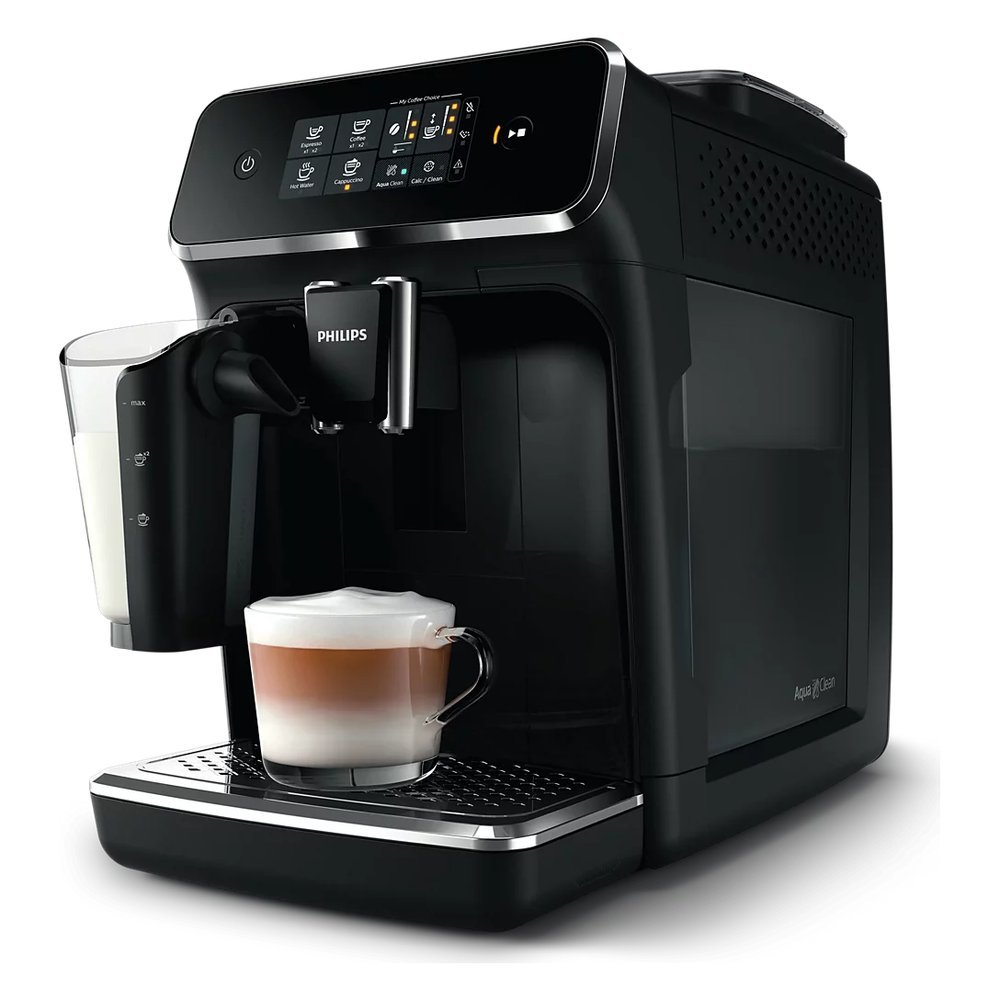
The 2200 Series holds 4.2 out of 5, though from only 5 productreview.com.au reviews. That is far too thin a sample to call settled consensus, so it is worth treating as an encouraging early signal rather than proof.
One reviewer specifically praised the grinder as “excellent and easy to adjust,” a real point of difference from pricier machines where dialling in a grind setting is described as fiddly, but another flagged a hopper-feed issue where beans do not migrate well to the grinder inlet once the hopper drops below about half full, needing a manual nudge.
This is a budget-mid entry point into fully automatic bean-to-cup with a grinder, and the LatteGo milk system it pairs with is separately well regarded for easy cleaning, though that is a milk-system point rather than a grinder one.
Pros
- Grinder adjustment specifically praised as easy compared to fiddlier premium rivals
- An accessible price point into fully automatic bean-to-cup
Cons
- Only 5 reviews confirmed on productreview.com.au, too thin to call this settled consensus
- A hopper-feed design issue means beans need manual encouragement once the hopper runs low
7. DeLonghi Magnifica Evo (ECAM290) – Another Grind-and-Brew Option

7. DeLonghi Magnifica Evo (ECAM290)
The Magnifica Evo sits at 2.9 out of 5 from 29 productreview.com.au reviews, a small sample worth treating cautiously, but the grinder itself draws mixed-to-positive commentary within that data. One reviewer specifically called it “really good,” citing fine adjustment that supports good espresso.
Set against that, other reviewers report the grinder or feed funnel stopping bean flow after around three months, and a persistent grinder warning light that recurred even after the entire unit was replaced under warranty, a real reliability concern rather than a one-off.
A cross-cutting finding worth flagging honestly across the whole DeLonghi range checked in this sweep: a chute or pathway near the hopper that traps ground coffee and stalls the grinder shows up repeatedly across multiple DeLonghi models, not just this one, suggesting a brand-level design pattern rather than an isolated fault.
Pros
- Grinder fineness and adjustment specifically praised as good by at least one detailed reviewer
- Mid-tier pricing for a fully automatic machine with real grind control
Cons
- Feed funnel stoppages reported by multiple owners around the three-month mark
- Part of a wider DeLonghi-range pattern where a hopper-adjacent chute traps grounds and stalls the grinder
8. Sunbeam Barista Max (EM5300K) – Cheapest True Grind-and-Brew Entry
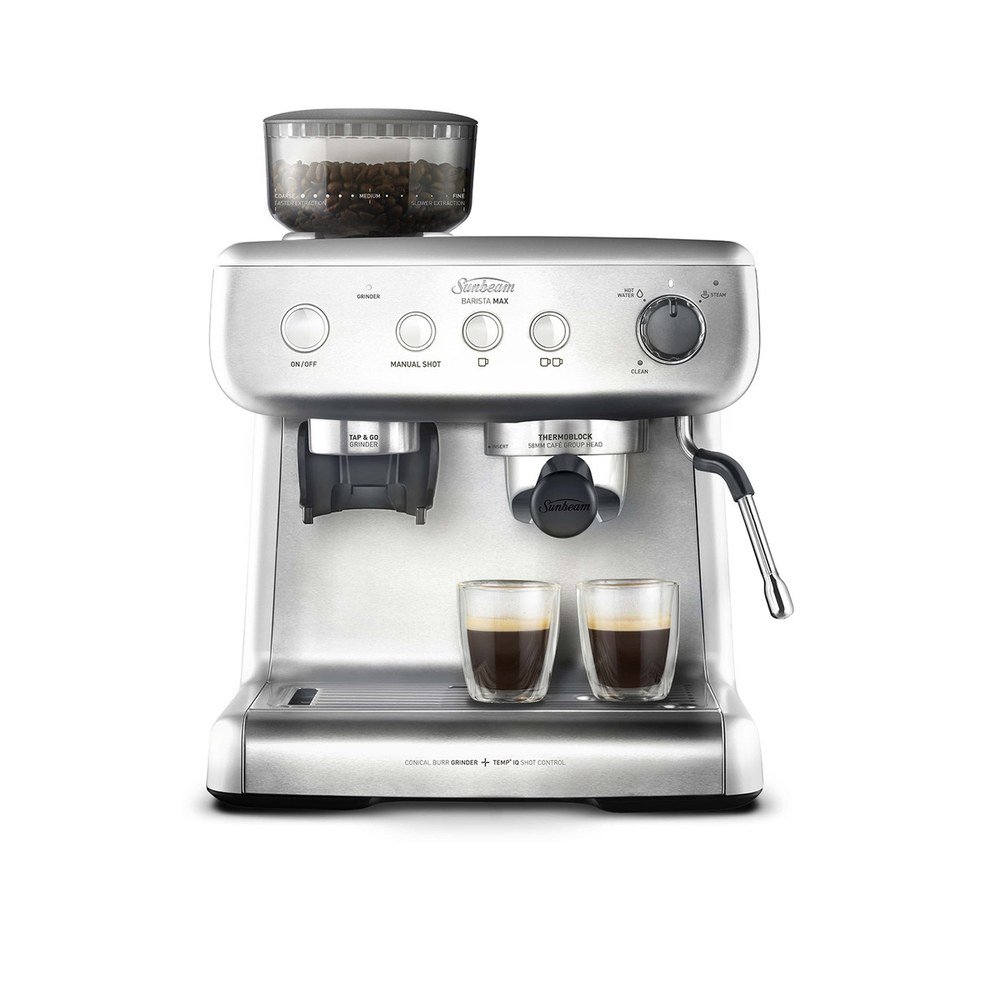
8. Sunbeam Barista Max (EM5300K)
The Barista Max is the most affordable true integrated-grinder machine covered in this sweep, using a conical burr with 30 grind settings and a tap-and-go action, a real budget alternative to the Breville Express above.
A CoffeeSnobs forum thread specifically documenting this model gives real, named owner evidence: “the grinder isn’t consistent, you sometimes will waste coffee from an inconsistent grind” even after a setting has been dialled in. That is a grinder-quality complaint rather than a general build gripe.
One reviewer separately called the build “poor quality, completely plastic internals,” though that complaint was not specific to the grinder itself, and another reviewer, working against that, called the unit “surprisingly very quiet” in operation.
Pros
- The most affordable integrated-grinder machine with a real forum-documented track record
- 30 grind settings on a budget-tier machine, which is more range than the price suggests
Cons
- A CoffeeSnobs thread documents real owner-reported grind inconsistency even after dialling in a setting
- General build quality is criticised as heavily plastic, though not a grinder-specific complaint
9. Breville Barista Touch / Touch Impress – Inconsistent Across Sub-Models

9. Breville Barista Touch / Touch Impress
This is the clearest do-not-blanket-recommend case in the whole Breville range. The standard Barista Touch (BES880) sits at 3.7 out of 5 from 64 reviews with 23 percent negative, while the Touch Impress variant sits lower at 3.4 from just 13 reviews, too thin a sample to trust on its own. These are distinctly different real-world experiences wearing very similar names.
Standard Touch owners report grounds piling against the grinder chute wall and spilling, along with what one reviewer called “terrible racket” during grinding. The Touch Impress adds a specific, documented software gap: it cannot save a per-drink grind-size memory, so changing the grind for one saved drink changes it for every drink, and it will not reliably detect an empty hopper, which corrupts its auto-dose calculation.
Anyone shopping this family specifically for the touchscreen convenience should treat “Barista Touch” as at least two different products with different track records, not one name to buy on faith.
Pros
- Touchscreen control simplifies saving and recalling drink profiles when it works as intended
- The standard Touch’s 64-review sample is reasonable enough to trust the general pattern
Cons
- Grounds spillage at the grinder chute is a repeated, named complaint on the standard Touch
- The Touch Impress cannot save a per-drink grind setting and struggles to detect an empty hopper, both clear software-level gaps
10. Gaggia Anima Prestige (RI8762/03) – Another Grind-and-Brew Option
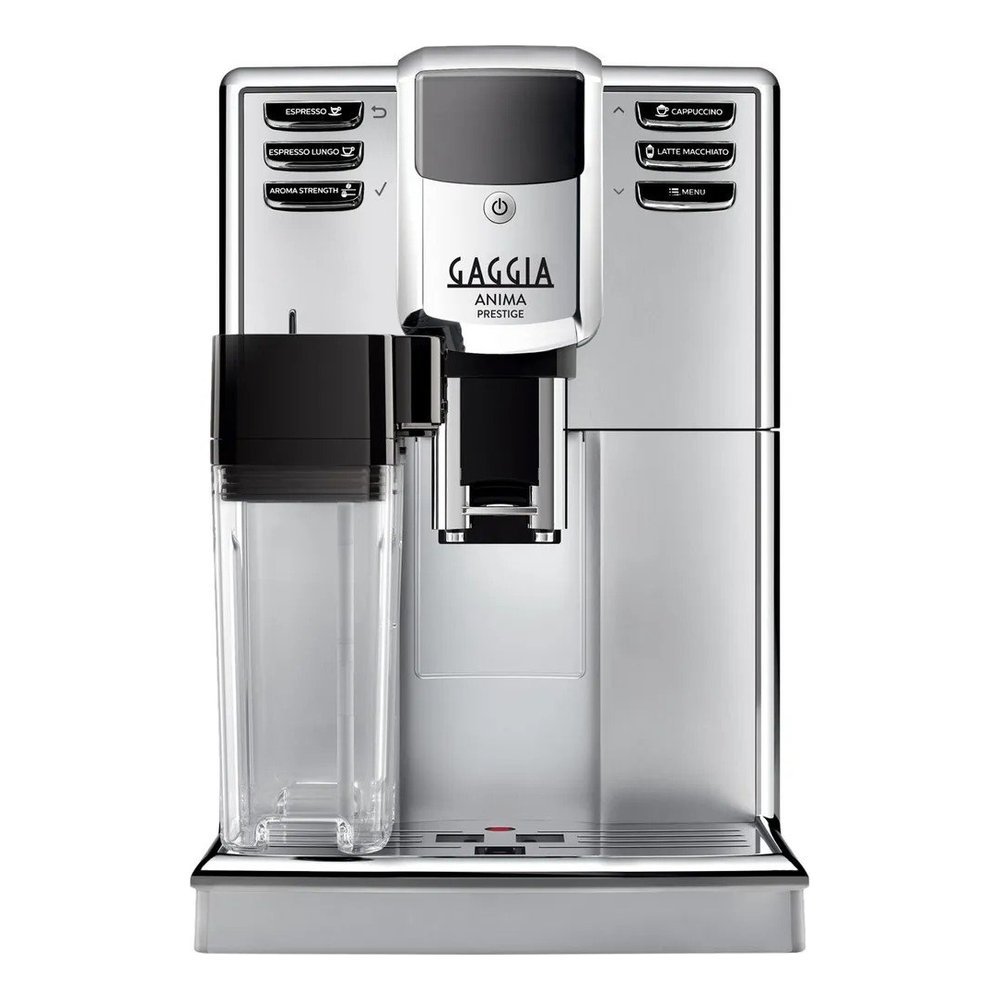
10. Gaggia Anima Prestige (RI8762/03)
The Anima Prestige uses a ceramic grinder with real adjustment range, but its productreview.com.au data is very thin: 2.2 out of 5 from just 3 reviews, too small a sample to draw firm conclusions from either direction.
What evidence exists points to a hopper design complaint rather than a grind-quality one specifically: reviewers describe the hopper as “an awkward design” that is “slow and messy” to fill, with stray beans catching in a surrounding ridge that stops the lid closing properly.
A separate reviewer on a different Gaggia listing reported an intermittent squeal traced to the brew unit rather than the grinder, fixed under warranty. It is worth noting as a related but distinct issue rather than conflating it with the grinder itself.
Pros
- An adjustable ceramic grinder with real fine-tuning range
- Represents a distinct European brand alternative to the Breville/DeLonghi/Sunbeam options above
Cons
- Only 3 reviews confirmed, so this data is too thin to treat as settled consensus in either direction
- The bean hopper is repeatedly described as an awkward, messy design to fill
How to Choose a Coffee Machine with a Grinder
Decide between semi-automatic and fully automatic first, before comparing individual models. A semi-automatic grind-and-brew machine (the Breville Express and Pro, or the Sunbeam range) still needs you to tamp and pull the shot by hand, which means more control but more skill required. A fully automatic bean-to-cup machine (the Jura, Philips, DeLonghi and Oracle above) does the whole job at one button press, giving more convenience but less say over the result.
Weigh grind consistency evidence over grind setting count. A machine with 30 settings and an inconsistent grinder (the Sunbeam Barista Max’s CoffeeSnobs-documented issue) is a worse buy than one with fewer settings and consistently praised grind quality, such as the Breville Pro above. More numbers on a spec sheet do not guarantee a more even grind landing in your basket.
Treat a family name as a starting point, not a guarantee. Both “Barista Touch” and DeLonghi’s “Maestro/Prestigio” naming cover sub-models with meaningfully different real-world ratings and even different documented faults. Look up the exact model number’s own review data before assuming a well-regarded family name means every variant in it performs the same.
If a separate standalone grinder paired with a dedicated espresso machine appeals more than an integrated one, my best espresso machines roundup covers that path, and my office coffee machine roundup covers lower-maintenance picks for a shared kitchen instead.
Keep Your Machine Running
Whichever machine you choose, the grinder itself needs its own maintenance separate from the espresso side. My guide to cleaning a coffee grinder covers the routine that keeps an integrated hopper-fed grinder running consistently rather than clogging the way several models above are documented to.
A Breville machine specifically benefits from a proper descaling routine on the boiler side too. See my Breville descaling guide and Breville cleaning guide if you land on the Express, Pro or Oracle above.
Chosen a DeLonghi fully automatic instead? My DeLonghi descaling guide covers the maintenance schedule that keeps the brand-wide grinder-chute issue flagged above from getting worse.
Frequently Asked Questions
Is a coffee machine with a built-in grinder better than a separate grinder?
It is more convenient and takes less bench space, but the evidence above shows integrated grinders vary widely in consistency: some owners of premium machines like the Oracle report better results switching to a separate single-dose grinder instead. Convenience and ultimate grind consistency are a real trade-off, not a given.
What is the difference between semi-automatic and fully automatic grind-and-brew machines?
A semi-automatic machine, like the Breville Express or Pro, grinds and doses for you but still needs manual tamping and shot control. A fully automatic bean-to-cup machine, like the Jura E8 or DeLonghi Magnifica Evo, grinds, brews and often froths milk at one button press with far less hands-on control.
Why do integrated grinders clog or stop feeding beans?
Several documented Australian complaints point to hopper or chute design rather than the burrs themselves: oily dark-roast beans clogging ceramic grinders over time, or a chute near the hopper trapping grounds, which is a pattern found repeatedly across the DeLonghi range specifically. Regular cleaning and avoiding very oily beans reduces this.
How many grind settings do I actually need?
Most machines on this list offer 15 to 30 settings, and real range matters more than the exact number: enough to move meaningfully finer for a light roast or coarser for a dark one. A machine with fewer settings but consistently praised grind quality outperforms one with more settings and documented inconsistency.
Should I trust every model in a well-known machine family equally?
No. Both Breville’s Barista Touch family and DeLonghi’s Maestro/Prestigio family show meaningfully different review scores and even different documented faults across their own sub-models. Always check the exact model number’s own review data rather than assuming a good family reputation applies evenly.
Is a cheap integrated-grinder machine like the Sunbeam Barista Max worth buying?
It is the most affordable grind-and-brew entry point covered in this research, but a CoffeeSnobs thread documents real owner-reported grind inconsistency even after dialling in a setting. It suits a buyer prioritising price over grind precision, not someone chasing cafe-level consistency.
Verdict
The Breville Barista Pro leads on grinder stability, with real caveats elsewhere
For most buyers wanting fresh-ground coffee without a separate grinder, the Breville Barista Pro has the strongest evidenced grinder in this list, more stable than the entry-level Express and backed by a reasonable review sample. Buyers wanting full automation should look at the Jura E8 for its professional-grade grinder engineering, or the Breville Oracle for its large review volume, while treating the Barista Touch and DeLonghi Maestro/Prestigio families with real caution given the inconsistency documented across their own sub-models.
