
Finding the best coffee machine for office Australia has to offer is a different problem from choosing one for home: the machine needs to survive being used by ten or fifteen different people who have never read the manual, not just the one or two who bought it. This guide covers small-to-medium offices, roughly up to 15 to 20 people sharing a single machine, where a fully automatic or pod machine sits in a shared kitchen or kitchenette instead of being run by a dedicated barista.
Two things are deliberately left off this list, and both deserve an honest reason instead of a quiet omission. First, manual and semi-automatic espresso machines, the Breville Barista Express and similar, are excluded on purpose: they need consistent hands-on technique (grinding, tamping, dialling in a dose) to produce a decent shot, and that technique does not hold up when a rotating cast of untrained coworkers operates the same machine every day. If your office actually has one coffee-minded volunteer who wants to run a proper manual machine themselves, my Best Espresso Machines guide covers that case directly; just know it is a different kind of purchase from anything on this list.
Second, true high-volume commercial equipment (machines like Jura’s Giga X8 or a WMF or Franke commercial unit built for a 20-plus person office pulling something like 250 drinks a day) is also out of scope. Those machines are sold through business coffee suppliers on lease and service contracts instead of consumer retail, and they do not have the kind of independent Australian consumer review data every pick below is built on. Naming a specific commercial model here without that evidence would mean inventing a recommendation this guide cannot actually back, so it stays out instead of guessing.
Every machine below is judged specifically through an office lens: how simple it is for someone using it for the first time, how it copes with a queue of coworkers before a 9am meeting, who ends up responsible for cleaning it, how much noise it makes in an open-plan space, and whether it can go a few years without a technician visit. If you are furnishing a home instead of an office, my full home coffee machine roundup is the better starting point.
The DeLonghi Magnifica S ECAM22110SB is the best coffee machine for a small Australian office: a 4.1/5 rating from 334 reviews, the largest sample of any automatic machine checked, and a track record of surviving years of heavy daily use, exactly the kind of punishment a shared office kitchen delivers.
Best Coffee Machine for Office Australia: How the 10 Compare
| Product | Type | Best For | Key Spec |
|---|---|---|---|
| DeLonghi Magnifica S ECAM22110SB | Fully automatic, manual steam wand | Best Overall for a Small Office | 4.1/5 from 334 reviews |
| Jura S8 | Fully automatic, automated milk | Best for a Busy Morning Rush | Self-prompting cleaning cycle |
| Breville Oracle Touch BES990 | Fully automatic, dual boiler | Best for High-Volume Milk Orders | Simultaneous shot and steam |
| DeLonghi Nespresso CitiZ | Pod machine, Nespresso Original | Best Pod Machine for a Shared Kitchen | 4.2/5 from 328 reviews |
| Breville Nespresso Essenza Mini BEC220 | Pod machine, compact | Best for a Small Team or Tight Space | 4.4/5 from 59 reviews |
| Jura Z10 | Fully automatic, hot and cold brew | Best Executive or Client-Facing Pick | Full app control |
| Jura E8 | Fully automatic, compact | Best for a Quiet Office | Quieter than the ENA9 it replaced |
| Philips EP4346 (4300 Series LatteGo) | Fully automatic, LatteGo milk | Best for Easy, Low-Maintenance Cleaning | Dishwasher-safe milk system |
| Bosch Serie 8 Built-In | Fully automatic, built-in | Best for a Built-In Kitchenette | 29 specialities, Home Connect app |
| DeLonghi Magnifica Start ECAM220.31.SB | Fully automatic, entry-level | Best Budget Pick for a Bootstrapped Office | 5 one-touch recipes |
How I Compared It
Every rating in this guide traces back to the same productreview.com.au evidence already verified for this site’s fully automatic coffee machine guide and pod machine guide, re-examined specifically through an office-suitability lens: multi-user simplicity, throughput during a rush, who carries the cleaning burden, and reliability without a dedicated on-site technician, instead of a fresh review sweep from zero.
As covered in the intro, this guide deliberately excludes two categories rather than omitting them silently: manual and semi-automatic espresso machines (they need consistent technique a rotating office roster cannot guarantee, though my Best Espresso Machines guide covers that case for a dedicated volunteer), and large-scale commercial units like the Jura Giga X8 or a WMF or Franke installation (sold on business lease contracts with no independent Australian consumer review data to back a specific recommendation). CHOICE’s public testing pages were checked as a secondary cross-reference where relevant, though its detailed model scores sit behind a paywall.

1. DeLonghi Magnifica S ECAM22110SB – The Steady Pick for a Small Office
A shared office kitchen is a punishing environment for a coffee machine: nobody “owns” maintenance, everyone expects it to just work, and the same unit might pull twenty cups before lunch. The Magnifica S is built for exactly that kind of neglect-tolerant duty. It holds a 4.1/5 rating from 334 reviews on productreview.com.au, the largest and steadiest sample of any automatic machine checked for this list, and one reviewer reported pulling roughly 10,000 cups over six years with regular servicing. A large, easily removable water tank also means whoever tops it up on a given morning does not need any instruction.
The one real office-specific catch: the steam wand is manual, not automated. That is a non-issue if your office mostly drinks long blacks or if someone already knows how to steam milk, but it becomes a real daily friction point if nobody on staff has ever used a steam wand before: expect a learning curve and possibly a few wasted attempts at a flat white in the first week. Reviewers also flag the water tank’s locating lug as a known fragile part, and getting the intensity and grind settings dialled in takes real trial and error instead of being obvious out of the box.
Warranty service reports are inconsistent on faulty units, which is worth knowing before you buy one for a workplace where downtime affects more than one household. Even with that caveat, this is still the safest single pick for a small office that wants one dependable machine without assigning anyone to be the unofficial coffee technician.
Pros
- Largest, steadiest Australian review sample of any automatic checked (334 reviews)
- Large removable tank suits a shared kitchen with no single owner
- Real-world reports of years of heavy daily use before needing attention
Cons
- Manual steam wand only, a real training gap if nobody on staff can steam milk
- Water tank locating lug is a known fragile part
- Warranty service reports are inconsistent on faulty units
Whoever ends up responsible for this machine will need to descale it on a schedule. My DeLonghi descaling guide covers the Magnifica S step by step.

2. Jura S8 – Best for a Busy Morning Rush
What makes the S8 particularly suited to an office is not any single feature; it is how much it handles without anyone thinking about it: fast heat-up, a quiet pre-rinse cycle that will not interrupt a call in an open-plan space, and a machine that prompts its own cleaning cycle instead of relying on a coworker to remember. It holds a 4.2/5 rating from 76 reviews, with the same core grinder and brewing technology as the pricier Z10 further down this list.
The often-cited complaint about the water filter, needing replacement roughly every five to six weeks, reads differently in an office than at home: spread across a whole team’s worth of coffees, that cost is far easier to justify than it is for a single household. The trade-off is that an office’s higher daily cup count means hitting that filter-change interval faster in real time, not slower, so budget for more frequent changes than the home-use figure suggests. A handful of reviewers report watery or burnt coffee that persisted across different beans, one replacement unit had a touchscreen fail after five months and “drip tray not inserted” errors show up often enough to be worth expecting.
The glossy panels also show fingerprints fast, a real cosmetic annoyance on a machine multiple people touch every day. Still, the self-maintaining design is a real advantage for a workplace where nobody wants to be the designated coffee-machine caretaker.
Pros
- Prompts its own cleaning cycle, no designated caretaker needed
- Fast heat-up and a quiet pre-rinse cycle for an open-plan office
- Filter cost is easier to justify split across a whole team
Cons
- Higher office cup volume means hitting the ~9-filters-a-year mark sooner, not later
- A handful of reports of watery or burnt coffee, and one touchscreen failure
- Glossy panels show fingerprints fast under multi-person daily use
None of the Jura machines on this list have a brand-specific guide on this site yet. My general descaling guide covers the S8 the same way.

3. Breville Oracle Touch BES990 – Best for High-Volume Milk Orders
The dual boiler is the whole reason this machine belongs on an office list: it can pull an espresso shot and steam milk at the same time, which actually matters when three coworkers are queued for lattes before a 9am meeting and a single-boiler machine would make the third person wait out the full cycle twice. It holds a 3.7/5 rating from 125 directly-fetched productreview.com.au reviews, a 77/23 positive-to-negative split, with reviewers consistently praising how well the automated milk system balances what to automate against what stays manual.
The fault worth disclosing plainly: multiple reviewers report a recurring issue at the 18 to 36 month mark where boiler condensation drips onto the circuit board and cuts power, with out-of-warranty repairs running into the hundreds of dollars and some owners saying it recurred on a replacement unit. Breville’s support team is consistently praised for responding fast when this happens. Worth a specific, honest inference for an office buyer: that 18-36 month window is usually framed in elapsed calendar time, but it plausibly tracks actual usage hours more closely, and an office machine accumulates those hours far faster than a household one, so treat that window as a reasonable estimate instead of a guaranteed timeline; it is not a confirmed fact either way.
For a reception area or a floor that regularly queues for milk drinks every morning, nothing else on this list processes that queue as fast. Just budget for the fault pattern being a real possibility, not a remote one, given the extra hours a shared machine racks up.
Pros
- Dual boiler pulls espresso and steams milk simultaneously, cuts queue time
- Automated milk system reviewers say balances automation and manual control well
- Breville support consistently praised as fast to respond
Cons
- Documented recurring fault: boiler condensation onto the circuit board at 18-36 months
- Heavier office usage plausibly reaches that failure window sooner in elapsed time
- Out-of-warranty repairs run into the hundreds of dollars
A machine handling this much daily volume needs its descaling cycle taken seriously. My Breville descaling guide covers the Oracle Touch specifically.

4. DeLonghi Nespresso CitiZ – Best Pod Machine for a Shared Kitchen
Every machine above this one still asks something of the person using it: a grind setting to check, a steam wand to manage, a filter schedule to track. A pod machine sidesteps all of that, and that is exactly why pod machines get recommended for offices at all: pop in a capsule, press a button, done, with zero training required for the next person who walks up to it. The CitiZ holds a 4.2/5 rating from 328 Australian reviews, the largest verified sample of any pod machine on this site, from owners who report years of reliable daily use and a heat-up time measured in seconds.
A minority of units do fail early (watery shots followed by a full stoppage within the first year, sometimes recurring even after a warranty repair), which is worth knowing before you commit a whole office to it. Cleaning underneath the drip tray is fiddly, and the short/long shot dial takes a session to learn properly, though that is a one-time cost for whoever sets the machine up, not something every user needs to learn.
The larger water reservoir compared to the Essenza Mini below means fewer mid-morning refills when several people are queuing back to back, a real practical advantage in a shared kitchen. It pairs cleanly with an Aeroccino frother for offices where people actually drink milk-based coffee instead of straight shots.
Pros
- Zero training required, anyone can walk up and get a consistent result
- Owners report years of reliable daily use
- Larger reservoir means fewer refills during a shared morning queue
Cons
- A minority of units fail early: watery shots, then a full stoppage within a year
- Fiddly to clean under the drip tray
- Short/long shot dial takes a session to learn
Keep it on a proper schedule with my guide on how to clean and descale a Nespresso machine.

5. Breville Nespresso Essenza Mini BEC220 – Best for a Small Team or Tight Kitchen Space
At 4.4/5 from 59 reviews, this is the highest-rated pod machine found in Australia, and the two-button operation is arguably an even bigger asset in an office than at home: there is no manual to read and nothing to explain to a new hire on their first morning. It is also remarkably tiny, a real plus for a cramped kitchenette where the coffee machine competes with a microwave and a dish rack for the same stretch of bench.
That same small footprint is the limiting factor for anything beyond a handful of people: the water tank and used-pod bin are small enough to need daily attention even with one household’s worth of use, and an office with several daily users will empty both noticeably faster, so expect to be refilling and emptying multiple times a day instead of once. Standard mugs also need the drip tray removed to fit underneath. Some reports of leaks and a buckled plastic panel appear between 12 and 24 months of use.
One naming trap worth knowing before you buy: Nespresso Original also sells a similarly named “Essenza Mini” made by DeLonghi instead of Breville, and that DeLonghi-made version rates lower (4.0/5) than the Breville-made BEC220 reviewed here (4.4/5). Check the manufacturer badge on the box, not just the model name. Treat this as a small-team pick, five or six people sharing a kitchenette, not a machine for a whole floor.
Pros
- Highest star rating of any pod machine checked in Australia
- Two-button operation, nothing to explain to a new hire
- Remarkably tiny footprint suits a cramped kitchenette
Cons
- Small tank and pod bin need attention multiple times a day with several users
- Standard mugs need the drip tray removed to fit
- Some reports of leaks and a buckled panel after 12-24 months
My pod machine cleaning guide covers the upkeep routine for a compact machine like this one.

6. Jura Z10 – Best Executive or Client-Facing Pick
The Z10 makes the most sense on an executive floor or in a client-facing reception area, somewhere presentation matters as much as throughput. It holds a 4.5/5 aggregate from around 26 reviews (20 five-star, 3 four-star, 3 critical), and owners praise consistent results, properly frothy milk texture, and a real point of difference: both hot and cold brew from one machine, with full control over both from Jura’s phone app.
The app is also where complaints concentrate: more than one reviewer reports it simply not connecting for stretches of two months. Running costs sit higher than anything else on this list once consumables are factored in, and a shared office machine amplifies that cost across more cups instead of fewer, which is worth weighing against the executive-floor use case before committing. At least one reviewer also describes a slow warranty-repair turnaround.
Pros
- Real hot and cold brew from one machine, a clear differentiator for a client-facing space
- Full app control suits a presentation-focused reception or executive floor
- Strongly positive review sample for a premium machine
Cons
- App connectivity failures reported for stretches of up to two months
- Highest running and consumable cost on this list, amplified across a shared office
- At least one report of a slow warranty-repair turnaround
Even a flagship needs regular descaling. My step-by-step descaling process applies to the Z10 the same as any entry-level machine.

7. Jura E8 – Best for a Quiet Office
Noise is a real, specific problem the Breville entries above do not solve as well: a loud grinder going off next to someone’s desk in an open-plan office, multiple times an hour, is a constant daily annoyance. The E8 is noticeably quieter than the ENA9 model it replaced, and reviewers praise its milk system for producing what one owner called perfect foam even in large amounts, useful when several people want milk drinks back to back. Its compact footprint is also a real plus for a small kitchenette.
The recurring complaint is temperature: several reviewers report coffee arriving lukewarm, common enough that Jura’s own suggested fix is pre-heating the cup, a workaround that works less well in an office where cups are not always warmed before use. Premature “change filter” prompts and a froth-lever hole that clogs without regular rinsing are the other real maintenance points, worth assigning to someone specifically since a shared machine has no single obvious owner to notice a clogged wand.
Set beside the S8, the E8 trades some feature depth for a smaller, quieter footprint, worth the trade in a noise-sensitive open-plan space.
Pros
- Noticeably quieter than the ENA9 it replaced, a real plus in open-plan offices
- Milk system reviewers describe as producing perfect foam even in large batches
- Compact footprint suits a small kitchenette
Cons
- Recurring lukewarm-coffee complaints; Jura’s own fix is pre-heating the cup
- Premature change-filter prompts
- Froth-lever hole clogs without regular rinsing, needs an assigned owner
My descaling guide covers the maintenance routine every Jura on this list shares.
8. Philips EP4346 (4300 Series LatteGo) – Best for Easy, Low-Maintenance Cleaning
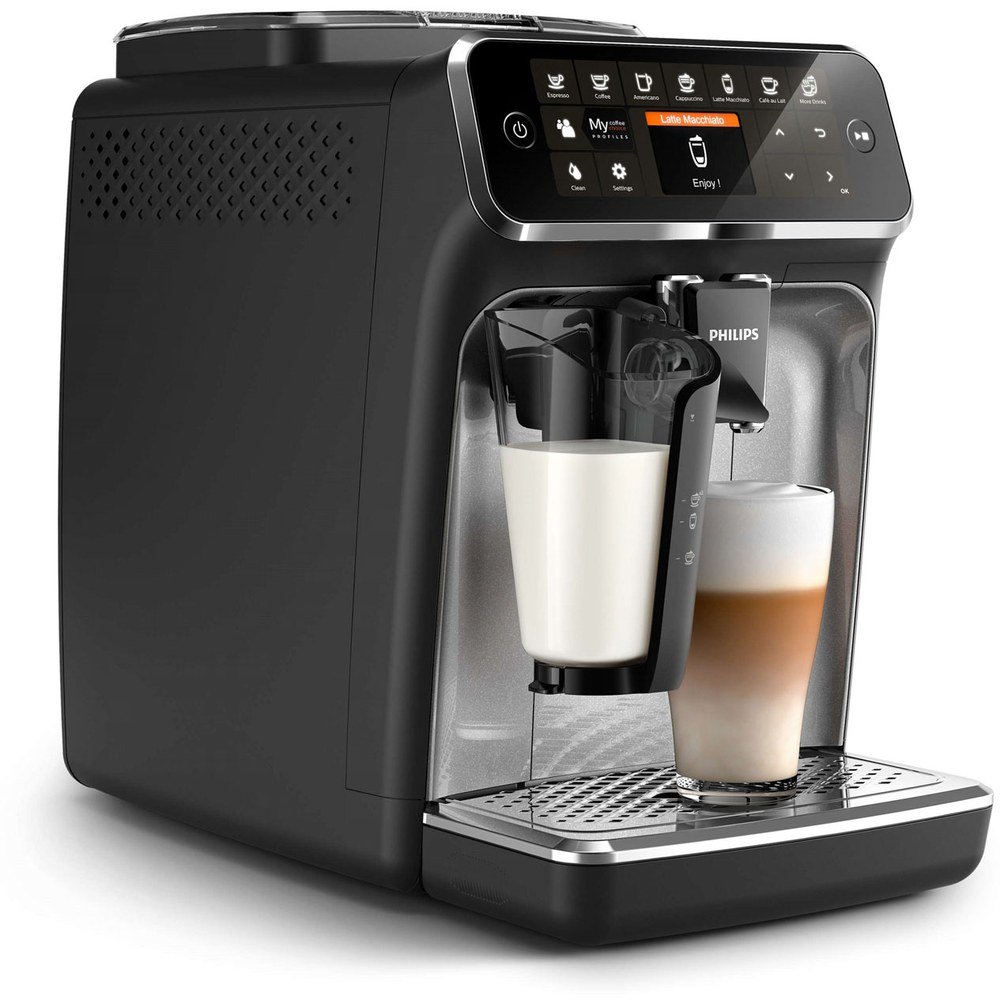
The no-tubing LatteGo milk system is arguably more valuable in an office than at home: whoever ends up unofficially responsible for the machine does not want to be reaching into someone else’s internal milk lines to clean them. LatteGo is a two-part design with no internal tubing at all, and both parts are dishwasher safe, a real reduction in the maintenance burden for whoever inherits that job. It holds a 4.1/5 rating, though the Australian sample behind that number is small, worth being upfront about instead of treating it as a settled verdict.
The main durability complaint is a Reddit-sourced report of a replaced milk carafe failing again after roughly 14 months, worth flagging even though it sits on a weaker evidence tier than a direct productreview.com.au fetch. It is also worth noting the standalone product page for this model is no longer live on Philips Australia’s own site, though it remains sold through mainstream retailers, so it is still a current, purchasable machine even if Philips is not actively promoting it locally right now.
For an office where nobody wants ongoing milk-system upkeep to become a recurring chore, the cleaning convenience alone is worth the trade-off against a smaller review base.
Pros
- No internal milk tubing, both LatteGo parts are dishwasher safe
- Lowers the maintenance burden for whoever ends up responsible for it
- Straightforward one-touch operation for untrained users
Cons
- Small Australian review sample, treat the 4.1/5 as indicative instead of settled
- Reddit-sourced report of a replacement carafe failing again within about 14 months
- No longer listed on Philips Australia’s own website
My descaling guide covers machines like the EP4346 without a brand-specific walkthrough.

9. Bosch Serie 8 Built-In – Best for a Built-In Kitchenette
Every machine above sits loose on a benchtop. This one does not, and that is precisely the reason it earns a place on this list despite a thinner Australian review base than the benchtop picks above: an office fit-out with proper joinery and a built-in kitchenette is a distinctly different buyer need from a machine someone just plugs in. It handles up to 29 coffee specialities and connects through Bosch’s Home Connect app, and one long-term owner, two years and five months of daily use, reports it makes better coffee with less effort than what they had before.
Real faults reported include coffee not reaching full temperature even on the “very hot” setting, with some suspicion Bosch is aware of the issue without disclosing it, touch-panel failures needing a service call, a stuck coffee-selector wheel and a door that would not close properly on some units, and a self-clean programme that stalled partway through on one machine. The WiFi and Home Connect features reportedly did not work at all in Australia on at least one owner’s unit, worth knowing if the app was part of the appeal.
On the plus side, Bosch gave at least one owner a free goodwill repair after the warranty period ended. If your office is renovating or fitting out a kitchenette instead of buying a standalone appliance, this is the only truly built-in option on the list.
Pros
- Only true built-in option on this list, suits a proper office fit-out
- Up to 29 coffee specialities from one machine
- At least one long-term owner reports better coffee with less effort after 2+ years
Cons
- Smaller Australian review base than the benchtop picks above
- Touch-panel and coffee-selector faults reported on some units
- Home Connect WiFi reportedly did not work at all for at least one AU owner
My descaling guide covers the process; just check your water hardness setting first.
10. DeLonghi Magnifica Start ECAM220.31.SB – Best Budget Pick for a Bootstrapped Office
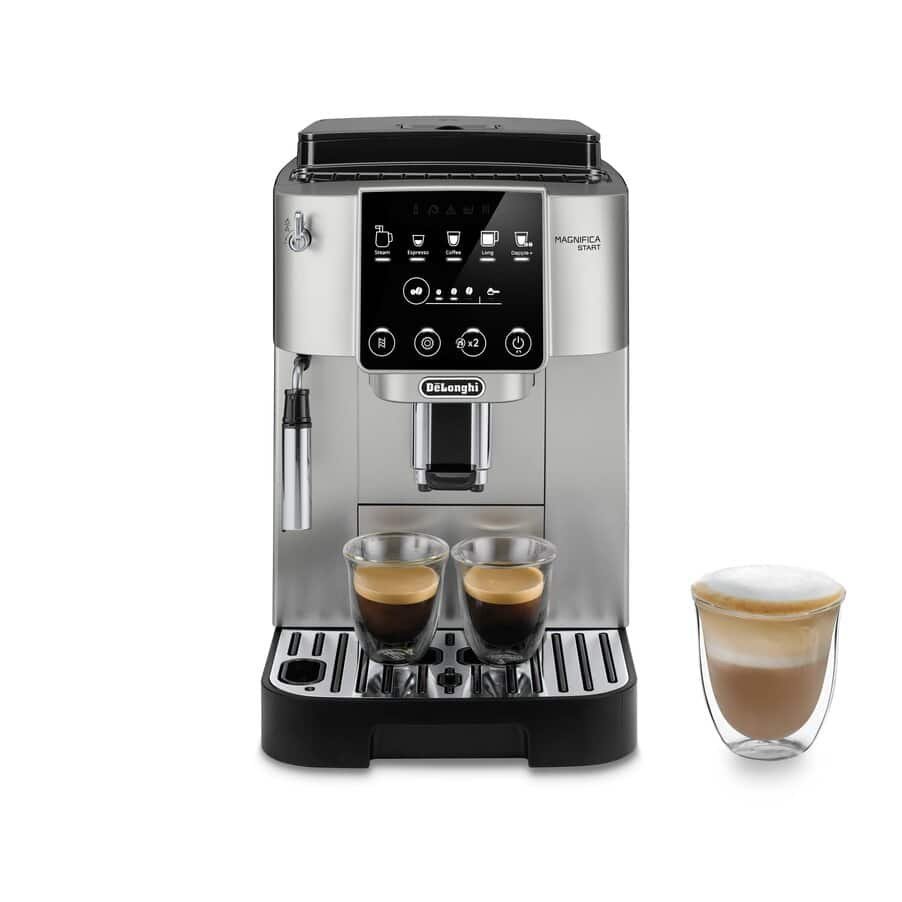
For a small team or a business closely watching costs, the Magnifica Start is the sensible entry point: simpler and cheaper than the Magnifica S at the top of this list, without dropping the core grind-and-brew automation that makes a fully automatic machine viable for shared use in the first place. One reviewer who upgraded from the Magnifica S actually preferred the Start’s grind and said it tasted stronger, not the direction that comparison usually runs.
The review base here is smaller than the Magnifica S above, so treat the pattern as indicative instead of exhaustive. The real complaints that do surface: one owner reported no water output at all despite following the setup guide correctly, and another described dry, under-extracted grounds with the grinder sticking partway through a cycle, worth knowing before a whole office relies on it every morning.
Five one-touch recipes and a traditional manual frother keep things simple for untrained users, and the basic reliability story tracks the Magnifica S above, just without that machine’s cup-warmer and dual-cup convenience.
Pros
- Cheaper entry point than the Magnifica S without losing core automation
- One reviewer who upgraded from the Magnifica S preferred this machine’s grind
- Simple 5-recipe one-touch operation, easy for untrained staff
Cons
- Smaller Australian review base than the Magnifica S above
- One reviewer reported no water output despite correct setup
- Another reported the grinder sticking with under-extracted grounds
The descaling process mirrors its bigger sibling above, on a smaller tank. My DeLonghi cleaning and maintenance guide covers both models.
How to Choose a Coffee Machine for an Office
Match the machine type to how much training you can rely on. A pod machine like the CitiZ or Essenza Mini needs none, a fully automatic like the Magnifica S needs a five-minute walkthrough for anyone steaming milk manually, and a semi-automatic espresso machine (not on this list, deliberately) needs real ongoing technique from every single user. Pick based on how much you can realistically expect from a rotating group of coworkers.
Work out who actually cleans it. Every machine on this list needs descaling and some form of milk-system cleaning, and in a shared office that job either falls to whoever notices first or nobody at all. Machines with dishwasher-safe or tube-free milk systems, the Philips EP4346 in particular, noticeably lower that burden.
Think about noise before you buy, not after. A grinder going off next to someone’s desk multiple times an hour is a real daily irritation in an open-plan office. The Jura E8 is the specific standout for quiet operation on this list; the loudest machines here are generally the ones with the largest built-in grinders.
Match capacity to headcount honestly. The Essenza Mini is a five-or-six-person pick, not a whole-floor one; its small tank and pod bin will need attention multiple times a day well before that. For anything beyond about 20 people, this guide has deliberately stopped short of recommending a specific commercial unit, for the reasons covered in the intro.
Keep Your Machine Running
Three DeLonghi machines are covered here: the Magnifica S, the Magnifica Start and (in DeLonghi-made form) the Nespresso CitiZ. My DeLonghi descaling guide covers the automatic pair end to end.
Cleaning is a separate job from descaling and it is what stops a shared machine from souring between people. My DeLonghi cleaning guide covers the routine for the Magnifica S and Magnifica Start.
Both Nespresso machines on this list, the CitiZ and the Essenza Mini, share the same underlying descaling process. My Nespresso cleaning and descaling guide covers both.
For the Jura, Philips and Bosch machines on this list, none of which have a brand-specific guide on this site yet, my general descaling guide covers the same underlying process.
Frequently Asked Questions
What is the best coffee machine for a small office in Australia?
For most small offices, the DeLonghi Magnifica S ECAM22110SB is the safest pick: the largest, steadiest Australian review sample of any automatic machine and a real track record of surviving years of heavy shared use. If your office drinks mostly milk-based coffee and nobody knows how to use a manual steam wand, a pod machine or the Jura S8’s automated milk system may suit better.
Should an office buy a pod machine or a fully automatic machine?
A pod machine needs zero training and is the safest choice if you cannot rely on coworkers learning any technique at all. A fully automatic machine costs more per cup in beans than pods but produces better coffee once people learn the basics, a fair trade for an office that drinks a lot of coffee daily and can absorb a short learning curve.
Why does this guide exclude manual and semi-automatic espresso machines?
Manual and semi-automatic machines need consistent technique (correct grinding, dosing and tamping) to produce a good shot, and that technique does not transfer reliably across a rotating group of untrained coworkers. One dedicated, coffee-minded staff member can absolutely run one well; my separate Best Espresso Machines guide covers that specific case.
How many people can one office coffee machine realistically serve?
It depends heavily on the machine. A compact pod machine like the Essenza Mini suits five or six people sharing a kitchenette before its small tank and pod bin become a daily chore. Larger fully automatic machines with bigger tanks, like the Magnifica S or Jura S8, comfortably serve a 15 to 20 person office.
How often should an office coffee machine be descaled?
More often than a household machine on the same model, since a shared machine pulls far more cups between services. Every two to three months is a common manufacturer baseline for home use; an office in Perth or Adelaide, where mains water runs harder, should plan on descaling every four to six weeks instead.
What about a machine for a truly large office or corporate cafeteria?
This guide deliberately does not recommend a specific model for offices beyond about 20 people. True high-volume commercial machines are sold through business coffee suppliers on lease and service contracts, not consumer retail, and lack the independent Australian review data every pick above relies on, so naming one here would mean guessing rather than recommending.
The Magnifica S is the safe default, with two clear alternatives depending on your office
For most small-to-medium Australian offices, the DeLonghi Magnifica S ECAM22110SB is the sensible default: the largest, steadiest review base of any machine here and a real history of surviving years of heavy shared use, provided someone on staff can run a steam wand. If your team mostly wants milk drinks with zero training required, the DeLonghi Nespresso CitiZ is the safer pod-machine pick, or step up to the Jura S8 for a fully automatic machine that maintains itself. For a reception area or executive floor where presentation matters, the Jura Z10 is the standout, and for an office building out a proper kitchenette, the Bosch Serie 8 is the only truly built-in option on this list.
