
Coffee machines under $500 cover four distinctly different jobs: a semi-automatic espresso machine you dial in yourself, a pod machine that trades customisation for consistency, a drip filter machine built for brewing by the jug, and, in theory, a fully automatic bean-to-cup machine that grinds and brews at the touch of a button. Every product on this list is a real, currently stocked model, verified against a live Australian retailer listing rather than a manufacturer’s suggested price nobody actually pays.
Espresso machines in this bracket ask you to learn grind size, tamping pressure and milk texturing yourself, in exchange for the widest range of capable hardware under $500. Pod machines remove almost all of that learning curve, at the cost of a higher running price per cup and, on some capsule lines, a proprietary pod system with no cheaper third-party alternative. Drip filter machines are the cheapest and simplest entry point of all, built for a full pot instead of a single shot. Fully automatic bean-to-cup machines, the ones that grind whole beans and froth milk without you touching a portafilter, are the one category this budget still struggles to reach in Australia right now. More on that below.
$500 is not an arbitrary line. It is roughly where 15-bar pump pressure, once a premium feature, becomes the default rather than the exception, and where a machine with a dedicated wand for steaming milk (not an auto-frother clip) starts to show up at all. Drop much below around $200 and features like a built-in grinder or a proper steam wand mostly disappear. Go much higher than $500 and you are increasingly paying for automation and finish, not necessarily for a better cup.
This list only includes machines a mainstream Australian retailer such as JB Hi-Fi, Harvey Norman, The Good Guys, Bing Lee or Appliances Online currently sells for truly less than $500, cross-checked against real owner sentiment on productreview It excludes anything discontinued, anything Australian owners and CHOICE have specifically flagged as a false economy (see the avoid list further down), and the entire fully automatic bean-to-cup category, which does not currently have a credible model under this price in Australia; the cheapest current automatics start closer to $580-650. If you are still deciding which type of machine actually suits your kitchen, my guide to choosing a coffee machine is the place to start before committing to any specific model below.
The Nespresso CitiZ is the strongest evidence-backed pick among coffee machines under $500, rating 4.2 out of 5 from 328 productreview.com.au reviews, but if you want to learn real espresso rather than drop in a capsule, the DeLonghi Dedica EC685 is the most consistently well-reviewed manual machine at this price, sitting around 4.0 out of 5 across every colourway on productreview.com.au.
The Best Coffee Machines Under $500, Compared
| Product | Type | Price Range | Best For |
|---|---|---|---|
| Nespresso CitiZ | Pod/Capsule | $230-330 | Strongest evidence under $500 |
| DeLonghi Dedica EC685 | Espresso, semi-automatic | $180-250 | Learning real espresso |
| Nespresso Essenza Mini | Pod/Capsule | $220-260 | Smallest footprint |
| Auspure AusBrew-1812 | Drip/Filter | $67-90 | Cheapest solid option |
| DeLonghi Clessidra ICM17210 | Drip/Filter, pour-over | $199 | Batch brewing and entertaining |
| Breville Bambino Plus BES500 | Espresso, semi-automatic | $450-480 | Adding your own grinder later |
| Sunbeam Barista Max EM5300 | Espresso, built-in grinder | $370-400 | All-in-one grind and brew |
How I Compared It
I checked productreview ratings and written reviews, CHOICE’s public coffee machine testing and its “avoid buying” list, and current listings at JB Hi-Fi, Harvey Norman, The Good Guys, Bing Lee, Appliances Online and each manufacturer’s own Australian site, across every coffee machine type sold here, then kept only the models a mainstream retailer currently prices under $500. Every price quoted below was checked against a live retailer listing while researching this guide in September 2026; RRP and street price often differ by $50-150 and both drift with sales, so treat the figures as a snapshot, not a guarantee.
I weighted a larger productreview.com.au sample above a smaller one, treated CHOICE’s public scores as the strongest single signal for the machines it has actually tested, and excluded several widely sold budget models outright once CHOICE’s own testing rated them as a false economy despite a low sticker price. Where a machine’s rating looked strong but its sample size was thin, I said so plainly instead of presenting it with the same confidence as a machine backed by hundreds of reviews.
1. Nespresso CitiZ – The Strongest Evidence Under $500

The CitiZ carries the largest and most consistent review base of anything on this list: 4.2 out of 5 from 328 reviews on productreview.com.au, a sample size most machines twice its price cannot match. It is a straightforward Nespresso Original machine. Insert a capsule, press a button, and out comes espresso or lungo in under a minute, with a small integrated frother handling milk duties.
The catch is the one every pod machine shares: Original-line capsules cost more per cup over a year than ground coffee through a semi-automatic like the Dedica below, and unlike some rivals the CitiZ has no touchscreen or app control, just physical buttons. Reviewers do flag that the coffee is not always served as hot as they would like (worth knowing if you like your long black properly scalding). On the plus side, third-party compatible capsules exist for Original machines, unlike Nespresso’s newer Vertuo line, so the long-term running cost is not locked to Nespresso’s own pod pricing.
If you want a coffee machine that behaves the same way every single time, with zero learning curve and cafe-adjacent quality, the CitiZ is hard to argue with for under $500. It particularly suits a share house or a rental where nobody wants to argue over grind settings.
Pros
- Largest, most consistent Australian review base of any machine on this list (4.2/5, 328 reviews)
- Simple one-button operation, no grind or tamp learning curve
- Compatible with third-party Original-format capsules, unlike Vertuo
Cons
- Running cost per cup is higher long-term than ground coffee through a semi-automatic
- Some reviewers say coffee is not always served piping hot
- No touchscreen, physical buttons only
Keep the water path clear of scale, especially if you are on Sydney’s or Perth’s harder tap water; my guide to cleaning and descaling a Nespresso machine covers the CitiZ specifically.
2. DeLonghi Dedica EC685 – Best for Learning Real Espresso
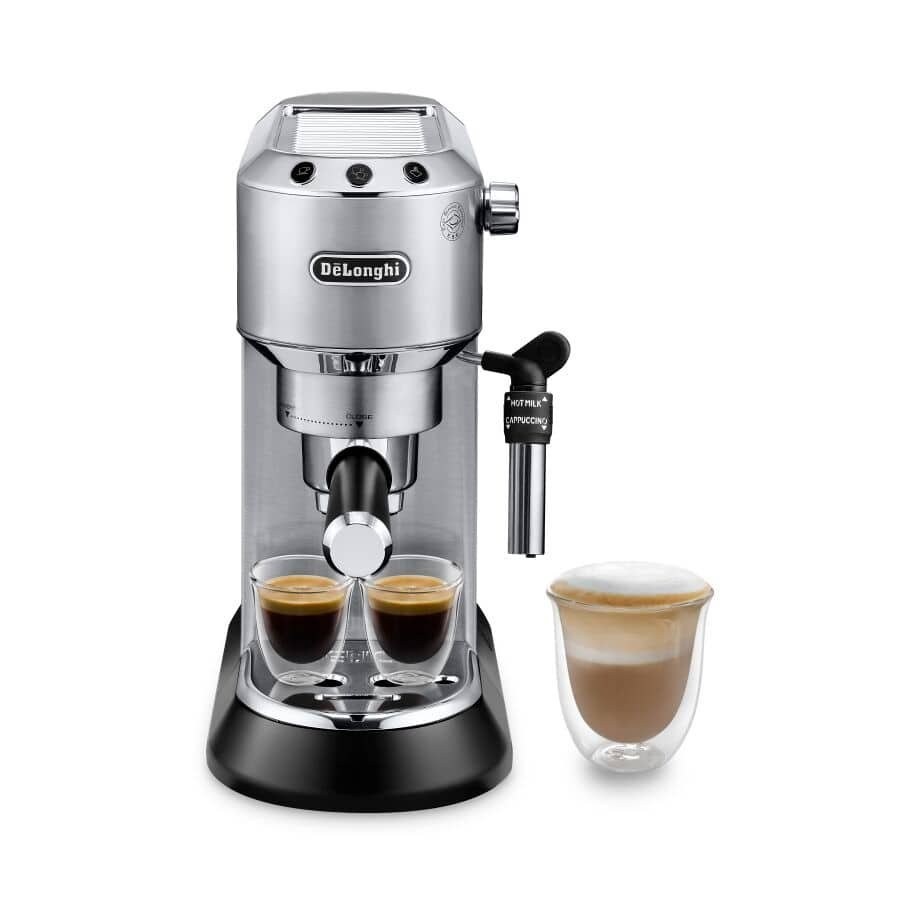
Where the CitiZ removes decisions, the Dedica hands them all back to you: dose, tamp and pull your own shot with a proper 19-bar pump, in a body just 15cm wide that slots into a corner of the bench no full-size espresso machine could touch. It carries the strongest manual-machine review base at this price, sitting around 4.0 out of 5 across all four colourways on productreview.com.au (black, white, silver and red combined run well past 200 reviews).
Reviewers are consistent about one thing: this machine punishes a lazy grind or tamp. Get the settings wrong and you get inconsistent shots and, in a few cases, flashing warning lights. Get them right, and long-term owners report machines still working after seven years. It is also noticeably light, light enough that some reviewers say they have to hold the body steady while locking in the portafilter, a fair trade for a footprint this small.
This suits someone who already wants to learn proper espresso technique on a tight bench, not someone who wants to skip that step entirely. If that is you, the Sunbeam or Bambino Plus further down build the grinder in for you.
Pros
- Most consistently well-reviewed manual machine at this price (approx. 4.0/5, 200-plus combined reviews)
- Narrowest footprint of any machine on this list, fits a truly small kitchen bench
- Long-term reliability reports of five-plus years of daily use
Cons
- Real learning curve; a sloppy grind or tamp shows up immediately in the cup
- Light chassis needs a steadying hand when locking in the portafilter
- No built-in grinder, budget for one separately if you do not already own one
A machine this compact has less internal tolerance for scale buildup than a larger unit; my DeLonghi descaling guide walks through the Dedica’s process.
3. Nespresso Essenza Mini – Best Ultra-Compact Pod Machine

The Essenza Mini is Nespresso’s smallest Original machine, and Australian owners rate it 4.0 out of 5 from 115 reviews on productreview.com.au. One AU-specific naming quirk worth knowing: Nespresso Original machines sold here are manufactured under licence by either DeLonghi or Breville, so the same Essenza Mini shape turns up listed as both a DeLonghi Nespresso Essenza Mini and a separate Breville-badged version. Check which one you are actually buying before comparing reviews between listings.
The recurring complaint is a leak, specifically water escaping from the base or squirting out when the capsule-release lever is lifted, reported by a meaningful minority of owners, some within months of purchase. Weigh that against the machine’s real strengths: it is smaller again than the CitiZ above, making it a fit for a studio apartment or a desk in a share office, and it shares the CitiZ’s compatibility with third-party Original-format capsules.
Choose this over the CitiZ if bench space is the deciding factor and you can live without a built-in milk frother; the Essenza Mini needs a separate Aeroccino if you want steamed milk.
Pros
- Smallest Nespresso Original footprint sold in Australia
- Compatible with third-party Original-format capsules
- Strong 4.0/5 sample across 115 reviews
Cons
- A meaningful minority of owners report base leaks or squirting water, some within months
- No built-in milk frother
- Small 0.6L tank means more frequent refills than the CitiZ
Pair it with a dedicated Nespresso descaling kit every three months or so, particularly if your local water is on the harder side.
4. Auspure AusBrew-1812 – Best Cheap Filter Coffee Machine

At under $90, the AusBrew-1812 is the cheapest machine on this list by a wide margin, and it still manages a properly strong 4.4 out of 5 from 38 reviews on productreview.com.au, with 79 percent of reviewers rating it positively. It is a straightforward 12-cup programmable filter coffee machine: fill the reservoir, set the timer, and wake up to a full pot.
The recurring weak point is the glass carafe, which several reviewers describe breaking during ordinary cleaning, and a replacement is not cheap relative to the machine itself. Some owners also found the keep-warm function too short on earlier units (20 minutes), though Auspure has since extended this to roughly two hours on current stock, so it is worth confirming with the retailer before you buy. Auspure’s own customer service is repeatedly praised as responsive, a real point of difference from some of the bigger brands on this list.
This is not a machine for espresso-based drinks. It is for someone who wants a full pot of filter coffee for the household without spending more than the price of a decent bag of beans.
Pros
- Strongest rating-to-price ratio of anything on this list (4.4/5 for under $90)
- Consistently praised, responsive customer service
- No ongoing paper filter cost
Cons
- Glass carafe reported to break easily during cleaning
- Earlier units had a short 20-minute keep-warm window
- Not suitable if you actually want espresso-style coffee instead of filter
There is no Auspure-specific maintenance guide yet, but the descaling process is the same as for any filter machine; my generic descaling guide covers the citric acid method that works here too. For more filter and drip options beyond this one, see my full roundup of the best drip coffee machines in Australia.
5. DeLonghi Clessidra ICM17210 – Best for Batch Brewing and Entertaining

The Clessidra sits between a filter machine and a pour-over, brewing up to 10 cups through either an automatic drip cycle or a manual pour-over mode, and it holds a solid 3.9 out of 5 from 34 reviews on productreview.com.au. Reviewers consistently call it “beautifully made,” and the glass-and-chrome hourglass design (Clessidra is Italian for hourglass) is easily one of the better-looking machines at this price.
Two complaints turn up often enough to flag. First, several reviewers report the coffee coming out lukewarm instead of hot, with one measuring the final temperature at just 54 degrees Celsius after adding milk. That is a real problem if you like your coffee served hot, not warm. Second, despite the marketed 10-cup capacity, most reviewers say the practical yield is closer to 3-5 mugs once you account for how much coffee people actually drink per cup. It also makes an audible clicking noise during the pour-over cycle that some owners find irritating.
Compared with the cheaper Auspure above, the Clessidra looks considerably nicer on the bench and suits someone who actually entertains, but the lukewarm-coffee complaint is common enough across both machines that neither should be your pick if piping-hot coffee matters more than price or looks.
Pros
- Distinctly attractive glass-and-chrome design, not just another plastic jug
- ECBC certification backs up the brewed-at-the-right-temperature claim on paper
- Dual brew modes, automatic or manual pour-over, in one machine
Cons
- Recurring reports of coffee serving lukewarm; one reviewer measured 54C after milk
- Real-world yield closer to 3-5 mugs than the marketed 10 cups
- Audible clicking during the pour-over cycle
Glass and chrome show scale buildup fast; my DeLonghi cleaning guide covers keeping the carafe and filter basket free of it.
6. Breville Bambino Plus BES500 – Best if You Want to Add Your Own Grinder Later

The Bambino Plus is Breville’s smallest machine: an automatic steam wand and a 54mm portafilter in the tiniest footprint the brand makes. It currently sells for around $450-480 at mainstream retailers even though its listed RRP sits at $599 (retailer sales and clearance pricing move this around, so treat the figure as a snapshot, not a fixed number). CoffeeSnobs forum members regularly recommend it as a budget entry point for someone who wants a proper 54mm portafilter to grow into a separate grinder down the track, instead of being locked into a built-in one.
Australian owners on productreview.com.au rate it 3.5 out of 5 from 65 reviews (3.4/5 from a further 40 reviews on the stainless steel finish specifically), noticeably lower than the Dedica above despite the similar price. Two separate durability patterns show up instead of one consistent fault: one reviewer’s automatic frothing system partially failed around the two-year mark despite what they describe as careful maintenance, and a different reviewer had the steam wand fail within a month of purchase, then again after the warranty replacement arrived. Reviewers also describe Breville’s service booking process as slow and repetitive when something does need fixing.
If the automatic steam wand and the wider Breville ecosystem (readily available parts, accessories, a wide network of service agents) matter more to you than raw review numbers, it still earns its place here. Just know you are choosing brand ecosystem and automatic milk texturing over the Dedica’s stronger raw rating. For the rest of Breville’s lineup above this budget, my full espresso machines roundup covers what changes once you spend more.
Pros
- Automatic steam wand, no manual technique required for milk
- 54mm portafilter leaves room to add a proper grinder later
- 3-second ThermoJet heat-up, no waiting around before your first coffee
Cons
- Lower productreview.com.au rating than the Dedica at a similar price (3.5/5 vs approx. 4.0/5)
- Two separate reviewer-reported steam wand and frother failure patterns
- Breville’s service booking process described as slow by some owners
Its compact build leaves less room for scale to build up unnoticed; my Breville descaling walkthrough covers the Bambino Plus specifically.
7. Sunbeam Barista Max EM5300 – Best All-in-One Grind and Brew Under $500
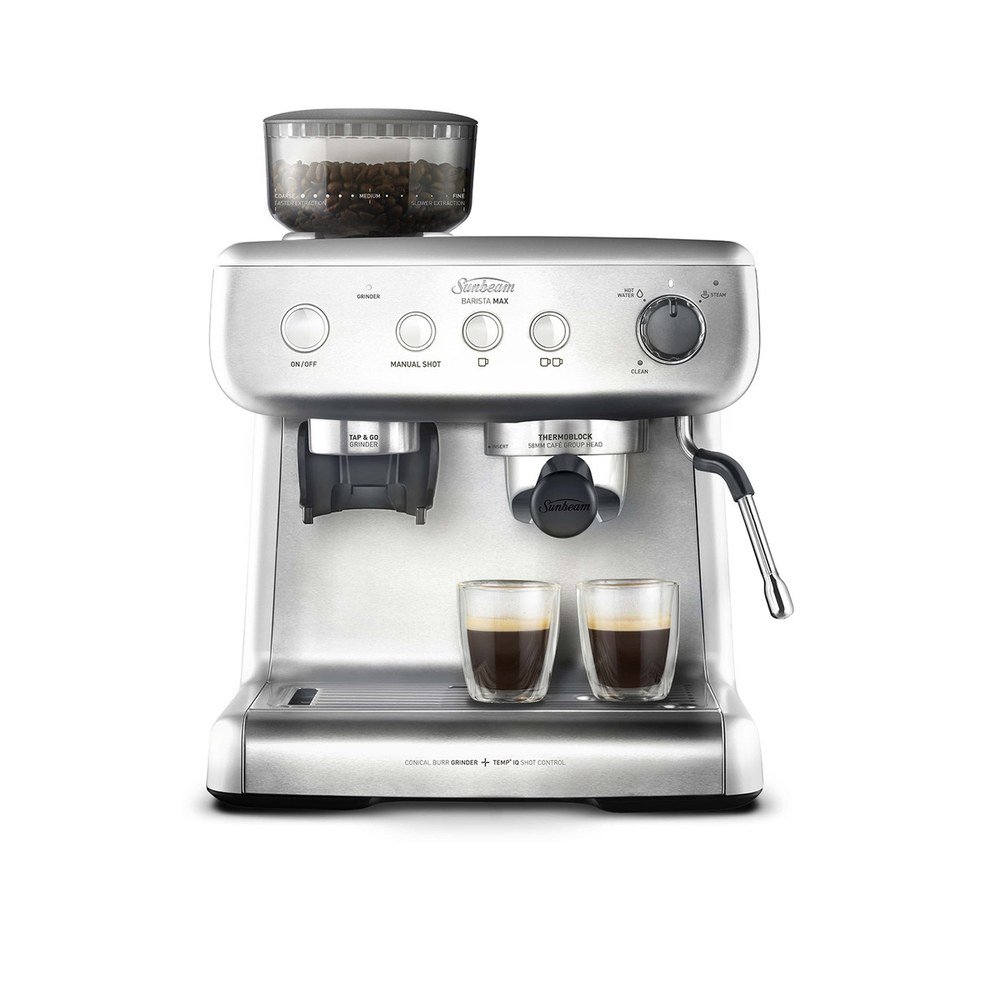
The Barista Max is the only machine on this list with a built-in conical burr grinder, meaning you buy whole beans and it handles grinding, dosing and tamping assistance in one unit for around $370-400, well down from Sunbeam’s own $499.90 listed RRP. For someone who wants the espresso experience without buying a separate grinder, it is the only truly complete package under $500.
The evidence here is more mixed than anywhere else on this list: 3.2 out of 5 from 193 reviews on productreview.com.au, the largest single review sample of any espresso-style machine here, but also the most inconsistent. Recurring complaints centre on group-head and steam-wand leaks, some appearing within the first month of ownership, alongside a smaller group of long-term owners who report years of reliable daily use. That split reads less like a universally bad machine and more like real unit-to-unit variation, which is worth knowing before you buy, not after.
If the built-in grinder is the deciding factor, weigh that real convenience against the DeLonghi Dedica’s considerably stronger and more consistent review base above. The Dedica costs less, but leaves you to source your own grinder.
Pros
- Only machine on this list with a built-in grinder, properly complete out of the box
- Large 1.5L water tank, fewer refills than most machines here
- Dose-control grinder lets you adjust grind amount without a separate tool
Cons
- Lowest and most inconsistent productreview.com.au rating of any espresso machine here (3.2/5)
- Recurring group-head and steam-wand leak reports, some within the first month
- Reliability reads as truly unit-to-unit, not a single universal fault
Because it grinds beans internally as well as brewing, it needs two separate maintenance habits: my generic descaling guide covers the brewing side, and my grinder cleaning guide covers the burrs.
How to Choose Between Coffee Machines Under $500
Start with the drink you actually make, not the one you think you should want. Someone who drinks a long black or a filter coffee every morning gets little benefit from a semi-automatic espresso machine’s learning curve. Someone who wants a flat white or a cappuccino at home needs a real steam wand (manual or automatic) or a pod machine with a built-in frother, not a basic drip machine.
Bench space is a real constraint in Australian kitchens, especially in an apartment or a rental where you cannot exactly knock out a wall for more counter room. The Dedica’s 15cm width and the Essenza Mini’s small footprint both exist specifically to solve this; a 12-cup drip machine like the Auspure needs more clearance for the same reason it makes more coffee at once.
Running cost compounds over years, not just at checkout. A pod machine’s capsules cost more per cup than ground coffee through a semi-automatic, and that gap widens the more coffee your household drinks. A machine with a built-in grinder like the Barista Max saves you buying a separate grinder now, but whole beans still cost less per cup than pods over time.
Finally, check the machine’s current AU retail naming before you buy. Nespresso Original machines are sold under licence by either DeLonghi or Breville depending on the model, and some international model names and numbers do not carry over to Australian listings unchanged. If a listing’s name or model number does not match what is on this page, confirm it against the manufacturer’s own Australian site before ordering.
Models to Avoid Under $500
Being priced under $500, or even well under $100, does not automatically make a coffee machine a bargain. CHOICE’s own lab testing has publicly flagged the following budget models as false economies, and every one of them is truly under $500, which is exactly why they belong on this list and not a pricier roundup:
- Anko Compact Espresso (Kmart), $79 – CHOICE rating 57%. Poor-quality build, a plastic tamper, and a light chassis that creates stability issues; milk froths with oversized bubbles instead of proper microfoam.
- DeLonghi Classic Manual EM450.M, $189 – CHOICE rating 55%. Poor taste results and only “OK” temperature consistency across four consecutive cups; no milk jug included and an awkward plastic tamper.
- Sunbeam Prima Latte EMP5100BK, $299 – CHOICE rating 54%. Poor milk frothing with large bubbles, a flimsy plastic tamper, and inadequate overall coffee quality for the price.
- L’Or Sublime Compact LM9012/60, $89 – CHOICE rating 52%. No milk frother at all, and a taste score of just 55% despite an easy-to-use rating.
- MZBG Etika Capsule Machine, $129 – CHOICE rating 42%. CHOICE’s own tasters described the coffee as having a “really awful flavour,” with another noting it tasted burnt and over-extracted.
- Espressotoria System Piccolo, $125 – CHOICE rating 39%, the lowest of any pod machine CHOICE has tested. Pale, very light crema with little to no aroma, sour flavours, and inconsistent temperature between consecutive cups.
Nespresso’s own Vertuo line is worth a specific caution too, not because it is badly made across the board but because its real Australian ratings swing wildly by model: some Vertuo machines sit around 4.0/5, while others (the Vertuo Next Solo, for one) sit as low as 1.7/5. Vertuo pods are also proprietary, with no third-party alternative, unlike the Nespresso Original capsules used by the CitiZ and Essenza Mini above. If you are looking at a Vertuo machine under $500, check that specific model’s own rating instead of assuming the Nespresso name alone is a safe enough signal.
Keep Your Machine Running
Whichever machine you land on, regular descaling matters more at this price point than at the premium end, since a budget machine has less tolerance for scale before something fails. Breville owners running the Bambino Plus should bookmark my Breville cleaning guide alongside the descaling walkthrough linked above. DeLonghi owners running either the Dedica or the Clessidra can follow my DeLonghi descaling guide for the full citric-acid cycle. Nespresso owners on the CitiZ or Essenza Mini should run my combined Nespresso cleaning and descaling process roughly every three months. And if you own the Sunbeam Barista Max or the Auspure AusBrew-1812, neither of which has a brand-specific guide on this site yet, my generic descaling guide covers the citric-acid method that works across both.
Frequently Asked Questions
Is it worth buying a coffee machine under $500?
Yes, for most home use cases. The evidence here shows properly well-reviewed machines across espresso, pod and drip categories under $500, including the Nespresso CitiZ at 4.2/5 from 328 reviews. The exception is fully automatic bean-to-cup machines, which do not currently have a credible model under this price in Australia; expect to spend closer to $580-650 for one of those.
What is the best coffee machine under $500 in Australia?
Based on real Australian owner evidence, the Nespresso CitiZ has the strongest overall rating and review volume (4.2/5 from 328 productreview.com.au reviews). If you want to learn manual espresso instead of using capsules, the DeLonghi Dedica EC685 has the strongest evidence among semi-automatic machines at around 4.0/5.
Why is there no fully automatic bean-to-cup coffee machine under $500?
Fully automatic machines combine a grinder, a boiler and milk automation in one unit, and that combination of parts truly costs more to build reliably. Current AU retail pricing puts the cheapest credible automatics closer to $580-650, with the DeLonghi Magnifica Start around $650-700. Below that, quality and reliability both drop off sharply.
Are pod machines cheaper to run than espresso machines under $500?
No, the opposite is generally true. Pod machines like the Nespresso CitiZ or Essenza Mini cost more per cup over a year than ground coffee through a semi-automatic machine like the DeLonghi Dedica, because you are paying for convenience and consistency with every capsule. Third-party compatible pods for Nespresso Original machines narrow that gap, but do not close it.
Which coffee machines under $500 should I avoid?
CHOICE’s own testing has publicly flagged the Anko Compact Espresso ($79, 57%), the DeLonghi Classic Manual EM450.M ($189, 55%) and the Sunbeam Prima Latte EMP5100BK ($299, 54%) among manual machines, plus several capsule machines including the Espressotoria System Piccolo (39%). All are truly under $500 but scored poorly on CHOICE’s own taste and consistency testing.
How often should I descale a coffee machine under $500?
Roughly every three months for most Australian households, but check monthly if you live in a harder-water city like Perth or Adelaide. Budget machines under $500 generally have less internal tolerance for scale buildup than premium machines, so skipping descaling tends to cause problems sooner, not later.
Verdict
The Nespresso CitiZ leads on evidence; the Dedica leads on real espresso
For the strongest, largest body of real Australian owner evidence under $500, the Nespresso CitiZ is the pick: a 4.2/5 rating from 328 reviews is not a number many machines at any price can match. If hands-on espresso technique matters more to you than dropping in a capsule, the DeLonghi Dedica EC685 earns its place with the most consistently well-reviewed manual machine at this price, in a footprint small enough for almost any kitchen. The Auspure AusBrew-1812 rounds out the list as the honest budget pick if all you want is a full pot of filter coffee for well under $100. None of the three costs anywhere near what the premium end of this market charges, and the value gap between them and a $1000-plus machine is smaller than the sticker prices suggest.
