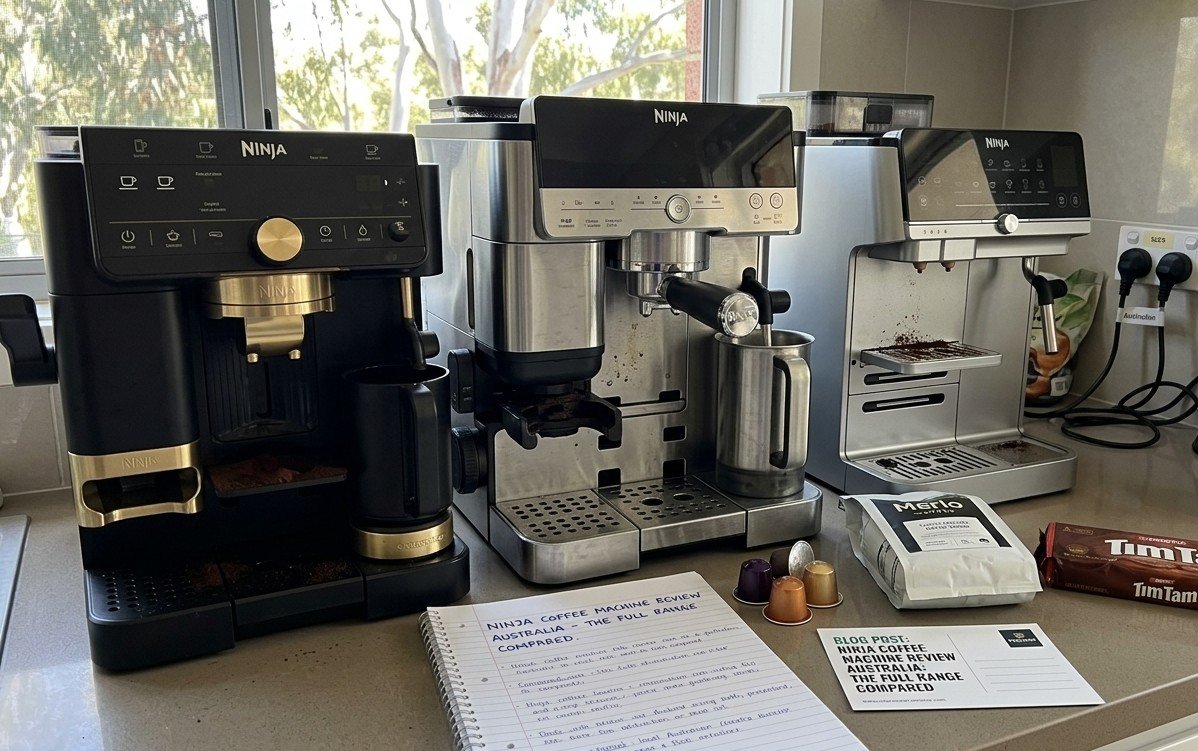
Ninja spent years making blenders and air fryers before it decided espresso was next, and the range it has landed in Australia is bigger than most shoppers realise. There are three current Ninja coffee machines sold locally: the Luxe Cafe Premier, the step-up Luxe Cafe Pro (sold here only as a David Beckham limited edition), and the fully automatic AutoBarista Pro. In this Ninja coffee machine review for Australia, I compare all three side by side, based on my own hands-on testing of every machine in the range rather than SharkNinja’s marketing copy.
Each model targets a different kind of buyer. The Luxe Cafe Premier ES601 is the entry point: a semi-automatic 3-in-1 that pulls espresso, brews filter coffee and makes cold brew, with a built-in grinder and an automatic milk frother doing most of the thinking for you. The Luxe Cafe Pro adds a tamp lever, a hot water spout and a bigger milk jug for a faster workflow. The AutoBarista Pro drops the manual steps entirely: it grinds, doses, tamps and pulls the shot itself, all controlled from a touchscreen.
The number that actually matters across the range is 9 bar, the pump pressure all three machines share. It is the same benchmark Breville and DeLonghi build to for proper espresso extraction rather than just hot, flavoured water. The Premier sits at the budget end of the range, the Beckham-branded Pro is a clear step up in price, and the AutoBarista Pro sits at the top, roughly comparable to what Harvey Norman or JB Hi-Fi charge for a mid-tier Breville automatic.
I ran all three machines myself, side by side, over several weeks of daily use, rather than piecing this together from marketing copy or a single unboxing. The full detail on how each machine performed sits in its own dedicated review (linked below), while this guide focuses on how the three actually compare with each other.
The Luxe Cafe Pro (David Beckham Limited Edition) is the pick for most buyers: its tamp lever is a real, tested upgrade over the entry-level Premier, not just a cosmetic one. Every machine in the range rewards learning its grinder properly, and the AutoBarista Pro trades some shot-ratio precision for real convenience.
These are my own scores from direct hands-on testing of all three machines, some synthesis of other reviews. See each model’s dedicated review, linked below, for the full breakdown behind these numbers.
The Ninja Coffee Machine Range in Australia, Compared
Before I get into the detail, here is how the three currently compare on paper.
| Model | Type | Best For | Key Spec |
|---|---|---|---|
| Ninja Luxe Cafe Pro (Beckham LE) ES771BK | Semi-automatic, integrated tamp lever | Buyers who want the full manual workflow without the Premier’s fiddly dosing ring | 4-in-1 with independent hot water, 350ml milk jug |
| Ninja Luxe Cafe Premier ES601 | Semi-automatic, dosing ring and tamper | The cheapest way into the range | 3-in-1, built-in scale, 230ml milk jug |
| Ninja AutoBarista Pro AE1051 | Fully automatic bean-to-cup | Buyers who want zero manual steps and don’t mind a touchscreen | 13 drink presets, 53mm brew group, 2 swappable hoppers |
How I Reviewed This Range
I set up all three current Ninja coffee machines and ran them daily over several weeks, brewing espresso, milk drinks, filter coffee and cold brew on each one, side by side rather than one at a time from memory. That included measuring shot doses and extraction where it mattered, most notably on the AutoBarista Pro, where I used a scale and a refractometer to check real TDS readings rather than relying on taste alone. Each machine also got its own dedicated deep-dive review, linked throughout this guide, covering far more detail than fits in a range comparison.
The scores above reflect my own units and my own testing conditions, and appliance quality control can vary between individual units of any machine, mine included. I found no ACCC recall on any current Ninja coffee machine as of this review. Nothing in this guide is a synthesis of other people’s reviews; it is my own direct experience with all three machines.
1. Ninja Luxe Cafe Pro (David Beckham Limited Edition) ES771BK – Best for the Full Barista Workflow

1. Ninja Luxe Cafe Pro ES771BK
In Australia, the Luxe Cafe Pro is only sold as this David Beckham limited edition in beaded matte black, not as a plain version the way it is badged in some overseas markets. That is worth knowing before you go hunting for a cheaper unbranded version, because it is not stocked here.
The single change that matters most is the tamp lever. Where the Premier makes you fit a dosing ring and tamp manually with a separate tool, the Pro tamps with the pull of a lever. Having run both machines side by side, this is the upgrade I would point to first if someone asked whether the Pro is worth it. Tamping consistency is one of the biggest variables in home espresso, and automating it noticeably improved shot-to-shot consistency in my own testing.
Beyond the lever, the Pro adds an independent hot water spout, a bigger 350ml milk jug versus the Premier’s 230ml, and a thicker steam wand. Cosmetically, it looks sharper too, but the finish does not change what lands in the cup; the tamp lever, jug size and hot water spout are the real upgrades. My full Ninja Luxe Cafe Pro review covers setup, tamping, milk frothing and daily use in detail.
Pros
- Tamp lever removes the Premier’s fiddliest manual step, confirmed in my own side-by-side testing
- Independent hot water spout, handy for tea, not just an espresso add-on
- Bigger milk jug and thicker steam wand suit households making multiple drinks
Cons
- Only available in Australia as the Beckham limited-edition colourway, with no plainer alternative sold locally
- Same core grinder as the Premier, so it improves the tamping step specifically, not every part of the machine
- A noticeable step up in price for what is largely a workflow and finish upgrade
Keeping the grinder clean and the steam wand descaled matters on every machine in this range; see my generic descaling and maintenance guide for the routine.
2. Ninja Luxe Cafe Premier Espresso Machine ES601 – Best Budget Entry Point
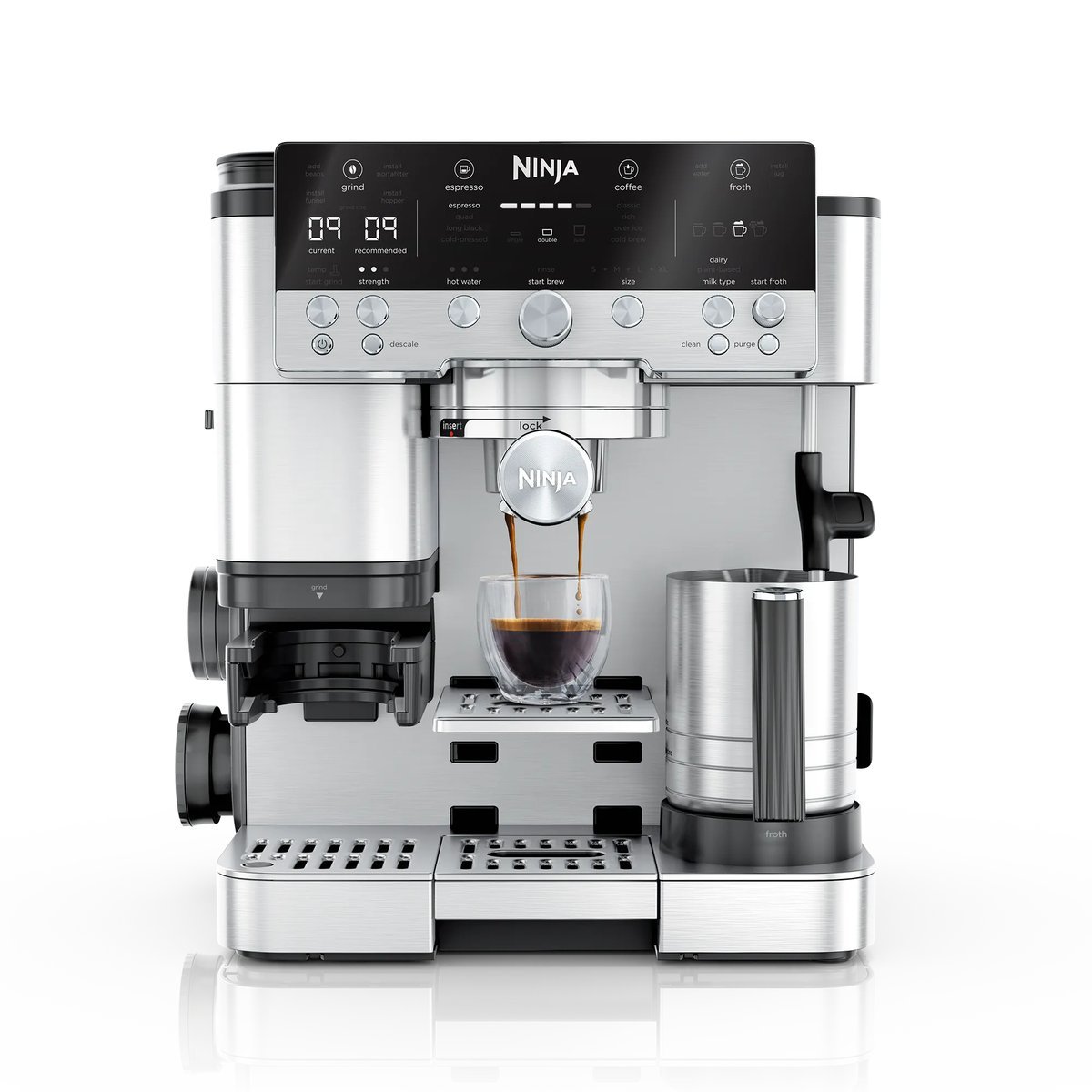
2. Ninja Luxe Cafe Premier ES601
This is the machine most of the “Ninja Luxe Cafe Premier espresso machine review” searches are actually about, and it is the cheapest real way into the range. In my testing, I confirmed it uses a real, non-pressurised portafilter basket rather than a pressurised one that fakes crema, so when the grind is dialled in, you get a proper shot with real body and a decent layer of crema.
The built-in grinder and automatic dosing made it easy to get consistent results day to day, and the barista assist grind suggestions are a useful starting point, though I would not follow them blindly; a few times, the suggested grind was finer than it needed to be. The drip tray fills faster than I expected and needs regular checking. The exterior also leans on plastic rather than metal, which is worth knowing at this price point.
My full Ninja Luxe Cafe Premier review covers setup, the grinder, milk frothing and daily quirks in detail.
Pros
- Real, non-pressurised basket gives a proper shot when the grind is right
- Built-in scale and grind-size guidance make it easy to learn on
- The cheapest real entry point into the Ninja range
Cons
- Drip tray fills faster than expected and needs regular checking
- Mostly plastic build for the exterior, not a heavy commercial-grade unit
- Cannot brew espresso and froth milk at the same time, a real limitation when making several drinks in a row
3. Ninja AutoBarista Pro AE1051 – Best for Convenience Over Precision
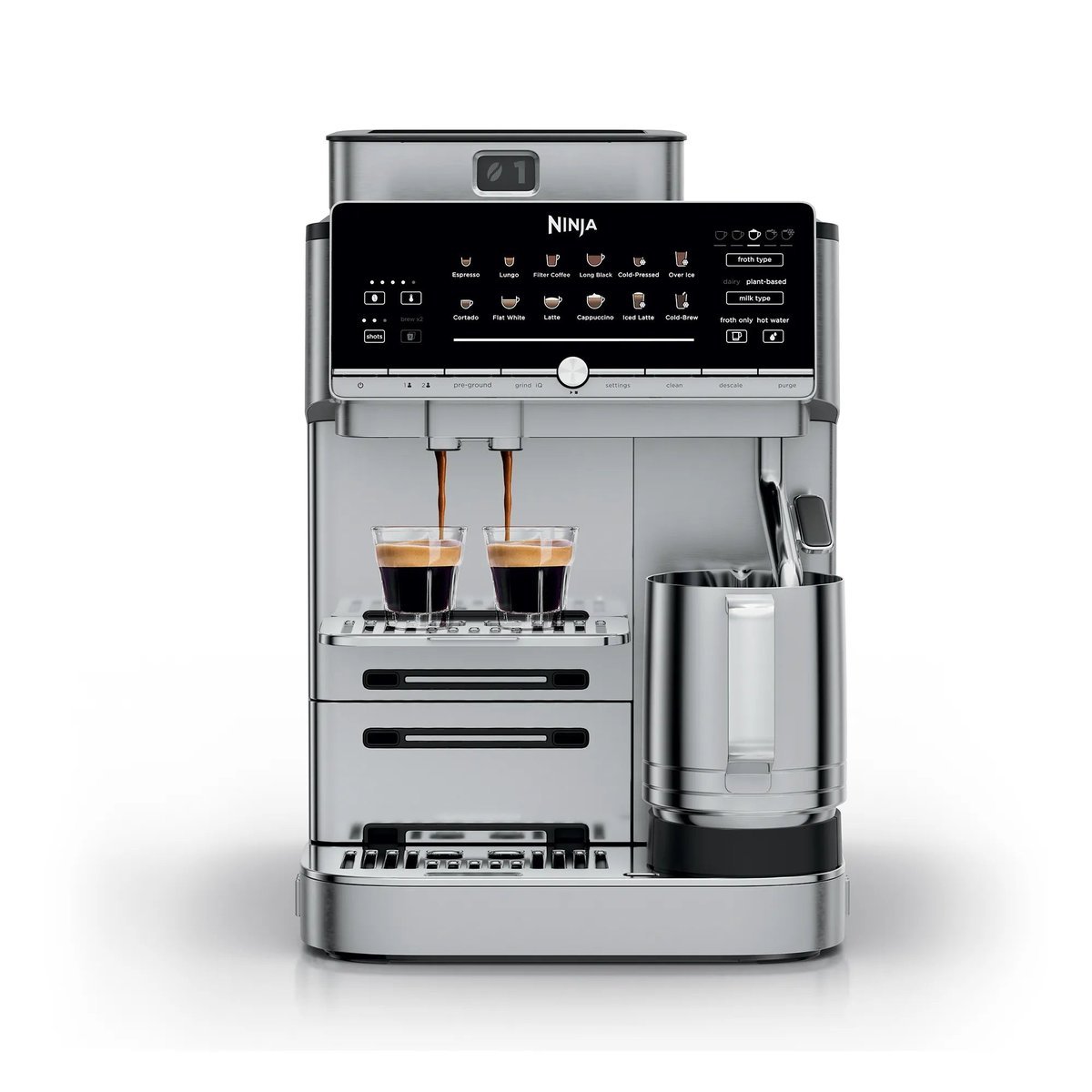
3. Ninja AutoBarista Pro AE1051
The AutoBarista Pro is not just a bigger Premier; it is Ninja’s answer to the fully automatic bean-to-cup machine, the same category Breville’s Oracle and the Jura and DeLonghi automatics compete in. Its GrindIQ system automatically grinds and doses across 50 grind settings, and two swappable 340g bean hoppers let a household keep two different beans loaded without emptying one to change the other. I pulled a hopper out mid-testing specifically to check this claim, and the chamber underneath was completely clean: a real, tested advantage that most rivals at this level do not offer.
I measured this machine properly rather than relying on taste alone, using a scale and a refractometer to check real TDS readings across all three dose settings. The honest finding: its ratios run longer and more diluted than a classic 1:2 espresso, especially on the single-shot setting, which I would avoid for a straight espresso. The double and triple settings fared much better, with good body and a persistent crema, closer to a portafilter machine than a typical automatic.
If precise, repeatable shot ratio matters to you, this is the model to be most cautious about. If you mostly want strong milk-based drinks at the press of a button, the ratio quirk matters less. My full Ninja AutoBarista Pro review breaks down the full TDS testing and the GrindIQ calibration process.
Pros
- Two swappable bean hoppers with zero cross-contamination, confirmed directly in my testing
- Larger 53mm brew group than most direct competitors, giving real body to double and triple shots
- Zero manual steps, closest thing in the range to true one-touch coffee
Cons
- My own TDS testing showed shot ratios running longer than a classic 1:2, especially on the single-shot setting
- GrindIQ’s initial calibration takes several shots and a fair handful of beans, so setup is not instant
- Manual grind override is limited to two steps either side of what GrindIQ sets
Which Ninja Coffee Machine Should You Buy?
If you want to learn real espresso technique without the Premier’s tamping fiddliness, the Luxe Cafe Pro Beckham edition is the one to save for. The tamp lever was the clearest, most consistently useful upgrade in my own side-by-side testing.
If budget is the main constraint, the Premier still gets you a good shot for the least money, provided you stay on top of the drip tray and accept the plastic-heavy build for what it is at this price point.
If you just want milk-based drinks at the press of a button and do not care about shot precision, the AutoBarista Pro’s convenience still holds up even with the ratio quirk I measured, since most of that gap only matters if you are chasing espresso-bar precision from a machine that was never really built for it.
For context on how these stack up against the established competition, see my Best Espresso Machines in Australia roundup, where Breville and Sunbeam still hold the strongest long-run Australian track record.
Keep It Running
Ninja does not yet have its own dedicated maintenance content on this site, so the same fundamentals that keep any semi-automatic or automatic machine happy apply here: regular descaling on the cadence above, wiping the steam wand after every milk drink to stop the automatic frother clogging, and using fresh beans, since all three machines rely on their built-in grinder for much of the shot quality. My generic descaling and cleaning guide covers the process step by step and applies directly to the Ninja range.
Frequently Asked Questions
Is my Ninja Luxe Cafe Premier espresso machine review positive?
Yes, on balance. In my own testing it produced a good shot once the grind was dialled in, thanks to a real non-pressurised basket, though the drip tray fills faster than expected and the exterior leans on plastic. It is a capable budget entry point, not a flawless one.
Is the Ninja Luxe coffee machine worth buying?
For most buyers, yes, provided expectations match the price. The Luxe Cafe Pro’s tamp lever fixes the Premier’s fiddliest step and is the version I would recommend if budget allows. The Premier remains worth it as a solid budget entry into real espresso.
How does the Ninja espresso machine compare to Breville?
Ninja undercuts Breville on price at every tier and matches its 9-bar pump pressure. In my own testing, Ninja’s automation (the tamp lever and GrindIQ grinding) is competitive, though Breville still has the longer Australian track record.
Which Ninja coffee machine is best in Australia?
Based on my own testing, the Luxe Cafe Pro (David Beckham Limited Edition) is the strongest overall thanks to its tamp lever and bigger milk jug. The Premier is the best budget pick. The AutoBarista Pro suits buyers who want fully automatic convenience and do not need precise shot ratios.
What’s different about the Ninja Luxe Cafe espresso machine models?
The Premier (ES601) uses a manual dosing ring and tamper and a smaller 230ml milk jug. The Pro (sold in Australia as the Beckham limited edition) adds an integrated tamp lever, independent hot water spout, and a larger 350ml jug. Both share the same 9-bar pump and built-in grinder.
Does the Ninja coffee machine range have known reliability issues?
There is no ACCC recall on any current Ninja coffee machine as of this review. In my own testing, the main quirks worth knowing are the Premier’s small drip tray and the AutoBarista Pro’s longer-than-classic shot ratio, both real but manageable rather than safety issues.
My Ninja Coffee Machine Review Australia Verdict
The Luxe Cafe Pro is the pick, the Premier is the honest budget option, and the AutoBarista Pro is for convenience over control.
Based on my own hands-on testing of all three machines, the Luxe Cafe Pro’s tamp lever earns it the strongest recommendation in the range, a clear, tested improvement over the Premier’s fiddlier manual step. The Premier remains a capable way into real espresso at the lowest price, as long as you stay on top of its smaller drip tray. The AutoBarista Pro suits anyone who wants milk-based drinks with zero manual steps and can live with the longer shot ratio my own testing measured.
