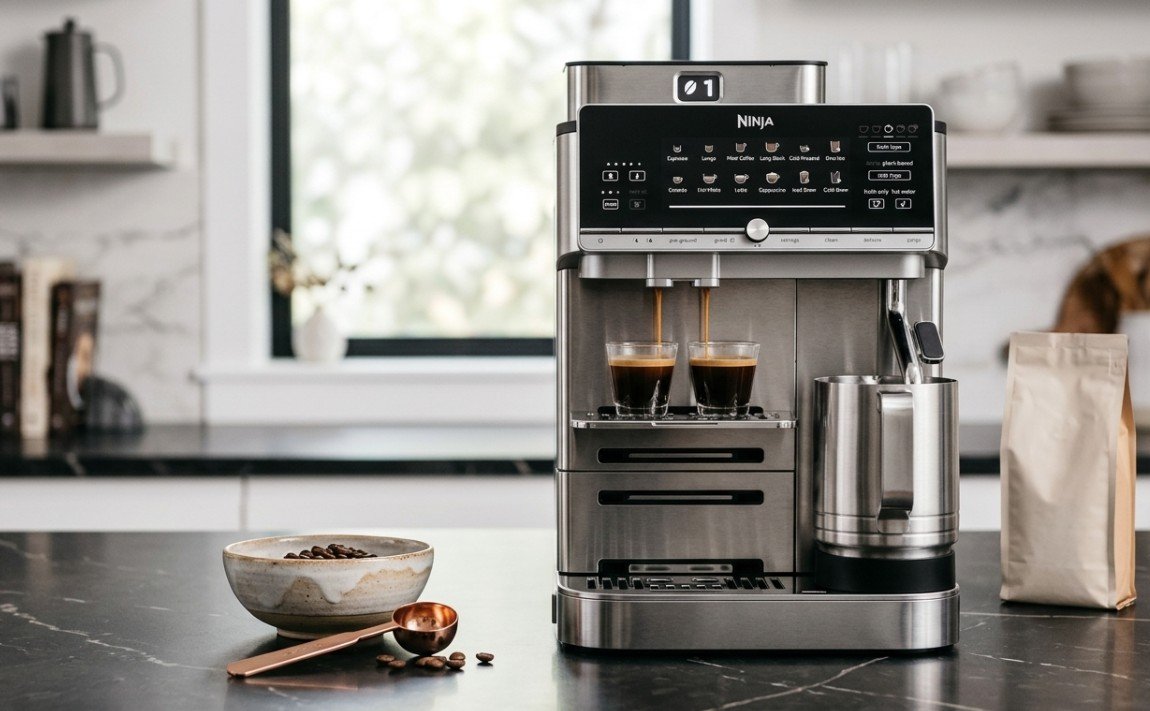
This Ninja AutoBarista Pro review is based on several weeks of running this machine daily alongside my earlier tests of the Luxe Cafe Premier and Pro, and it is a very different machine from both. There is no manual dosing, no tamping, and no steam wand technique to learn here. You load whole beans, pick a drink on the touchscreen, and the machine’s GrindIQ system handles grinding, dosing and extraction on its own. It sits in the same fully automatic bean-to-cup category that Breville’s Oracle and the big European automatics compete in.
This is model AE1051, the flagship of Ninja’s automatic range, and its most useful feature is a pair of swappable bean hoppers, each holding 340g, which let a household keep two different beans loaded and switch between them instantly. There is no purging and no wasted shots clearing out the old beans, which is more than most machines at this level manage. The grinder automatically selects from 50 settings and feeds a wide 53mm brew group, far larger than the small baskets most automatic machines use.
The number that matters most is that 53mm basket. Most super-automatics dose somewhere between 7 and 14 grams into a small chamber, which is a big part of why automatic espresso so often tastes thin. This machine’s basket allows a large, properly packed puck instead, and that single design choice is behind almost everything this machine does well.
This review covers what is actually in the box, the swappable hopper system, the brew group and dose sizes, the GrindIQ calibration process, what my own measurements showed about espresso strength and ratio, milk frothing, and the full drink menu, all based on my own hands-on testing. If you are comparing this against the semi-automatic Luxe Cafe range, my guide to choosing the best coffee machine is a good starting point for working out which category actually suits you.
The AutoBarista Pro closes much of the gap between automatic convenience and real espresso strength, largely thanks to its oversized 53mm brew group. However, my own measurements show its automated ratios run longer and more diluted than a traditional 1:2 espresso, especially on the single-shot setting, which is worth knowing before you rely on it for a straight espresso.
These are my own scores from hands-on testing, including refractometer measurements of total dissolved solids (TDS) across all three dose settings. Shot Ratio Consistency is marked down specifically because my own numbers show the machine running longer and more diluted than a classic espresso ratio. See “How I Reviewed This” below.
Ninja AutoBarista Pro AE1051 Specs
| Spec | Detail |
|---|---|
| Type | Fully automatic, bean-to-cup, with milk frother |
| Grinder | Steel conical burrs, 50 grind settings, auto-calibrated via GrindIQ |
| Dosing | Built-in scale, single/double/triple shot, weighs beans before grinding for zero retention |
| Brew group | 53mm basket, durable plastic housing, accessed via a side maintenance door |
| Bean hoppers | Two swappable hoppers, 340g capacity each, rubberised gasket to keep beans fresh |
| Pre-ground option | Dedicated pre-ground chute with its own scoop for occasional use |
| Milk system | Automatic frothing jug with built-in whisk plus integrated steam wand; settings from steamed milk through to extra-thick froth, plus cold foam |
| Dimensions | Approx 47cm deep, 40cm wide, 27cm tall, around 16 to 18kg |
| Water filtration | Reservoir filter with a dial to track the install month |
What’s in the Box
Ninja includes everything needed to get started, and the documentation is actually worth reading rather than skipping. Alongside the safety information and a quick start guide, the drink guide clearly lays out the froth options (steamed milk, thin froth, thick froth, extra thick froth, cold foam) and a customisation chart for dialling in a stronger or weaker cup. There is also a proper cleaning guide with a real maintenance schedule, not just a one-line warning to descale occasionally.
First Impressions and Design

This is a substantial appliance, roughly 47cm deep, 40cm wide and 27cm tall, and it carries real heft on the bench. It is not trying to be a classic Italian stainless steel showpiece. It looks like a Ninja appliance, which means if you already own a Ninja air fryer or ice cream maker, it will fit right into the lineup. The glossy silver finish is a real fingerprint magnet. That is worth knowing if you are house-proud, since it picks up marks fast and needs wiping down more often than a matte finish would.
The Swappable Hopper System

This is the standout feature of the whole machine. Instead of one fixed hopper, you get two swappable hoppers: one installed and one ready to swap in. Fill one with your everyday beans and the other with decaf, or a light roast for mornings and something darker for afternoons. What makes it actually work is the metering system inside the hopper throat: small rotating fins drop beans through a few at a time, paired with a built-in scale that weighs out exactly what a drink needs and nothing more.
I pulled a hopper out mid-testing specifically to check this claim, and the chamber underneath was completely clean, without a single stray bean left behind. That means no purging and no wasted shots when switching between hoppers. You can pull a caffeinated double, swap to the decaf hopper and pull a decaf straight after, with no cross-contamination. For a two-coffee-preference household, that is a real, practical advantage most machines at this level simply do not offer.
The Brew Group and Big Doses
Most super-automatics use a small basket and dose between 7 and 14 grams, which is one of the biggest reasons automatic espresso so often tastes thin. The AutoBarista Pro uses a completely different brew group with a 53mm basket, closer to what you would find on a semi-automatic prosumer machine than a typical automatic. That larger basket allows a properly packed puck rather than a token amount of coffee floating in water.
Ninja also thought about long-term upkeep here. Tucked into the side maintenance door is a small storage spot holding food-safe grease for the brew group and a two-in-one cleaning brush with a pick for clearing the steam wand. It is a small detail, but one that shows the whole lifecycle of the machine was considered, not just the first cup.
GrindIQ: How the Auto-Calibration Actually Works

GrindIQ is the machine’s automatic dial-in system. Fill the hopper, select a drink, tap GrindIQ, and the machine takes over. It pulls a shot at its best-guess grind setting, measures the flow rate, and adjusts coarser or finer before pulling again, continuing for up to three shots until it lands within tolerance. It then locks that setting in for that hopper, so switching beans later just means running the calibration again.
In my own testing, the first run was not perfectly smooth: the grinder spun for a moment without any beans dropping through, and a power cycle sorted it out. Every run since has worked as intended. It is worth setting expectations honestly, though: the calibration is not a 30-second job. It pulled several shots over roughly ten minutes and used a fair handful of beans doing it, so it is closer to a proper setup process than a quick tap-and-go.
Of the machine’s 50 internal grind settings, you only get direct access to a narrow band around wherever GrindIQ lands: two steps finer or two steps coarser. Think of that as fine-tuning rather than full manual control. It is enough to nudge a shot back into balance. It will not turn this into a manually dialled espresso machine.
Testing the Espresso: What My Numbers Actually Show
I did not want to rely on tasting notes alone, so I measured every dose with a scale and checked extraction with a refractometer to get real total dissolved solids (TDS) readings, the standard measure of how concentrated a coffee actually is.
The single shot on the machine’s lowest intensity setting is one to skip if you want real espresso. It used close to 10g of coffee to produce about 15g of liquid, a poor ratio, and came in at just 3.44 percent TDS, well below the 10 to 12 percent you would expect from a well-tuned manual shot. It tastes exactly as thin as that number suggests.
The double shot is a different story. It used 16g of coffee for around 50g of liquid, a 1:2.3 ratio. That is still a touch longer than the classic 1:2, but the TDS came in at 7.17 percent, a solid concentration with real body and a persistent crema. This is where the machine shows what it can actually do. The triple pushes further still: 21g of coffee for close to 70g of liquid and 8 percent TDS. It is the strongest cup the machine makes, though at that point it sits right on the edge between full-bodied and slightly bitter.
Most super-automatics land between 6 and 8 percent TDS, so this machine sits at the upper end of that range on the double and slightly above it on the triple, which is a good result for the category. It is not the short, syrupy shot you would get from a well-dialled manual machine, and the reason is simple: the ratio runs long. If you want to get closer to a traditional 1:2 shot, place a cup on a scale under the spout and manually stop the double around 36 to 40g rather than letting it run its full cycle. It works, but if you are paying a premium for a fully automatic machine, needing a scale most mornings somewhat defeats the point.
My recommendation based on this: stick with medium to medium-dark, forgiving roasts. Very light, delicate single-origin beans that need precise manual dialling in to shine are not this machine’s strength. Chocolatey, nutty, classic espresso blends are, especially once milk gets involved.
Milk Frothing and Cold Foam

The included milk jug has a built-in whisk that spins the milk while the integrated steam wand heats it. This dual-action approach produces velvety microfoam rather than just hot, bubbly milk. Froth levels run from thin to extra thick, plus a dedicated cold foam setting for iced drinks. Fill the jug, place it, select the drink, and the machine does the rest. It is every bit as hands-off as the espresso side.
The Full Drink Menu and Brew x2
Beyond straight espresso, the menu covers lungo, Americano, drip coffee in a range of sizes, over-ice coffee, cold brew, and the full milk lineup: cortado, flat white, latte, cappuccino, and iced latte. There is also a dedicated pre-ground chute with its own scoop, which is handy for a one-off decaf without committing an entire hopper to it, for example when you are hosting and only one guest wants decaf.
For making drinks in pairs, the Brew x2 function pulls a shot, ejects the puck, and immediately brews a second identical shot, handy for two lattes back to back without pressing every button twice. It is sensibly limited to espresso-based drinks only, not the larger drip or over-ice brews.
Who This Suits (and Who It Doesn’t)
This machine suits someone who wants true one-touch convenience without giving up on espresso that actually tastes like espresso, especially in milk drinks where the extra body and TDS really show. It particularly suits a two-coffee household thanks to the swappable hoppers; decaf and regular with zero cross-contamination is a real, tested advantage. It does not suit a purist chasing a short, syrupy, manually dialled shot. The ratio runs long by design, and while the workaround with a scale gets you closer, at that point you are doing some of the work a fully automatic machine is meant to take off your hands.
Ninja AutoBarista Pro vs the Rest of the Range
| Model | Key Difference from the AutoBarista Pro | Best For |
|---|---|---|
| Ninja Luxe Cafe Premier ES601 | Semi-automatic, manual grind, dose and tamp with a dosing ring and separate tamper | Buyers who want a hands-on barista routine at the cheapest entry point |
| Ninja Luxe Cafe Pro (Beckham LE) ES771BK | Semi-automatic with an integrated tamp lever instead of full automation | Buyers who want the manual workflow without the Premier’s dosing-ring fiddliness |
| Ninja AutoBarista Pro AE1051 (this review) | Fully automatic, no manual dosing or tamping, swappable dual hoppers | Buyers who want zero manual steps and consistently good milk drinks |
Cleaning and Keeping It Running
The brew group slides out through the side maintenance door for rinsing, and the stored grease and cleaning brush make the routine maintenance simple rather than a hunt through a drawer for the right tool. My step-by-step descaling and cleaning guide covers the wider process in more detail, and my guide to cleaning a coffee grinder applies to the built-in burrs here as well.
Frequently Asked Questions
Can you switch between two different beans on the Ninja AutoBarista Pro without wasting any?
Yes. The dual swappable hoppers use a metering system that weighs out only the beans a drink needs, so removing one hopper and fitting the other leaves the chamber completely clean, with no purging and no wasted shots when switching between them, which I confirmed directly in testing.
Does the Ninja AutoBarista Pro make a real espresso or a diluted automatic shot?
It is stronger than most automatics thanks to its large 53mm brew group, but my own TDS testing showed its ratios run longer than a classic 1:2 espresso, especially on the single-shot setting. The double and triple settings are solid, with body and crema closer to a portafilter machine than a typical super-automatic.
How long does GrindIQ calibration take on the Ninja AutoBarista Pro?
In my testing, it took roughly ten minutes and several shots to dial in a new bag of beans, using a fair handful of coffee in the process. It is not an instant setup, but once calibrated it holds that setting reliably until you change beans.
Can you manually adjust the grind on the Ninja AutoBarista Pro?
Only within a narrow range: two steps finer or two steps coarser than wherever GrindIQ has calibrated to. The machine has 50 internal grind settings, but they are mostly for the automation to use itself, not for full manual control.
Does the Ninja AutoBarista Pro have a real steam wand?
Yes, an integrated steam wand works together with a spinning whisk inside the milk jug to produce textured microfoam automatically, covering everything from thin to extra-thick froth plus a dedicated cold foam setting.
Is the Ninja AutoBarista Pro better than the Ninja Luxe Cafe range?
It depends on what you want. The AutoBarista Pro is fully automatic with no manual dosing or tamping and consistently strong milk drinks, while the Luxe Cafe Premier and Pro are semi-automatic and reward learning to grind, dose and tamp by hand. Neither is strictly better; they suit different buyers.
How I Reviewed This
This is a real hands-on review. I ran the Ninja AutoBarista Pro daily for several weeks, testing single, double and triple shots across intensity settings, measuring every dose on a scale and checking extraction with a refractometer for real TDS readings rather than relying on taste alone. I tested the swappable hopper system directly by removing a hopper mid-use to check for retained beans, timed the GrindIQ calibration process from a cold start, and used the milk frother daily with both dairy and plant-based milk. Scores and claims in this review reflect that direct experience.
My Ninja AutoBarista Pro Review Verdict
The most capable fully automatic machine Ninja has made, with one honest caveat on ratio.
The Ninja AutoBarista Pro’s oversized brew group and zero-waste swappable hoppers are real, tested advantages that set it apart from typical super-automatics, and my own TDS numbers confirm that the double and triple shots have real strength and body. Where it falls short of a traditional espresso is the ratio: my measurements show it consistently runs longer and more diluted than 1:2, particularly on the single shot. For anyone who wants real convenience and strong milk drinks without learning to grind, dose and tamp by hand, it is a very good machine. For a purist chasing a short, syrupy shot, it gets close but does not quite arrive.
