

A coffee machine for a caravan is not just a small version of a home machine; it is a different category entirely, built around three things a kitchen bench never has to worry about: whether the power comes from a 12 volt battery or a mains-equivalent inverter, how little water it uses out of a limited onboard tank, and whether it will still work after a day on a corrugated dirt road. That is why this list mixes manual brewers, true 12V machines and compact mains options side by side, rather than just shrinking down a home bean-to-cup pick.
Three real categories cover almost everything grey nomads and tourers actually use: manual, no-power brewers (moka pots, plungers, AeroPress and hand-pump espresso makers) that work anywhere with hot water; true 12V or 24V machines that plug straight into a vehicle socket or an Anderson plug and draw current directly off the battery; and compact 240V machines that work fine on a powered site or through an inverter, but are not designed with vehicle power in mind.
The number that matters most here is not bar pressure; it is power draw versus what your rig can actually supply. A true 12V machine typically draws a fast, brief spike straight off the battery for well under a minute per cup. Run an ordinary 240V pod machine through an inverter instead and one caravan power supplier’s own figures put a typical 1300W machine at roughly 108 amps at 12V, which is a very different load on your battery bank, not a minor detail.
Every machine and brewer below made this list on real evidence: Australian grey-nomad and caravanning forum threads (Grey Nomads Forum, Caravaners Forum), CoffeeSnobs and Whirlpool discussion, and productreview.com.au data where it exists for a camping-relevant product. Where a heavily marketed “camping espresso” gadget had thin or mixed real owner satisfaction, that is said plainly (see the Wacaco entry below). Already have a home machine picked out and just want the basics of running any coffee machine? My guide to choosing the best coffee machine covers that ground. Coffee machines and 12V appliances both carry real installation risks in a vehicle; the ACCC Product Safety pages are worth a look before wiring anything into your caravan’s electrical system yourself.
For most caravan and camping trips, a stainless Bialetti Moka Express remains the best all-round pick: it needs no battery power at all, survives corrugations far better than glass alternatives, and has the strongest, most consistently positive Australian forum evidence in this entire list. If you specifically want vehicle-powered convenience without an inverter, look at a true 12V pick instead of a mains machine run through one.
The 10 Best Coffee Machines for a Caravan in Australia Compared
| Product | Type | Best For | Key Spec |
|---|---|---|---|
| Bialetti Moka Express | Manual, stovetop/gas | Best all-round for the road | No power needed, works on any gas source |
| AeroPress / AeroPress Go | Manual, hand-pressure | Best for consistent travel brewing | 4.5/5 on productreview.com.au, 46 reviews |
| Stainless steel French press | Manual, no power | Best zero-skill fallback | Stainless only, glass fails on corrugations |
| OutIn Nano | Battery, 12V/24V or USB-C charging | Best 12V-charged pick | Self-heating, 3 to 5 shots per charge |
| 12V Direct 12V pod machine | True 12V DC | Best purpose-built 12V for pods | Anderson plug, 550ml tank |
| Aldi pod coffee machine | 240V mains/inverter | Best budget pick for powered sites | Grassroots grey-nomad forum favourite |
| Nespresso Essenza Mini | 240V mains/inverter | Best compact pick for powered sites | Small footprint, fast heat-up |
| Wacaco Nanopresso / Minipresso | Manual hand-pump | Widely marketed, mixed reviews | 2.7-3.3/5 on productreview.com.au |
| Handpresso Auto | True 12V/24V | Best for manual-pump fans wanting vehicle power | Cigarette-lighter powered, no inverter needed |
| Staresso | Manual hand-pump | Alternative manual pick | Premium build, thin AU-specific evidence |
How I Compared It
I checked Australian grey-nomad and caravanning community discussion (Grey Nomads Forum, Caravaners Forum), CoffeeSnobs and Whirlpool Forums threads, and productreview.com.au listings for every camping-relevant product I could find, then checked current Australian retail or importer availability for each one.
This category has less consumer-review-platform coverage than home espresso machines: grey nomads swap recommendations on forums far more than they leave star ratings, so forum consensus carried real weight alongside the productreview.com.au data that does exist. Where a product’s only evidence was a seller’s own marketing copy with no independent forum or review mention at all, it was left off this list entirely rather than included on the strength of its spec sheet.
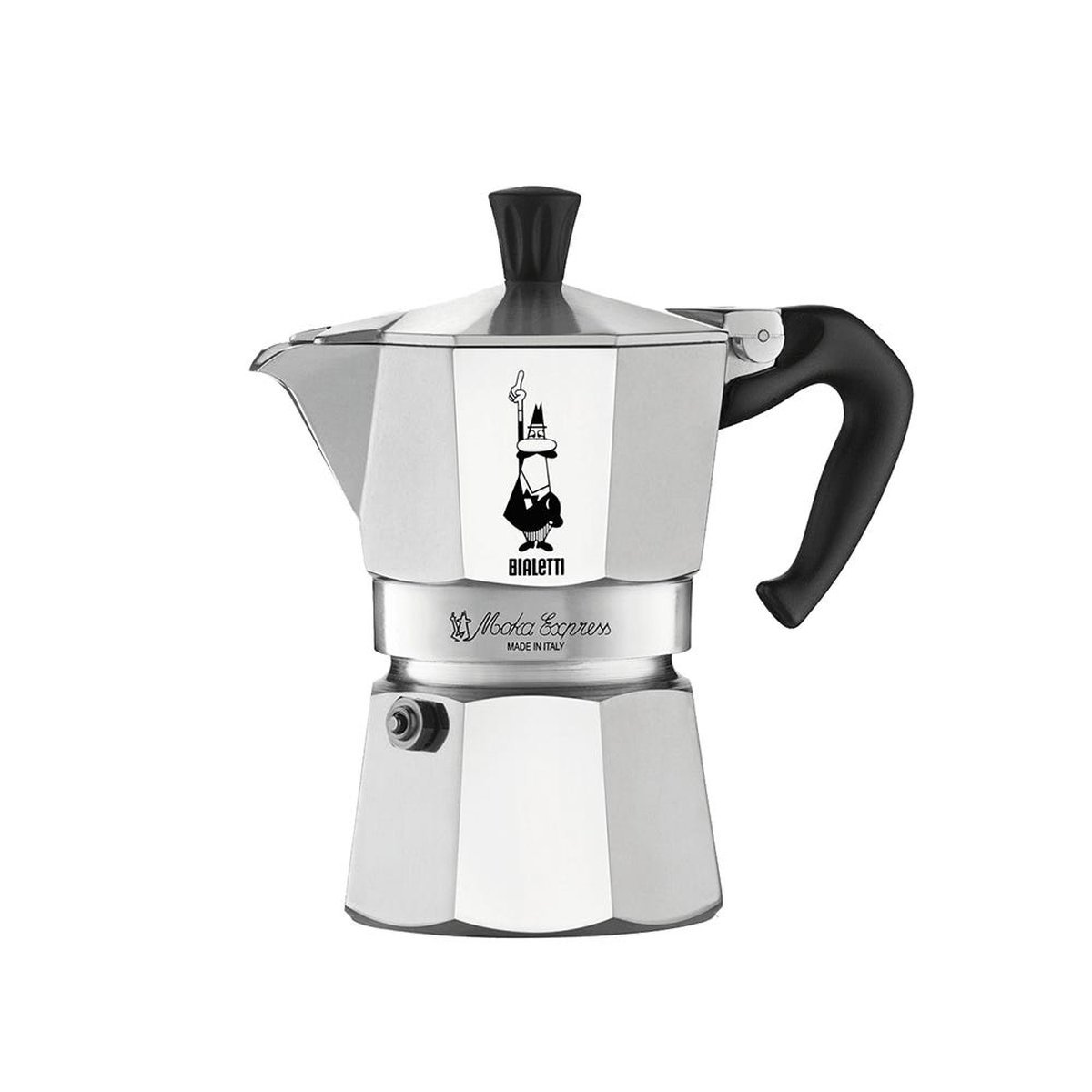
1. Bialetti Moka Express – Best All-Round for the Road
1. Bialetti Moka Express
The Moka Express turns up independently, and repeatedly, across Australian caravan and camping forums without anyone shilling it. One long-term owner reported a unit still going strong after nine years of gas-stove use, and another described a 27-year-old pot still producing what they called brilliant coffee. That is long-term evidence rather than a first-impression review.
It works on a gas stovetop, a portable gas burner or a campfire trivet, meaning it needs zero battery or inverter capacity at all, which is the simplest possible answer to the power question this whole list is built around. Australian Geographic’s own hands-on camp test backed up the forum enthusiasm.
The trade-off is a different drink to a pump espresso (no crema and a stronger, more concentrated result), and it is worth being direct that this only suits the stainless steel version. A glass-topped Moka is not the pick for a caravan.
Pros
- Multiple independent long-term Australian owners report units lasting decades of regular use
- Needs no battery, inverter or mains power at all and works anywhere there is a heat source
- Independently recommended, unprompted, across more than one Australian camping forum thread
Cons
- Produces a different drink to pump espresso: no crema, stronger and more concentrated
- Must be the stainless steel version for caravan use; glass-topped models are a poor fit for corrugated roads
For anyone new to this brewing method, my step-by-step moka pot guide covers the process in full.
2. AeroPress / AeroPress Go – Best for Consistent Travel Brewing

2. AeroPress / AeroPress Go
The AeroPress carries the strongest productreview.com.au evidence of any manual brewer in this list: 4.5 out of 5 from 46 reviews, with reviewers explicitly calling out travel use and comparing it favourably to a home pour-over setup.
The AeroPress Go variant is built specifically for this job, packing down to around 200 grams and nesting into its own mug, and it turns up recommended on the Grey Nomads Forum and in Australian grey-nomad targeted buying guides like Big Lap Bible alongside the more general enthusiasm.
The real limitation is that it makes one cup at a time and needs paper filters as an ongoing consumable, so it is worth packing a healthy stock before a remote trip where nothing is available to buy along the way.
Pros
- The strongest productreview.com.au rating and review volume of any manual brewer covered in this list
- The AeroPress Go variant is purpose-built for travel, compact and nests into its own mug
- Independently recommended on Australian grey-nomad forums, not just general coffee community sources
Cons
- One cup at a time only, not suited to brewing for a group quickly
- Needs paper filters as a consumable, so pack a spare supply for remote touring
3. Stainless steel French press – A Dedicated Vehicle-Power Option

3. Stainless steel French press
A stainless steel plunger is the default zero-skill fallback recommended independently on both the Grey Nomads Forum and Caravaners Forum: no dialling in required, just hot water and a few minutes.
The most important, repeated finding across multiple Australian sources is a durability warning: glass plungers are described as “famously” not surviving corrugated roads. This is not a generic complaint; it is specific to caravan and 4WD touring conditions and shows up unprompted in more than one independent source.
That makes the buying decision simple: stainless body and stainless or unbreakable plunger only; glass has no place in a caravan galley that is going to see any real dirt-road driving.
Pros
- Recommended independently across multiple Australian caravan and camping forums as the reliable no-power fallback
- No technique or dialling in required, forgiving for anyone in the group to use
Cons
- Glass versions are specifically and repeatedly named as a corrugation failure point, so stick to stainless for a caravan
- Produces a heavier-bodied cup with more sediment than a filtered method, not to everyone’s taste
4. OutIn Nano – Best Self-Heating 12V-Charged Pick

4. OutIn Nano
The OutIn Nano fixes the problem most 12V coffee gadgets never solved: it heats its own water. I charge it from the car or caravan 12V or 24V socket while driving (or from a USB-C power bank), then brew wherever I stop, with no inverter and nothing drawn from the house battery at the moment the coffee is made. It takes ground coffee in the standard basket or Nespresso Original capsules with the adapter, so the same supermarket pods that suit the Essenza Mini further down work here too.
OutIn quotes a 20 bar pump, a 200 second heat-up and up to five brews per charge starting from 50ml of room-temperature water. Independent testing lands a little lower. A three-month review on Camp Equipment Plus recorded 3 to 5 shots per charge from cold water and a 60 to 90 minute recharge. It also flagged the standard basket as small, at 50 to 80ml per shot, with the larger basket sold separately. The same reviewer found the espresso comes out hot enough to take milk, which is the complaint that sinks most manual portables.
I could not find a productreview.com.au listing or an Australian caravan forum thread for the Nano, so the evidence here is international testing, not local owner feedback. It suits a solo traveller or a couple with one espresso drinker. A group of three or four will empty a charge in one morning, and on a long off-grid stretch you are relying on driving days to top it up. Compared with the Handpresso Auto further down, it gives up plug-in brewing in exchange for battery freedom.
Pros
- Heats its own water and charges from a 12V or 24V socket, so no inverter is needed at brew time
- Takes ground coffee or Nespresso Original capsules, and testers report the shot comes out properly hot
Cons
- Only 3 to 5 shots per charge from cold water in independent testing, with a 60 to 90 minute recharge
- No productreview.com.au listing or Australian owner reports yet, and the larger basket costs extra
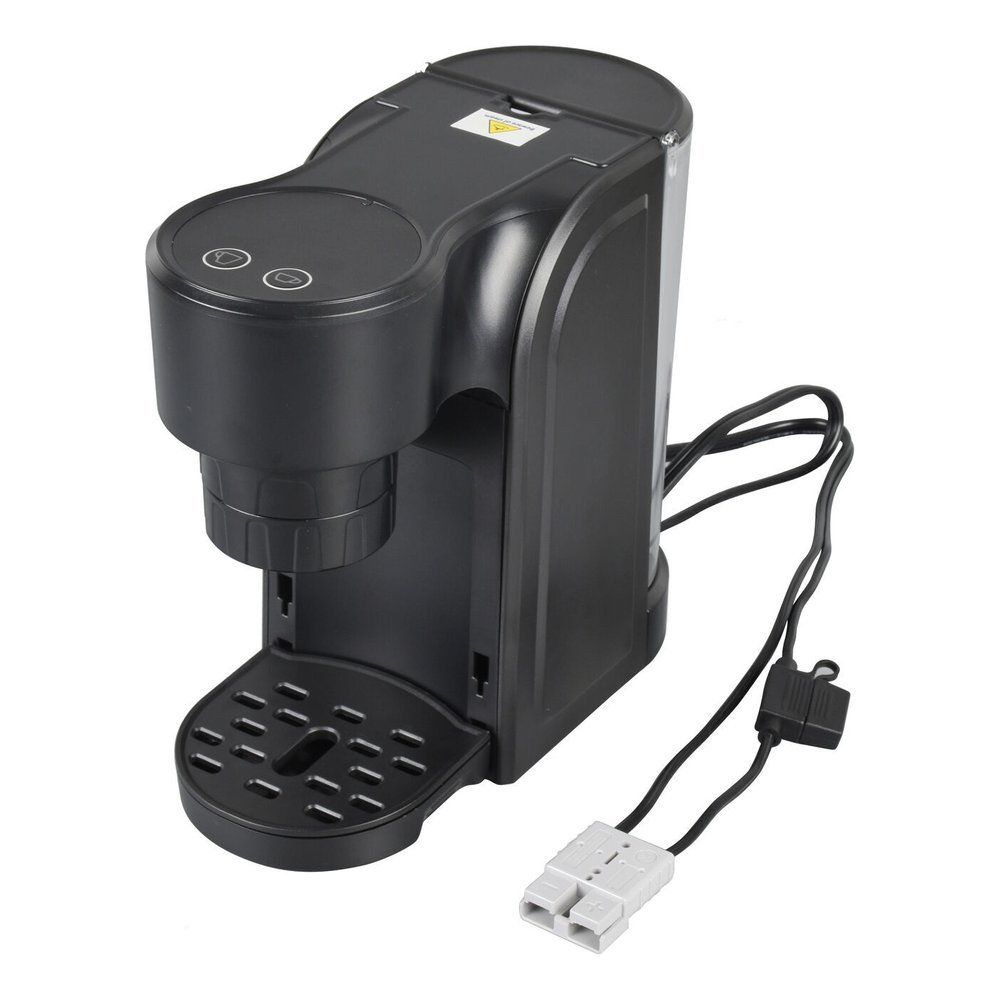
5. 12V Direct 12V pod coffee machine – A Dedicated Vehicle-Power Option
5. 12V Direct 12V pod coffee machine
This is a purpose-engineered 12V machine rather than an adapted home appliance, running 350 watts through a proper 50 amp Anderson connector with a 40 amp fuse, the kind of wiring detail that suggests real vehicle-power engineering rather than an inverter workaround.
Its 550ml tank and Nespresso-compatible pod or ground coffee capability make it more flexible than most single-format options on this list, and it is sold directly and through rebadged listings from other 12V accessory suppliers, suggesting steady niche demand behind it.
The honest gap is independent evidence: beyond one complaint that it only allows two pods before entering a ten-minute heating mode, this sweep found no productreview.com.au listing or multi-owner forum thread. The specs look right for the job, but independent verification is limited.
Pros
- Properly engineered for 12V vehicle power, not a 240V machine adapted with an inverter
- Accepts Nespresso-compatible pods or ground coffee, more flexible than most single-format picks here
Cons
- No independent multi-owner review or forum thread found; evidence here is mostly retailer specification copy
- One sourced complaint describes a ten-minute heating cool-down after only two pods
Whichever pod format you land on, my guide to using a pod coffee machine and pod machine cleaning guide both apply directly on the road.
6. Aldi pod coffee machine – Best Budget Pick for Powered Sites

6. Aldi pod coffee machine
When Aldi runs its pod coffee machine as a Special Buy, it gets recommended independently across multiple Grey Nomads Forum and Caravaners Forum threads without any prompting, which points to real grassroots consensus rather than a single enthusiastic review.
Forum language is consistently modest but positive: “pretty good coffee,” “good enough,” and “at that price you can’t go wrong,” the kind of measured praise that reads as sincere rather than promotional.
The catch is that it runs on 240V mains or an inverter rather than being a true 12V design, so it belongs on a powered caravan park site or a rig with a properly sized inverter and battery bank, not as a set-and-forget off-grid solution.
Pros
- Recommended independently and repeatedly across multiple Australian caravan forum threads
- Low upfront cost with consistently modest, believable praise rather than hype
Cons
- Runs on mains or inverter power, not a true 12V design, so it needs a powered site or a properly sized battery setup
- Intermittent Special Buy stock means it is not always available to purchase new
7. Nespresso Essenza Mini – Best Compact Pick for Powered Sites

7. Nespresso Essenza Mini
The Essenza Mini is named directly as caravan-suitable in the Australian grey-nomad targeted Big Lap Bible buying guide, praised for its compact footprint, fast heat-up and consistent shot with effectively zero technique required.
One buyer quote found was explicit about the intended use: bought specifically to take along in the trailer for camping, which is real if limited direct evidence of caravan-context satisfaction.
Like the Aldi machine above, it needs 240V mains or an inverter rather than being 12V-native, and its small rear water tank is harder to monitor at a glance. Both are general complaints beyond the caravan-specific context worth knowing about either way.
Pros
- Directly named as caravan-suitable in an Australian grey-nomad targeted buying guide
- Easily one of the smallest-footprint pod machines available, easy to fit in a caravan galley
Cons
- Needs mains or inverter power, not a true 12V design
- Small rear water tank is harder to monitor and top up than a front-loading design
8. Wacaco Nanopresso / Minipresso NS – Widely Marketed, Mixed Real Reviews

8. Wacaco Nanopresso / Minipresso NS
This is the most heavily marketed “camping espresso” product in the category, and it deserves an honest flag rather than blanket praise. On productreview.com.au, the Minipresso NS sits at 2.7 out of 5 from 16 reviews with half of those negative, and the Nanopresso at 3.3 from just 4 reviews.
Named complaints include seals failing after around six months, plastic cracking under hand-pump pressure, and at least one report of boiling water leaking from loose threads causing a scald. Against that, some long-term owners, one 18 months in, do call it a very good single shot for travel.
Its 80ml tank (140ml with the Barista Kit accessory for the Nanopresso) needs no power at all, a real advantage, but this is the clearest hype-versus-reality gap in this entire list and buyers should go in with that expectation set correctly rather than assuming the marketing photos match typical ownership.
Pros
- Needs no power source at all and packs down smaller than almost anything else on this list
- Some long-term owners do rate it well for a single travel shot
Cons
- Real, sourced complaints of seal failure, plastic cracking and at least one scalding leak report
- The most heavily marketed product in this category has the weakest average real-owner satisfaction of anything on this list
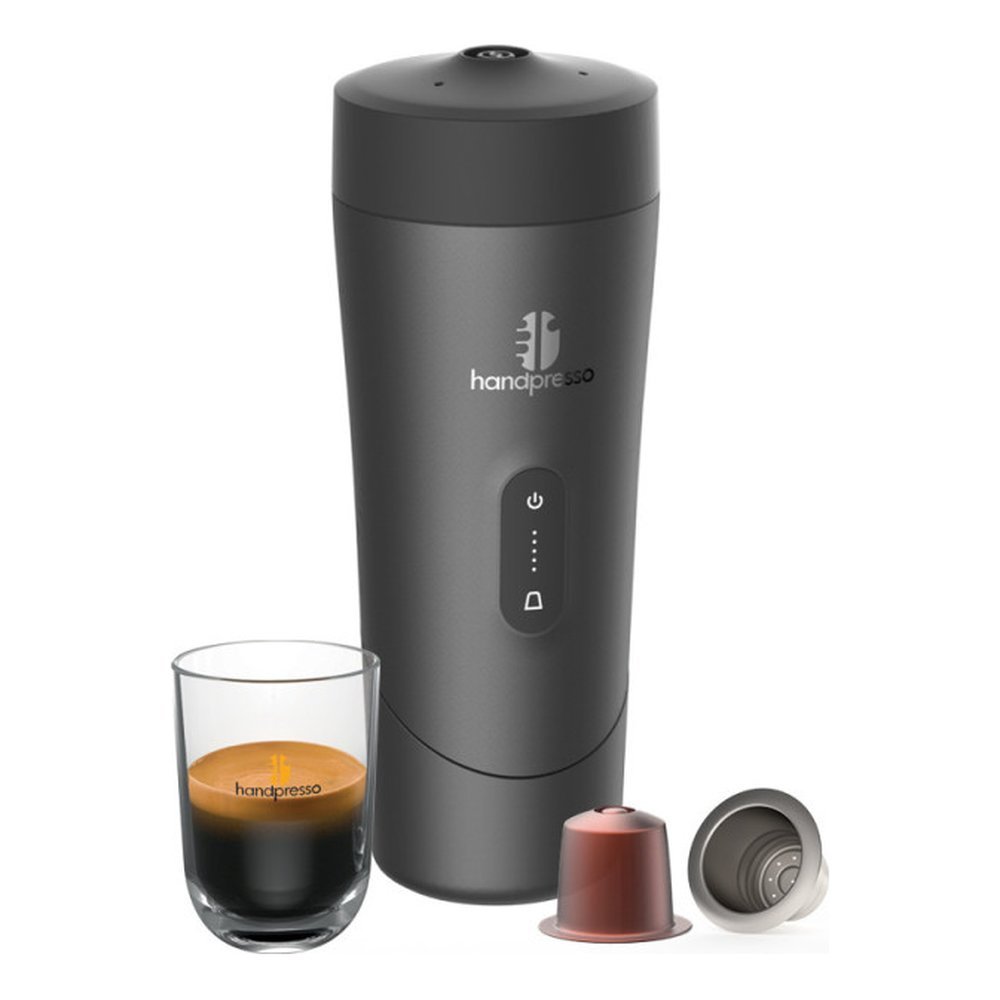
9. Handpresso Auto – A Dedicated Vehicle-Power Option
9. Handpresso Auto
The Handpresso Auto is a true 12V/24V machine, running directly off a cigarette lighter socket at around 16 bar and ready in roughly two and a half minutes. That is proper vehicle-power engineering rather than an inverter workaround, and it is sold in Australia through a specialty importer.
International reviews describe it as well built, easy to use and capable of a consistent shot, with two specific, real complaints: filling the tank is awkward because there is no level indicator, and the pressurising phase is loud.
The honest gap is that no Australian caravan or camping forum discussion of this specific product turned up in this research. The engineering fits the brief well, but real Australian owner evidence is essentially absent, which is worth knowing before treating it as forum-tested.
Pros
- True 12V/24V vehicle-power engineering, no inverter required
- International reviews consistently describe solid build quality and a consistent shot
Cons
- No level indicator on the water tank makes filling awkward by feel
- No Australian caravan or camping forum discussion of this specific product was found in this research
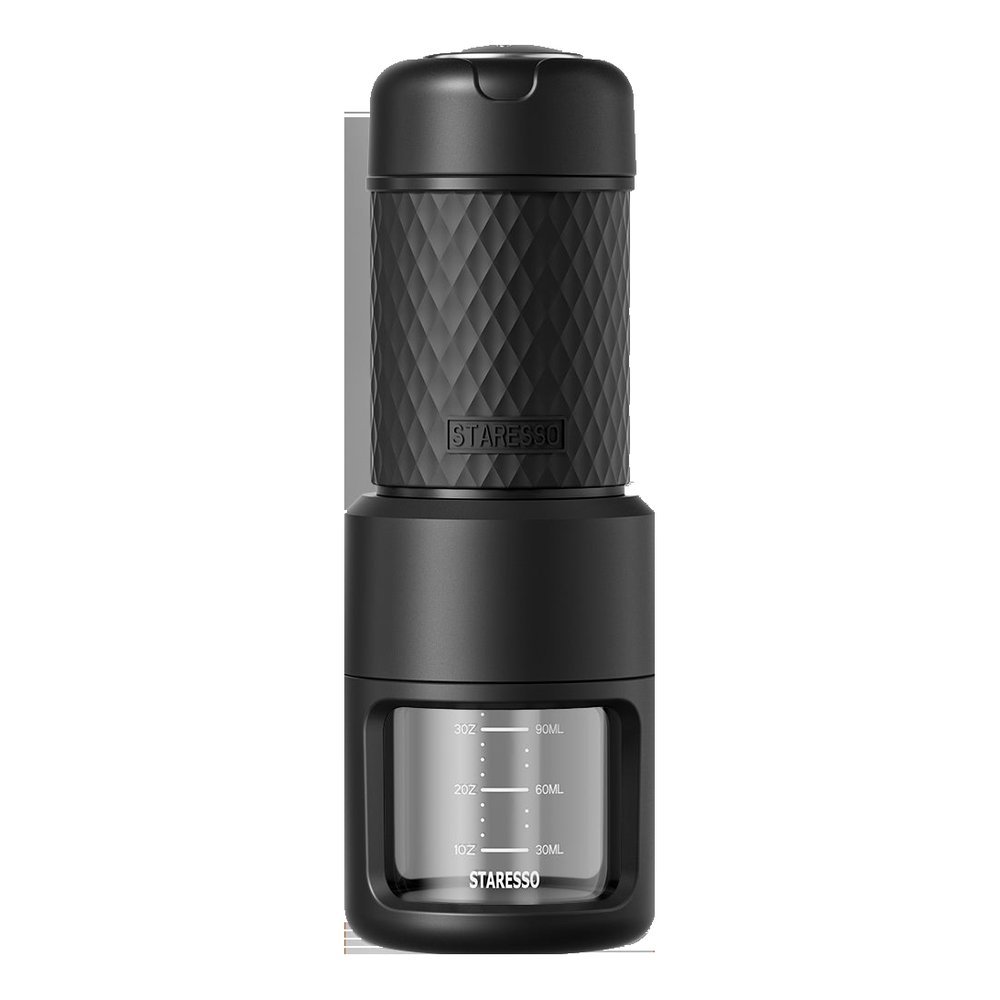
10. Staresso – Alternative Manual Pick
10. Staresso
Staresso is a manual hand-pump espresso maker running 15 to 20 bar of pressure with no power source needed at all, and general reviews describe its build quality as noticeably more premium than cheaper handheld brewers in the same space.
At around 450 grams it packs easily into a caravan cupboard, and the main long-term wear point named in general reviews is the gaskets and seals, typically after six to twelve months of regular use, which is worth knowing before relying on it exclusively for a long trip.
As with the Handpresso above, no Australian caravan-specific forum mention turned up in this research. It earns its spot as a readily purchasable manual alternative to the Wacaco range above, not because its Australian reputation has been independently tested.
Pros
- General reviews consistently describe noticeably more premium build quality than cheaper handheld alternatives
- Compact and needs no power source, packs easily into a caravan cupboard
Cons
- Gaskets and seals are the named long-term wear point, typically after six to twelve months
- No Australian caravan or camping forum evidence was found for this specific product in this research
How to Choose a Coffee Machine for Your Caravan
Work out whether you actually have 12V power to spare, or an inverter big enough for a mains machine. A true 12V machine draws directly off your battery for a short burst per cup with no conversion loss. Running an ordinary 240V machine through an inverter is a much bigger ask of your battery bank: one caravan power supplier calculates a typical 1300W pod machine at roughly 108 amps at 12V, which is worth checking against your own battery and inverter capacity before assuming any mains machine will simply work.
Match the brewer to how remote you actually travel. A manual brewer that needs no power at all, the Bialetti or a stainless plunger, is the safest choice for very remote touring where a flat battery or a broken 12V machine has no fallback. Powered options make more sense for caravan-park-based travel where you are regularly on mains power anyway.
Think about water tank size against your onboard tank capacity. Manual brewers and single-shot pod machines use a fraction of the water a home drip machine would, which is a clear advantage when you are also conserving tank water for washing and drinking. If you are shopping for a home machine as well as a travel one, my best espresso machines and fully automatic coffee machines roundups cover the fixed-kitchen side of that decision.
Keep Your Machine Running
A pod machine that only sees occasional use on trips still needs regular cleaning to avoid mould and residue buildup in a warm caravan. My pod coffee machine cleaning guide covers the routine, and applies just as well to a 12V or compact 240V pod machine as a kitchen-bench one.
New to brewing with a moka pot before you head off? Read my step-by-step moka pot guide at home first; it is a much easier method to dial in on a stable kitchen stovetop than for the first time on the road.
Milk on the road is usually UHT or powdered rather than fresh, and getting a decent froth without a full espresso machine’s steam wand is its own skill. My guide to frothing milk without a frother covers exactly that scenario.
Frequently Asked Questions
Can I run a normal coffee machine off my caravan battery?
Only through a properly sized inverter, and even then it is a heavy load: a typical 1300W mains machine can draw over 100 amps at 12V. A true 12V-native machine, or a manual brewer that needs no power at all, is a far more realistic choice for most caravan battery setups.
What is the best no-power coffee option for camping?
A stainless steel Bialetti moka pot has the strongest Australian forum evidence in this category, working on any gas source with no battery involved at all. A stainless French press and the AeroPress are both close seconds, with the AeroPress carrying the strongest productreview.com.au rating of any manual brewer checked.
Why does everyone say not to bring a glass French press or Nespresso in a caravan?
Corrugated dirt roads on routes common to Australian touring have repeatedly been named across independent forum sources as a recurring failure point for glass gear, not a one-off complaint. Stainless steel or unbreakable equivalents survive the same conditions far better and are the safer pack for any remote trip.
Are 12V coffee machines actually good, or just a novelty?
Purpose-built 12V machines with proper wiring, like the 12V Direct pod machine, run without an inverter, although independent owner evidence is still thin. Battery machines such as the OutIn Nano charge from a 12V socket and brew off their own battery, at the cost of only 3 to 5 shots per charge. Manual hand-pump devices marketed heavily as camping espresso makers, the Wacaco range specifically, have far more mixed real owner satisfaction despite the marketing.
Is Aldi’s pod coffee machine actually worth buying for caravan use?
Australian grey-nomad forums recommend it independently and repeatedly when Aldi stocks it as a Special Buy, with consistently modest, believable praise. It runs on mains or inverter power rather than true 12V, so it suits caravan-park-based travel more than fully off-grid touring.
How much water does a caravan coffee maker actually use?
A single-cup manual brewer or pod machine uses a small fraction of what a home drip machine would, generally well under 100ml of fresh water per cup, a real advantage when you are also budgeting tank water for washing and drinking on the road.
Verdict
The Bialetti Moka Express leads for remote touring
For most caravan and camping trips, a stainless Bialetti Moka Express is the safest, most consistently evidenced pick: it needs no battery power and survives corrugations that break glass gear. If you specifically want vehicle-powered convenience without an inverter, the OutIn Nano charges from the 12V socket while you drive and brews off its own battery, as long as 3 to 5 shots per charge covers your morning. For caravan-park-based travel where mains or a solid inverter is reliably available, the Aldi pod coffee machine remains the grassroots-recommended budget choice.
