

A French press, what most Australians actually call a coffee plunger, is a cylindrical jug with a mesh-and-rod plunger that steeps ground coffee directly in hot water before pressing the grounds to the bottom. There is no pump, no boiler, no electricity at all, which is exactly why finding the best French presses in Australia comes down to a much narrower set of questions than picking an espresso machine: is the carafe glass or metal, does the mesh actually stop grounds getting into your cup, and will the thing survive being bumped on a tap. The number worth knowing before you buy one is 4, as in 4 minutes, the standard steep time most brands and baristas agree on before you press, since steeping too long is the single biggest reason plunger coffee turns out bitter. This guide covers five coffee plungers actually sold in Australia, chosen because they represent real, different answers to the glass-versus-metal and budget-versus-premium questions, not because I could pad a list to ten.
Coffee plungers split into two practical types. Glass-carafe presses, like the classic Bodum Chambord, show you exactly what’s brewing and cost less, but a bump against a tap or a cold splash of water on a hot glass can crack them. Stainless steel presses, like the Bodum Columbia, cost more and hide the brew from view, but they survive a share house, a caravan or a toddler-filled kitchen in a way glass never will. If a plunger feels like too much hands-on brewing for your morning, my guide to choosing the best coffee machine covers the automatic alternatives.
Here is the honest limitation of this particular sweep: coffee plungers barely get reviewed in Australia at all. The entire productreview coffee plunger and French press category sits at roughly a dozen total reviews across every brand and model combined, nothing like the hundreds you will find for even a mid-range espresso machine. That is not this sweep cutting corners; it is what happens when a product is a cheap glass jug with no moving parts to break in the first year, so almost nobody thinks to leave a review. Where the productreview.com.au evidence ran out, I turned to CoffeeSnobs forum discussion among Australian brewing enthusiasts, which is a real, useful secondary source for this specific category, and I have said exactly which evidence backs which pick throughout.
The Bodum Chambord is the most-reviewed and safest starting point among Australian coffee plungers, but its real complaints about fragile glass and a gritty mesh filter are worth knowing before you buy; if durability matters more than tradition, the stainless steel Bodum Columbia is the pick CoffeeSnobs forum members specifically praise for lasting over a decade.
Best French Presses Australia: How the 5 Compare
| Product | Type | Best For | Key Spec |
|---|---|---|---|
| Bodum Chambord | Glass, classic | Most-Reviewed Classic | 3.2/5 from 6 reviews |
| Bodum Columbia | Stainless steel, insulated | Durability | CoffeeSnobs-endorsed, no AU rating yet |
| Espro P7 | Stainless steel, double micro-filter | Grit-Free Coffee | CoffeeSnobs-endorsed, no AU rating yet |
| Bodum Brazil | Glass, plastic frame | Budget Bodum | 5.0/5 from 3 reviews |
| Kmart 8 Cup Coffee Plunger | Glass, budget | Cheapest Option | 4.0/5 from 1 review |
How I Compared It
I checked productreview’s coffee plunger and French press category directly, then supplemented it with CoffeeSnobs forum discussion specifically about glass-versus-metal plunger durability among Australian coffee enthusiasts, since productreview’s own sample for this category is too thin to lean on alone. I confirmed every pick is currently sold new in Australia through a mainstream retailer or specialty coffee shop before including it.
1. Bodum Chambord – Best Overall Evidence
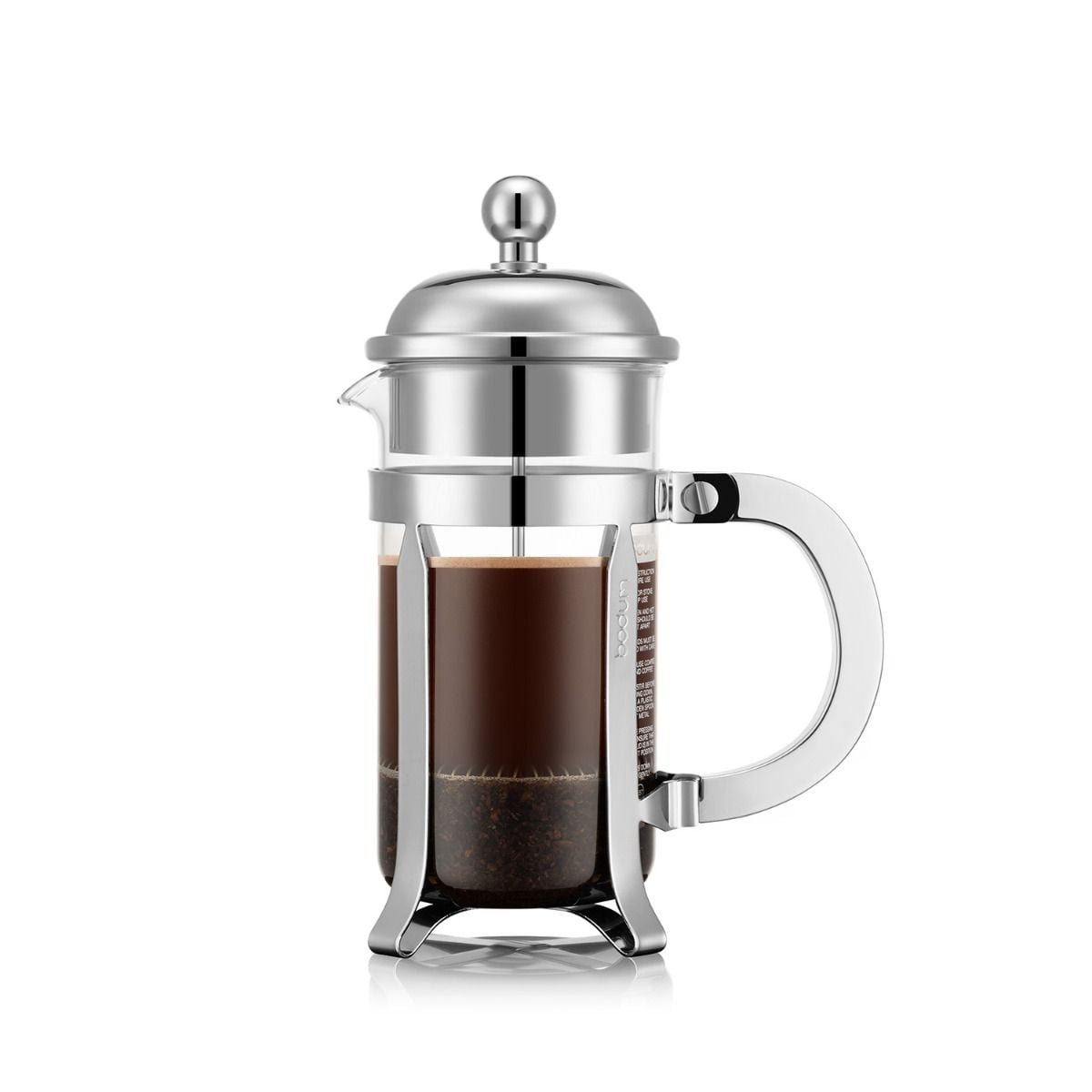
The Chambord is the plunger most people picture when they hear “French press”: chrome frame, glass carafe, the design Bodum has sold largely unchanged since the 1950s. It sits at 3.2 out of 5 on productreview reviews, a small sample but still the largest and most balanced one in this entire category, with reviewers praising the coffee quality, the rust-resistant frame, and how easily the whole thing comes apart for a proper clean in the dishwasher.
The complaints are specific enough to take seriously instead of shrugging off. Reviewers describe the glass as fragile, more like “thin wine glass” than something built for daily kitchen use, and several report the mesh filter letting through more grounds than expected, leaving gritty sediment at the bottom of the cup. One reviewer also mentioned the wire mesh edges are sharp enough to nick a finger while cleaning, so it is worth a moment’s care rather than a rushed rinse.
Against the Columbia below, this is the pick for someone who wants to see the brew happening and doesn’t mind a bit of extra care with the glass; if you have ever broken a French press on the edge of a sink, skip straight to the stainless steel option instead.
Pros
- Largest, most balanced Australian review sample in this category (6 reviews)
- Fully dishwasher-safe, unusual for a plunger with a metal frame
- Chrome frame resists rust and tarnish over years of use
Cons
- Glass carafe reported as fragile, thinner than expected
- Mesh filter can let noticeable grounds through into the cup
- Wire mesh edges can be sharp enough to nick a finger during cleaning

2. Bodum Columbia – Best for Durability
The Columbia swaps Chambord’s glass for a fully double-walled stainless steel body, insulated enough to keep coffee hot for close to two hours and cool enough to the touch that you don’t need a coaster underneath it. It does not yet have its own Australian review page on productreview.com.au, so I am not going to invent a star rating for it. What I do have is a specific, named account from an Australian CoffeeSnobs forum thread on non-glass plungers, where one member reported owning a double-walled Bodum for around fifteen years, describing it as reliable daily equipment rather than a novelty purchase.
Stainless steel brings its own trade-off: you cannot see the coffee steeping, so getting the timing right depends on a clock instead of a glance at the colour. It also costs meaningfully more than the glass Chambord of the same capacity, and the insulated double wall means it is bulkier to store than a single-wall glass carafe.
Compared with the Espro below, this is the simpler stainless option without a specialised filter system, a straightforward metal replacement for a glass plunger instead of a filtration upgrade.
Pros
- Cannot break the way a dropped glass carafe can
- An Australian CoffeeSnobs member specifically reports 15 years of reliable daily use
- Insulated double wall keeps coffee hot far longer than glass
Cons
- No dedicated Australian productreview.com.au rating exists yet to verify against
- You cannot see the brew, so timing relies on a clock instead of colour
- Costs noticeably more than an equivalent glass Chambord

3. Espro P7 – Best for Grit-Free Coffee
The Espro P7 exists specifically to fix the gritty-sediment complaint that shows up repeatedly against the Chambord above. Instead of a single mesh disc, it uses a patented double micro-filter, two nested layers of fine mesh, which is the exact feature Australian CoffeeSnobs forum members singled out when recommending it over a standard plunger, with one describing results as “better once you get used to it” and another noting replacement filters remain available so the press can actually last for years instead of being thrown out when a seal wears.
It is a specialty item, not a supermarket purchase. You will find it through dedicated Australian coffee retailers like Coffee Parts and Alternative Brewing instead of Kmart or Big W, and it costs several times what a Chambord does. There is no productreview.com.au listing for it yet, which is worth stating plainly instead of papering over with a borrowed international rating.
If the Chambord’s gritty cup is the reason you’re shopping for an upgrade in the first place, this is the plunger built to solve exactly that problem, at a real price premium over the Columbia’s more straightforward stainless design.
Pros
- Double micro-filter specifically addresses the grit complaint common to standard plungers
- Replacement filters sold separately, extending the press’s real lifespan
- Specifically recommended by name on Australian enthusiast forums
Cons
- No Australian productreview.com.au data exists to verify broader owner sentiment
- Only sold through specialty retailers, not a same-day supermarket buy
- Costs several times more than a basic glass plunger
4. Bodum Brazil – Budget Bodum
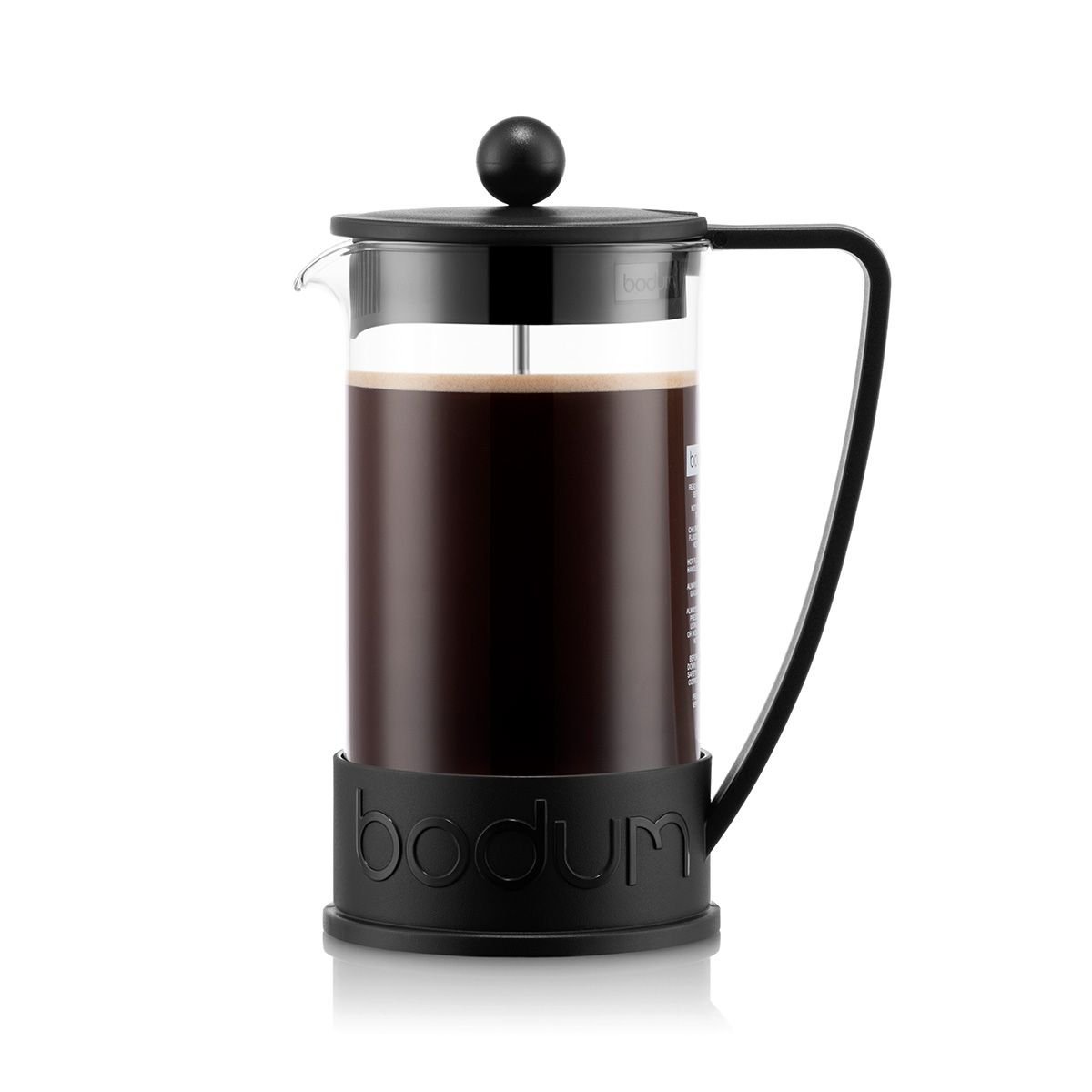
The Brazil is Bodum’s answer to its own Chambord at a lower price, a plastic frame in place of chrome-plated metal, holding the same glass carafe and mesh plunger underneath. It rates 5.0 out of 5 on productreview.com.au, but from only 3 reviews, a sample too thin to call this a confident win over the Chambord; treat the perfect score as encouraging instead of proven.
What the plastic frame buys you is a lower price for the Bodum name and the same brewing mechanics as the Chambord, without the chrome finish or quite the same shelf presence. It is a sensible pick if you want a Bodum specifically, for the brand’s reputation on parts availability and filter replacements, but do not want to pay chrome-frame prices.
Next to the Kmart plunger below, the Brazil sits in the middle: still a recognised brand with spare parts available, at a price closer to supermarket territory than specialty-store territory.
Pros
- Authentic Bodum build quality and spare-parts support at a lower price than the Chambord
- Same glass-and-mesh brewing mechanics as the more expensive model
- 5.0/5 rating, though from a small sample
Cons
- Only 3 productreview.com.au reviews, too thin to call it a confident win over the Chambord
- Plastic frame lacks the Chambord’s chrome finish and heft
- Still a glass carafe, so the same fragility concerns apply

5. Kmart 8 Cup Coffee Plunger – Cheapest Option
Realistically, this is the plunger the largest number of Australians actually own, priced low enough that Whirlpool Forums members casually mention it as the default cheap answer to “what plunger should I buy.” It has exactly one review on productreview.com.au, rating it 4 out of 5, with the reviewer praising the value at the price and noting it survives boiling water without complaint. One review is barely evidence at all, and I am saying so directly rather than dressing a single data point up as a verdict.
A Whirlpool Forums thread on plunger durability adds a relevant, if unflattering, general point instead of a Kmart-specific one: a metal plunger rod will gradually scratch the inside of any glass carafe over years of use, budget or premium, which is one reason enthusiasts on CoffeeSnobs increasingly move to stainless steel. At this price, that wear is easy to accept and cheap to replace when it happens.
If you just want to know whether plunger coffee suits you before spending real money on a Chambord or an Espro, this is the honest place to start, with eyes open to how little formal evidence backs it either way.
Pros
- The cheapest way to find out if plunger coffee suits you at all
- Handles boiling water without issue, per its one available review
- Widely stocked in Kmart stores across Australia, easy to replace if it breaks
Cons
- Only 1 productreview.com.au review exists, far too thin to draw any real conclusion
- Metal plunger rod will scratch the glass over years of regular use
- No specialised filter, so expect a similar grit result to a basic Chambord
How to Choose a Coffee Plunger in Australia
Decide on glass or stainless steel before you compare brands. Glass shows you the brew and costs less, but it is properly breakable, a real concern if you’re buying for a share house, a caravan, or a kitchen with kids. Stainless steel like the Columbia or Espro costs more and hides the process, but it will still be working after the glass options have gone through two or three replacements.
Match the grind to the plunger, not the other way around. A coffee plunger needs a coarse grind, roughly the texture of sea salt; anything finer slips through the mesh and ends up as sediment at the bottom of your cup, which is the single most common complaint against every plunger on this list, expensive or cheap. If you’re curious how this compares to what an automatic machine does with the same beans, my explainer on how a coffee machine works covers the mechanical side of extraction.
Australia-specific: A coffee plunger is one of the few brewing methods that actually suits Australian outdoor and travel life: no power point needed at a campsite, on a boat, or during a blackout after a summer storm. If that is the main use case, buy stainless steel over glass; a cracked carafe halfway through a camping trip from Byron Bay to the Great Ocean Road is a much bigger problem than at home, and a metal plunger like the Columbia will survive being packed next to camping gear in a way glass simply will not. Retail availability also varies a little by state: specialty options like the Espro are easiest to find through coffee-focused retailers based in Melbourne and Sydney, while Bodum and Kmart’s glass options are stocked in stores from Perth to Brisbane and Adelaide without any trouble.
Keep Your Coffee Plunger Brewing Well
A coffee plunger needs almost no maintenance, but the little it does need matters for taste. Rinse the mesh filter thoroughly after every use; old coffee oils trapped in the fine mesh turn rancid faster than most people expect and will taint the next brew, even in a dishwasher-safe model. Replace the rubber or silicone seal around the plunger disc every year or two once it stops sealing tightly, since a worn seal is the real reason a once-good plunger starts letting through more grounds than it used to.
If you grind your own beans for a plunger instead of buying pre-ground coffee, my guide to cleaning a coffee grinder covers keeping stale oils out of the burrs, which matters even more for a coarse plunger grind than it does for espresso.
Frequently Asked Questions
What is the best French press in Australia?
The Bodum Chambord has the most balanced Australian review evidence at 3.2 out of 5 from 6 productreview.com.au reviews, making it the safest starting point. For durability, Australian CoffeeSnobs forum members specifically recommend the stainless steel Bodum Columbia, which has no formal Australian rating yet but a strong enthusiast reputation.
Is a French press the same as a coffee plunger?
Yes, they are the same device. French press is the international name, while coffee plunger is the term most commonly used in Australia and New Zealand for the same cylindrical jug with a mesh-and-rod plunger. You will see both terms used interchangeably on Australian retail sites and packaging, so it is worth searching for either one.
Why does my French press coffee taste gritty?
Gritty sediment usually means your grind is too fine for the mesh filter to catch, or the mesh itself has gaps that let fine grounds through, a specific complaint reported against the Bodum Chambord. Using a coarser, sea-salt-textured grind or switching to a double micro-filter design like the Espro P7 both address this directly.
Should I buy a glass or stainless steel coffee plunger?
Glass lets you watch the brew and costs less, but it is truly breakable, a real risk in a share house, caravan, or kitchen with kids. Stainless steel options like the Bodum Columbia cost more and hide the brewing process, but they survive the kind of bumps that crack a glass carafe.
How long should I let coffee steep in a plunger?
Four minutes is the standard steep time most brands and baristas recommend before pressing down. Steeping longer is the most common reason plunger coffee turns out bitter, since the grounds keep extracting the whole time they sit in the hot water, well past the point of good flavour.
Is the Kmart coffee plunger any good?
It has only one real Australian review on productreview.com.au, rating it 4 out of 5 for value and handling boiling water well, which is far too thin a sample to call it reliably good or bad. It is a reasonable way to test whether plunger coffee suits you before spending more on a Chambord or Espro.
The Chambord is the safe classic, the Columbia the durable upgrade, and the Kmart plunger the honest way to test the waters
For most Australian buyers, the Bodum Chambord remains the sensible default on the strength of its comparatively larger review base, provided you handle the glass carefully and expect some grounds in the cup. If durability matters more than tradition, especially for a share house or camping trip, the stainless steel Bodum Columbia is the pick Australian enthusiasts specifically vouch for, and the Espro P7 goes further still for anyone chasing a properly grit-free cup. The Kmart plunger remains the cheapest, lowest-risk way to find out if any of this suits you before spending more.
