

Key takeaway: A Smeg ECF01 manual espresso machine and a Smeg BCC02 bean-to-cup machine are used in almost opposite ways: the ECF01 needs you to tamp ground coffee or a soft pod into a portafilter and work a steam knob by hand, while the BCC02 grinds whole beans and pours a finished drink at the touch of one button. Fill the tank, load coffee or beans, wait for the machine to say it’s ready, then follow whichever set of steps below matches the model on your bench.
To use a Smeg coffee machine, the first thing to work out is which of Smeg’s two genuinely different machine types you actually own. On the manual ECF01, you fill the tank, tamp ground coffee or a soft pod into the portafilter, lock it into the group head, and press the one-cup or two-cup button, then work the steam knob by hand to froth milk. On the automatic BCC02, you fill the tank and the bean hopper, let it warm up and run its own self-clean, then press one button for the drink you want. Neither one is hard to use once you know which buttons belong to which machine.
Get those first two fills right, the water and the coffee, and both machines do most of the rest of the work themselves. Where people get stuck is usually mixing up the two workflows: trying to tamp coffee into a machine that grinds its own beans, or expecting a manual machine to remember a drink size the way the BCC02 does.
1. Which Smeg Coffee Machine Do You Have?
Look at the front panel. If you see three round buttons and a separate steam knob you turn by hand, with no bean hopper anywhere on top, that’s the manual espresso range, badged ECF01 on older units and ECF02 on Smeg Australia’s current online range. If you see a lidded hopper for whole beans and a row of icon-labelled buttons that light up white or orange, that’s the automatic BCC range, and specifically the BCC02 if it also has a steam wand for milk, or the BCC01 if it doesn’t.
| Feature | ECF01 (manual espresso) | BCC02 (bean-to-cup) |
|---|---|---|
| Coffee input | Ground coffee or a coffee soft pod, tamped into a portafilter | Whole beans only, ground fresh by the built-in grinder |
| Water tank | 1 litre | 1.4 litres |
| Control panel | Three buttons (one cup, two cups, steam) plus a manual steam knob | One-touch buttons across a White and an Orange menu, 8 drinks total |
| Milk frothing | Manual steam wand, you move the jug by hand | Automatic steam wand, same manual jug movement for texture |
| Ready to brew after | Lights stop flashing and stay lit steadily | Heats up, then runs an automatic self-clean cycle |
Smeg’s own Australian site currently lists the manual espresso range under the ECF02 name rather than ECF01, and the automatic range under both the BCC01 and BCC02 depending on whether you want milk frothing built in. The steps below are verified against Smeg’s own ECF01 and BCC02 manuals, since that’s the pairing most Australian kitchens still have. The ECF02 keeps the same three-button-plus-steam-knob layout with an updated steam wand, so most of the ECF01 steps carry across, but check your own manual if a button press or light colour doesn’t match what’s below.
Model-scope note: the steps in this guide are verified against Smeg’s own ECF01 and BCC02 manuals for the Australian market, the two most common Smeg coffee machines in home kitchens here. Smeg’s range has included other models over the years, including the ECF02 successor and the BCC01 without milk frothing, and button layouts, light colours and hold-down timings can differ between them. If a step here doesn’t match what your machine actually does, check the manual that came with your specific model rather than assuming it’s identical.
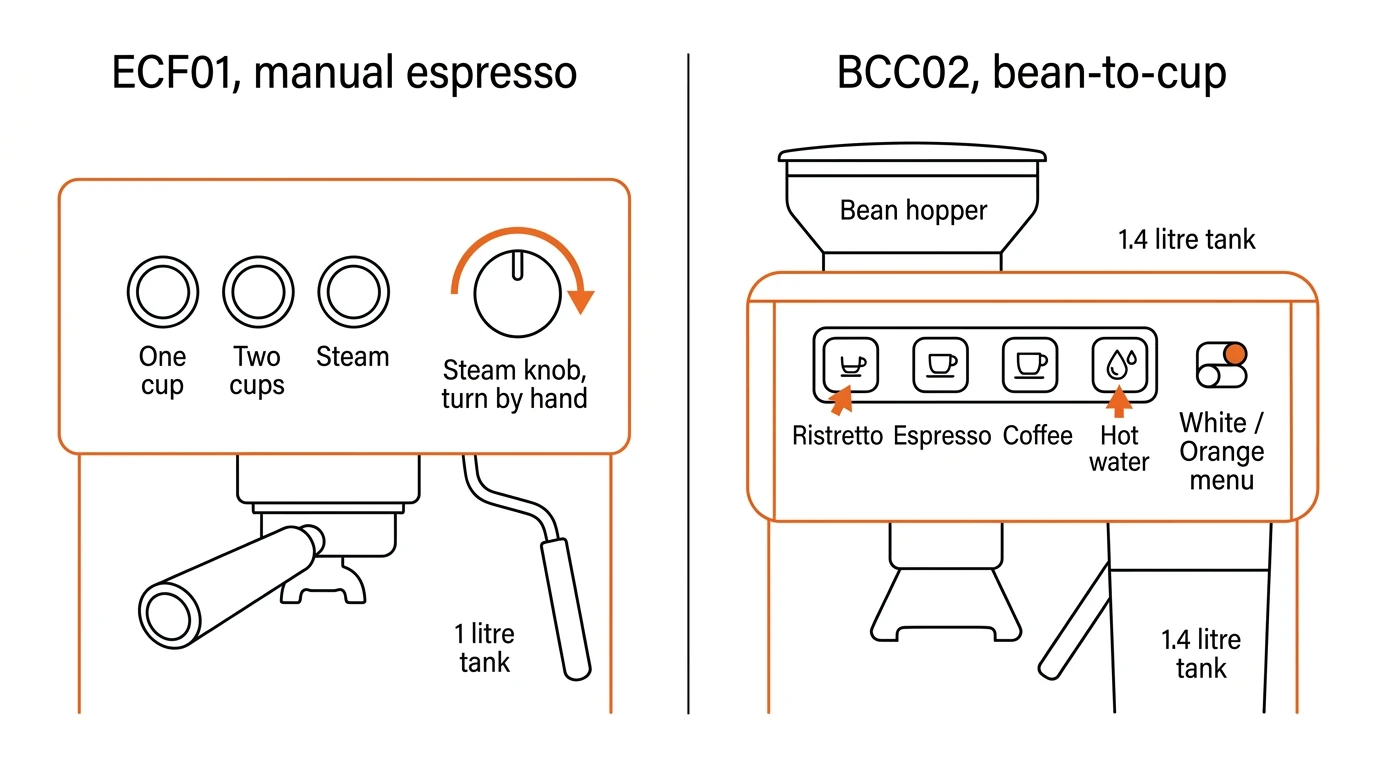
2. How to Use a Smeg ECF01 Manual Espresso Machine
Fill the tank with cool tap water up to the marked maximum, then switch the machine on. The three buttons flash in sequence while it warms up, and settle into a steady light once it’s ready to brew. On first use, or after it’s sat idle a while, run about 100 mL of water through the steam nozzle and five short bursts through the group head with no coffee loaded, which clears the internal circuit before your first real cup.
- Choose your filter and load the coffee. Fit the one-cup or two-cup ground coffee filter into the portafilter, or swap in the soft pod filter if you’re using a round coffee soft pod rather than ground coffee. One level scoop (roughly 7 grams) suits one cup, two level scoops suit two.
- Tamp it down with the supplied scoop, firmer for a stronger coffee and lighter for a milder one, then wipe any loose grounds from the rim so the portafilter seals properly.
- Lock the portafilter into the group head, lining the handle up with the unlock mark and turning it firmly to the right until it’s seated.
- Sit your cup under the spouts and press the one-cup or two-cup button. Dispensing stops on its own, or you can press the button again at any point to stop it early, or hold it down to pour a bit extra.
- Wait a couple of seconds before removing the portafilter once the pour has finished, rather than pulling it straight off the group head.
Frothing milk uses the same machine but a different sequence. Pull your espresso shot first, then press the steam button and wait for its light to stop flashing, since that’s the machine telling you the boiler’s hot enough. Purge the steam knob briefly into an empty jug to clear any water, then sit the nozzle a few millimetres into a jug holding about 100 mL of cold milk per cappuccino and open the knob. Move the jug slowly downward as the milk foams, and once the volume’s roughly doubled, push the nozzle fully into the milk and keep heating to around 60°C before closing the knob. If you’re making more than one cappuccino, pull every espresso shot first and steam all the milk together at the end, since swapping back and forth between coffee and steam makes the boiler hunt for temperature the whole time.
One quirk worth knowing: if you make a coffee straight after steaming milk, it can taste scorched, because the boiler’s still running hotter than brewing needs. Run a short burst of hot water through the steam nozzle first to bring the temperature back down, then pull the shot.
3. How to Use a Smeg BCC02 Bean-to-Cup Machine
Lift the water tank lid and fill it to the marked maximum, then lift the bean hopper lid and pour in whole beans, never pre-ground coffee, since the grinder is built to handle beans only. Press the ON/OFF button and let the machine run its warm-up and self-clean cycle uninterrupted; it’s ready once the drink buttons stop flashing and settle into a steady light.
- Pick White or Orange. The BCC02 runs two menus on the same four buttons: White gives you ristretto, espresso, coffee and hot water, Orange swaps in a lighter ristretto, a lighter espresso, a long coffee and the steam function. A single button toggles between them.
- Sit your cup under the height-adjustable dispenser, raising or lowering it to suit a small cup or a tall one, and remove the drip tray entirely for a very tall glass.
- Press the button for the drink you want. The machine grinds, doses and brews on its own, and dispensing stops automatically once it hits the programmed volume.
- Adjust the grind if your coffee runs weak or drips too slowly. Turn the grind knob only while the grinder is actually running, never with beans sitting idle in the hopper, since that can damage the burrs.
- For milk drinks, switch to the Orange menu and press the steam button, wait for the beep and steady light that mean it’s hot enough, then hold a jug with about 100 grams of cold milk under the steam wand and press the button again to start. Move the jug slowly from the bottom up the same way you would on a manual machine, and the steam cuts out on its own after two minutes if you don’t stop it sooner.
Holding down any of the four drink buttons for a few seconds mid-pour lets you reset how much that button dispenses in future, which is worth doing once early on if the default espresso volume runs too short or too long for your usual cup.
Since the BCC02 grinds its own beans, the grinder itself needs the same basic care as any standalone burr grinder. Oily bean residue builds up inside the hopper and grinding chamber the same way it does in a bench grinder, so it’s worth keeping the grinder clean on a similar schedule, on top of whatever the BCC02’s own alarms tell you about the brewing group and drip tray.
4. Common Mistakes
- Loading pre-ground coffee into the BCC02’s bean hopper. It’s built to grind whole beans only, and ground coffee can jam the mechanism.
- Tamping a soft pod into the ECF01 the way you’d tamp ground coffee. Use the dedicated soft pod filter and just centre the pod, don’t press it down.
- Turning the BCC02’s grind knob while the grinder isn’t running, which risks damaging the burrs rather than adjusting them.
- Pulling a coffee shot immediately after steaming milk on the ECF01 without cooling the boiler down first, which scorches the taste.
- Ignoring the BCC02’s amber alarm lights. A steady descale or brewing-group light means attention is needed soon, and a flashing one means the machine has already stopped dispensing until it’s addressed.
5. When to Troubleshoot Further, Not Just Try Again
Most day-to-day niggles, a coffee that’s weak, slow or not hot enough, come down to grind size, dose or a machine that hasn’t fully warmed up, and adjusting one of those usually fixes it on the next cup. Treat it differently if the ECF01’s three lights all flash together, which its own manual flags as a possible fault, or if the BCC02 throws a generic alarm that reassembling the brewing group and drip tray doesn’t clear. At that point stop guessing at button combinations and check the troubleshooting table in your model’s manual, since repeatedly forcing a cycle on a genuine fault is more likely to make a small problem worse.
Scale build-up causes a good share of these symptoms on both machines, and it’s a separate job from everyday use. Our full Smeg descaling and cleaning guide covers the ECF01’s 10-second button hold and the BCC02’s roughly 30-minute descale cycle in detail, including what the descale light actually means on each.
Deciding between a manual machine like the ECF01 and an automatic one like the BCC02 before you’ve even bought a Smeg? That’s a bigger question than this guide answers, and belongs in our full How to Choose the Best Coffee Machine rather than a walkthrough written for people who already own one.
