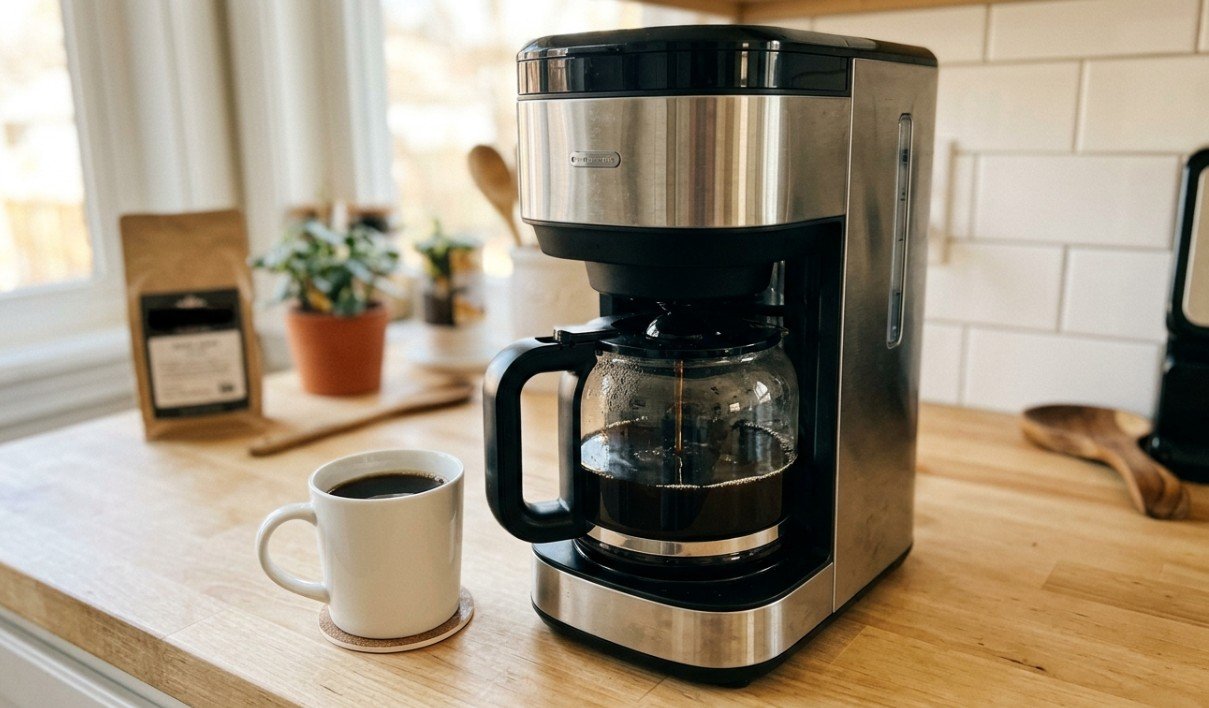
A drip coffee machine (also called a filter coffee machine) heats water to just under boiling, then pours it slowly over a bed of ground coffee sitting in a paper or reusable filter, letting gravity carry the finished coffee straight into a carafe below. It is the same basic method your grandparents probably used, just automated: no shots to pull, no milk to steam, and no grinder integration to fuss over, which is exactly why it remains the easiest way to make a full pot of coffee for a household instead of a single cup.
Within that simple idea, the machines sold in Australia split into a few real categories. Most are electric drip machines with a glass carafe sitting on a warming plate, the Sunbeam and Breville style found in department stores. A smaller premium tier, led by the Dutch-made Moccamaster, swaps the warming plate compromise for a proper copper heating element and a thermally stable carafe. DeLonghi’s Clessidra sits in between, styled more like a pour-over device than a bench appliance. None of these are the fully automatic bean-to-cup machines or capsule machines covered elsewhere on this site; a filter coffee machine’s whole appeal is that it does one job, the same way every time.
The number that actually separates a good drip coffee machine from a mediocre one is brew temperature, not price. Specialty coffee bodies put the ideal extraction window at roughly 92 to 96 degrees Celsius held steady for the whole brew cycle. Cheaper machines with a single element often start hot and drift down as the plate cycles on and off, which is the actual mechanical reason so many owner reviews below describe coffee coming out lukewarm. CHOICE’s own filter coffee buying guide covers the brewing side of this in more depth.
This list covers standard countertop drip and filter coffee machines currently sold in Australia, drawn from real owner ratings instead of brand reputation, following the same evidence-first approach as my guide to choosing the best coffee machine. If you’re after an espresso machine, a bean-to-cup, or a pod machine, those get their own dedicated lists.
The Auspure AusBrew-1812 leads this list on a strong 4.4-star average from 38 Australian owners on productreview.com.au, but if brew temperature and long-term build quality matter more to you than price, the Technivorm Moccamaster Classic is the one enthusiast forums keep coming back to.
The Best Drip Coffee Machines in Australia, Compared
| Product | Type | Best For | Key Spec |
|---|---|---|---|
| Auspure AusBrew-1812 | Electric drip, glass carafe | Everyday filter coffee | 1.8L / 12 cups, programmable |
| Technivorm Moccamaster Classic KB741AO | Electric drip, premium build | Buyers who want it to last | 1.25L / 10 cups, copper element |
| DeLonghi Clessidra ICM17210 | Drip and pour-over hybrid | Batch brewing with more control | Up to 6 real-world cups |
| Sunbeam Stainless Drip Filter PC7900 | Electric drip, glass carafe | Budget everyday brewing | 12 cups, reusable mesh filter |
| Breville Aroma Style Electronic (LCM700BSS2JAN1) | Electric drip, glass carafe | A built-in reusable filter | 1.5L / 12 cups, 24-hour delay timer |
| Sunbeam Specialty Brew PC8100 | Electric drip, glass carafe | Narrow benches | Slim body, 4-hour warming plate |
| Smeg Drip Coffee Machine DCF02 | Electric drip, glass carafe | Retro kitchens | 10 cups, permanent filter |
How I Compared It
I checked productreview.com.au ratings and written reviews, Whirlpool Forums threads on drip and filter coffee machines, and CHOICE’s public buying guidance and coffee-machines-to-avoid list, for drip and filter coffee machines currently sold in Australia, then filtered out discontinued models and near-identical rebadges. Current AU availability and naming for every model here were checked against a mainstream retailer listing (JB Hi-Fi, Harvey Norman, The Good Guys, or Bing Lee); none of those retailers are linked or quoted; they were used only to confirm a model is real and currently sold here. I also cross-checked productreview.com.au’s drip coffee machines category directly rather than relying on a search summary.
Sentiment was weighted toward sample size and consistency instead of the single highest star rating. That is why the Sunbeam PC7900, sitting at a modest 3.0 stars, still earns a place on the strength of 91 written reviews, while a couple of models with fewer than 20 reviews are named honestly as thin samples instead of settled verdicts. I also excluded the Breville Precision Brewer, a well-known US model, once I found it no longer listed as available through mainstream Australian retailers, and left out Kmart’s Anko range entirely because its one drip-style model has been discontinued.

1. Auspure AusBrew-1812 – Best for Everyday Filter Coffee
Auspure is a Sydney-run, Australian-owned kitchen brand instead of a household name, and the AusBrew-1812 is the closest thing on this list to a surprise pick. It sits at 4.4 stars from 38 reviews on productreview.com.au, the highest of any model checked for this guide, with owners repeatedly calling out how simple it is to set, use and clean. That is a smaller sample than the Sunbeam PC7900 below, which is worth saying plainly, but it is also the most consistent one I found.
It brews from a 1.8-litre tank into a glass carafe, holds a programmable timer for a set-and-forget morning routine, and uses a permanent mesh filter so you are not restocking paper filters every fortnight. Where it comes unstuck is exactly where most budget drip machines do: the glass carafe cracks or chips more easily than owners expect, a replacement costs close to a third of the machine’s own price, and the hot plate switches off after around 20 minutes, so a second cup poured later is properly cold instead of just cooler.
Australia-specific note: Auspure’s support is Sydney-based and phone-answered instead of routed offshore, which matters if the carafe does crack, since replacement glassware is the single most common complaint in the reviews I read.
Pros
- Highest and most consistent owner rating of any model on this list
- Programmable timer with a permanent filter, no paper to buy
- Fast, Australia-based customer support when something goes wrong
Cons
- Glass carafe reported as fragile, with owners paying a price close to a third of the machine’s own cost to replace it (sourced from productreview.com.au)
- Hot plate switches off after about 20 minutes, so coffee left standing goes cold quickly
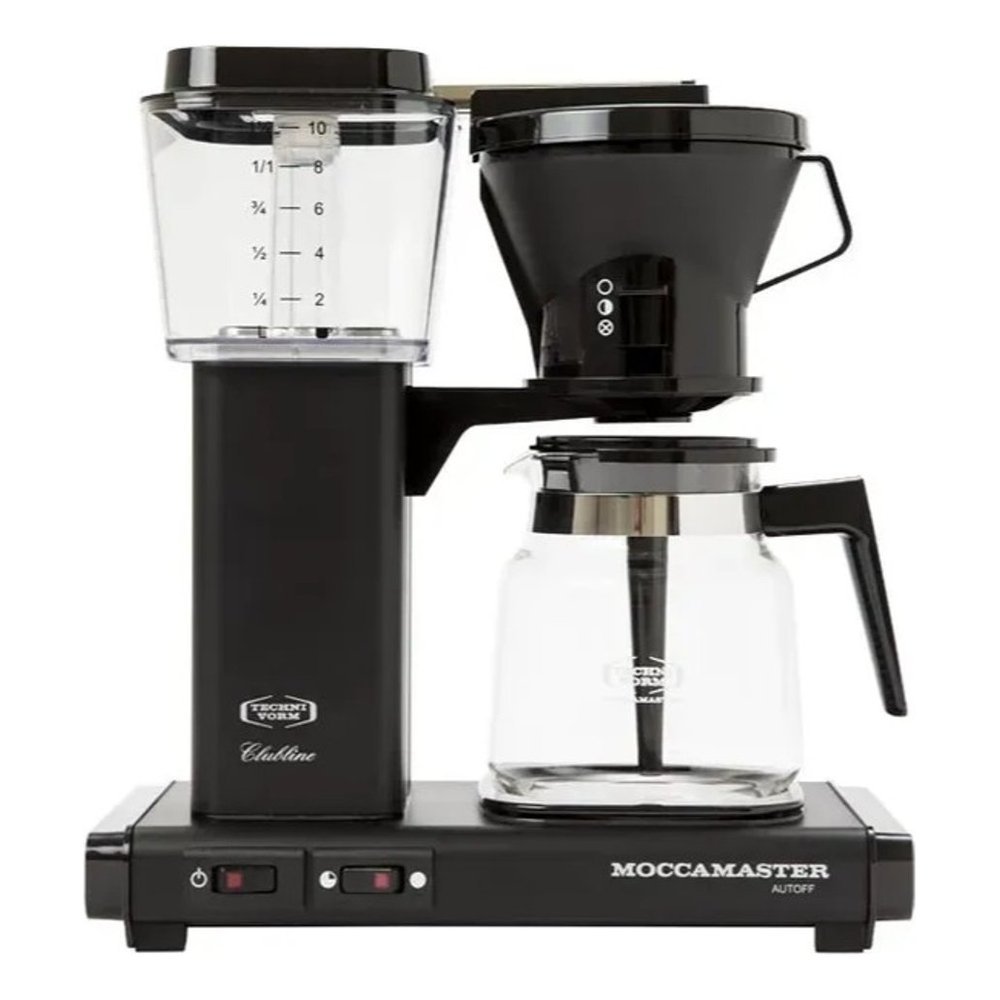
2. Technivorm Moccamaster Classic KB741AO – Best Premium Pick
The Moccamaster is the machine enthusiast forums point to when someone asks why their drip coffee tastes worse than the cafe down the road, and the reason is almost entirely the copper heating element. A Sunbeam or Breville cycles a single element on and off to hold temperature; the Moccamaster’s element is sized to reach and hold the 92 to 96 degree brewing window for the entire cycle, then finishes a full carafe in around six minutes. It is hand-assembled in the Netherlands, and every part, right down to the switch, is sold as a replaceable spare under a five-year warranty.
It shows up at just 16 reviews on productreview.com.au, sitting on a 4.3-star average. I want to be upfront that this is a thinner sample than the Sunbeam or Breville entries here. What offsets it is that the same consensus turns up independently on Whirlpool’s coffee threads and in enthusiast-forum write-ups, not just one review site: quick, quiet, and with one specific complaint worth repeating: a reviewer noting that a machine this size and price offers no way to tweak brew temperature or flow rate, since Moccamaster deliberately keeps the controls to two switches.
It is not sold through JB Hi-Fi or Harvey Norman. In Australia it comes through specialty coffee equipment importers like Coffee Parts, which is worth knowing before you go looking for one at a big-box store, and it is also why warranty service means shipping to a specialist instead of walking into a mall.
Pros
- Copper element holds brew temperature far more consistently than a cycling hot plate (Whirlpool and enthusiast-forum consensus)
- Five-year warranty with every part sold as a spare
Cons
- No way to adjust brew temperature, flow rate or contact time yourself, a real complaint from a productreview.com.au owner
- Only available through specialty importers, not mainstream retailers, so support means a shipped repair instead of an in-store swap

3. DeLonghi Clessidra ICM17210 – Best for Batch Brewing
The Clessidra looks nothing like the rest of this list. DeLonghi built it around an hourglass-shaped glass body, dripping through a shower head onto grounds sitting above the carafe instead of hiding the mechanism inside a plastic housing, and it is striking sitting on a bench. It holds a 3.9-star average from 34 reviews on productreview.com.au, a real step up from the two Sunbeam entries further down this list, though not quite at Auspure or Moccamaster’s level. You can check the full spec sheet on DeLonghi’s own AU spec page.
It brews up to ten espresso-cup-sized serves, which works out to roughly six normal-sized mugs, in about ten minutes. Owners like the look and the flavour it produces, but two specific complaints turn up often enough to be worth repeating instead of inventing one: a loud clicking noise during the brew cycle, and a glass carafe several reviewers describe as thinner and more fragile than they expected for the price. DeLonghi also does not include a permanent filter in the box on every version sold here, so check the listing before you buy if you don’t want to be sourcing paper filters.
Australia-specific note: it has a notably large footprint for a filter machine, closer to a small appliance than a compact one, which is worth measuring for before it arrives if your bench space is rental-apartment sized instead of a full kitchen.
Pros
- Distinctive design that still functions as a real daily brewer, not just a display piece
- Rated well above both Sunbeam entries on this list for taste and consistency
Cons
- Loud clicking noise during brewing, a recurring complaint on productreview.com.au
- Larger footprint than most drip machines here, worth checking bench space before buying
Related maintenance: a full DeLonghi descaling walkthrough.
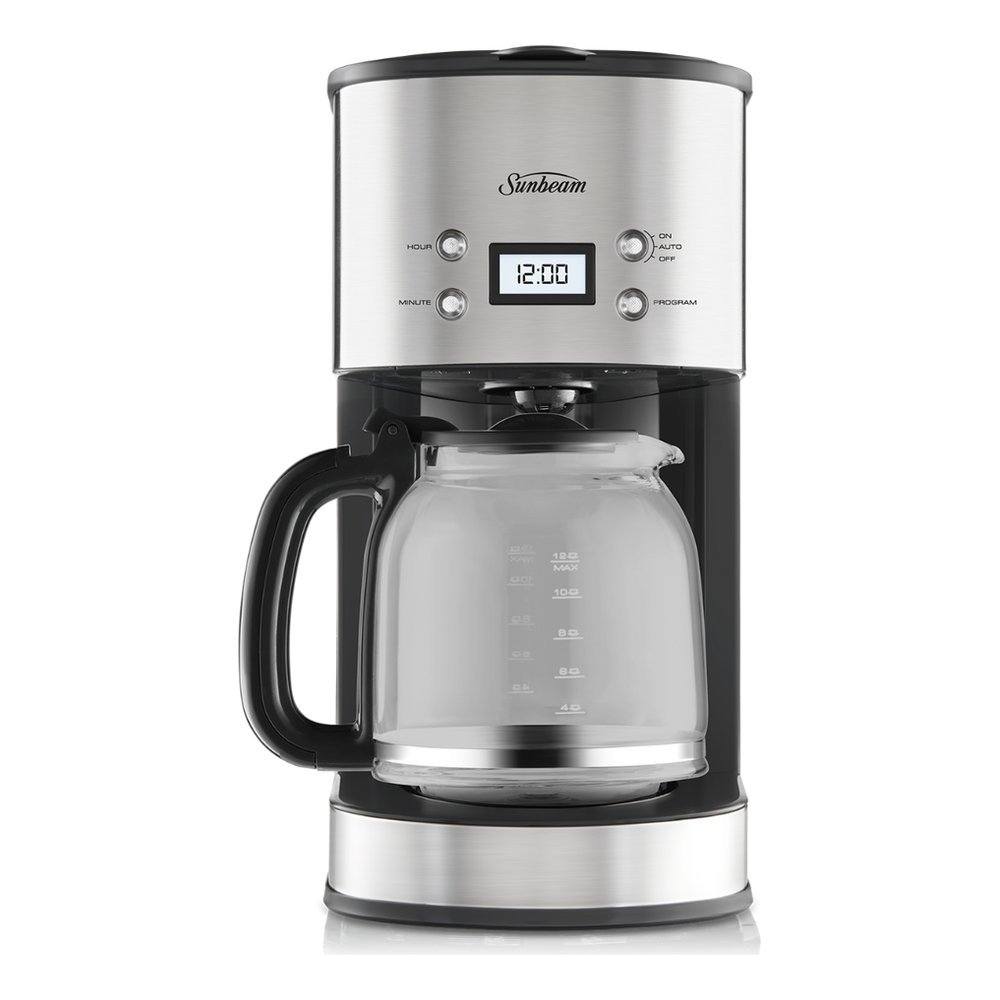
4. Sunbeam Stainless Drip Filter PC7900 – Best Budget
This is the budget benchmark, not because it is the best-reviewed machine here (it isn’t), but because 91 people have rated it on productreview.com.au and the average has settled at a middling 3.0 stars instead of swinging wildly either way. That is a useful signal on its own: a large sample landing on “fine, not great” tells you more than a tiny sample landing on five stars.
The recurring complaint, and it shows up again and again in the written reviews, is temperature: coffee described as lukewarm instead of hot, with some owners reheating it in the microwave. Set against that, reviewers consistently praise the programmable timer and the reusable mesh filter for cutting out paper filter costs entirely, and build failures inside the warranty period are a minority complaint, not the dominant theme, which is more than can be said for some machines further down this list.
Pros
- Largest review sample of any budget model checked, 91 reviews on productreview.com.au
- Reusable filter means no ongoing paper filter cost
Cons
- Coffee frequently described as lukewarm instead of hot, a recurring theme across dozens of reviews
- Occasional reports of the reusable filter shedding a blue dye when new
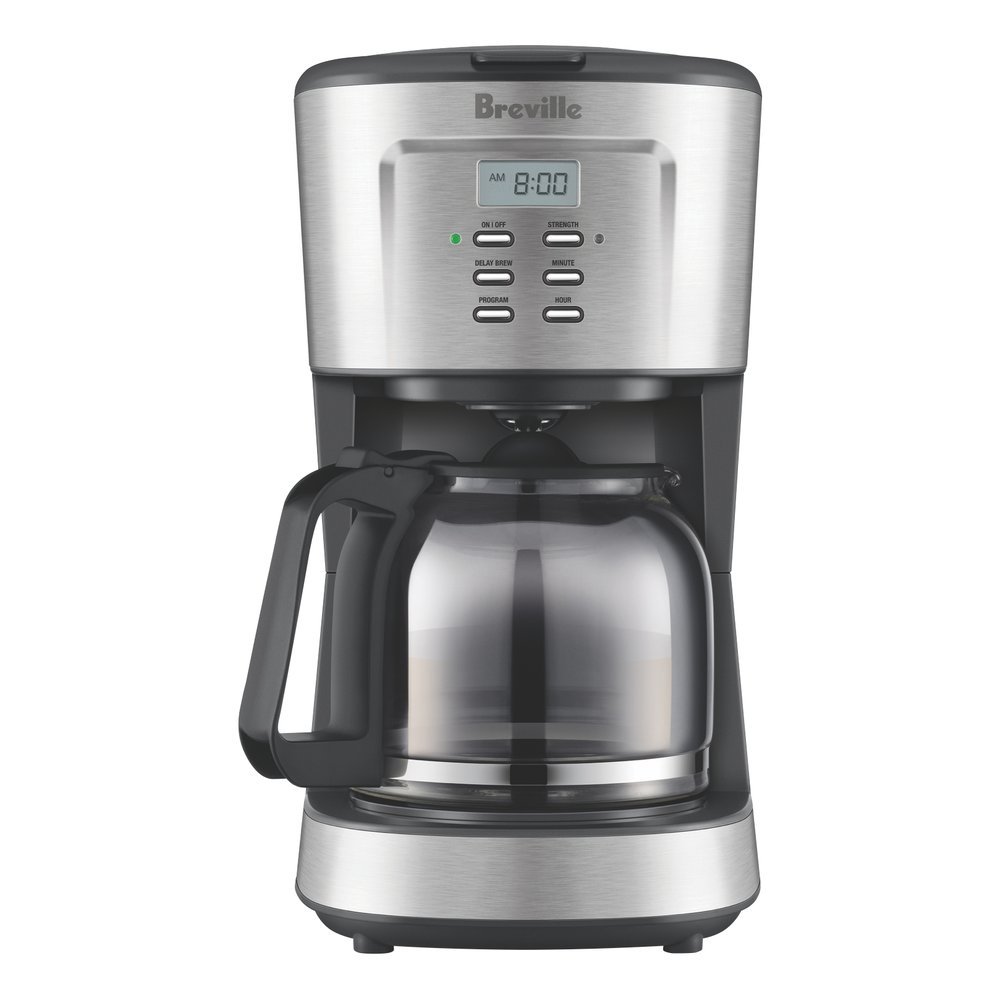
5. Breville Aroma Style Electronic (LCM700BSS2JAN1) – Best for a Reusable Filter
This is the one entry on this list where the evidence itself is inconsistent, and that deserves saying plainly instead of picking whichever number looks better. The current retail version, model LCM700BSS2JAN1, sits at 2.8 stars from a small sample of 12 reviews on productreview.com.au. An older, separately listed page for what appears to be the same Aroma Style range shows 4.0 stars from 107 reviews. I am not going to average those into one confident number; treat this as a machine with a mixed track record instead of a settled one either way.
What both sets of reviews agree on is the mechanism: a 24-hour delay timer, an LCD display, and an integrated stainless mesh filter that owners like for the same reason Auspure and Sunbeam PC7900 buyers like theirs: no paper filters to restock. Where they also agree is on durability complaints: units failing within 10 to 12 months, a plastic carafe some owners describe cracking during normal washing, and one reviewer reporting three separate failures inside two years.
For a well-known name in Australian coffee, that split result is worth flagging as a real gap between brand reputation and what current owners are actually reporting, instead of assuming the Breville badge alone guarantees the same reliability people associate with the brand’s espresso machines. If it fails, my full guide to cleaning a Breville coffee machine covers the maintenance steps that head off some of these complaints before they start.
Pros
- 24-hour delay timer and brew-strength selector, more control than the Sunbeam entries offer
- Integrated reusable filter, no paper filter cost
Cons
- Rating is inconsistent between two productreview.com.au listings for what looks like the same range, worth going in with tempered expectations
- Recurring reports of failure within 10-12 months and a carafe that some owners say cracks when washed
Related maintenance: guide to cleaning a Breville drip machine properly.
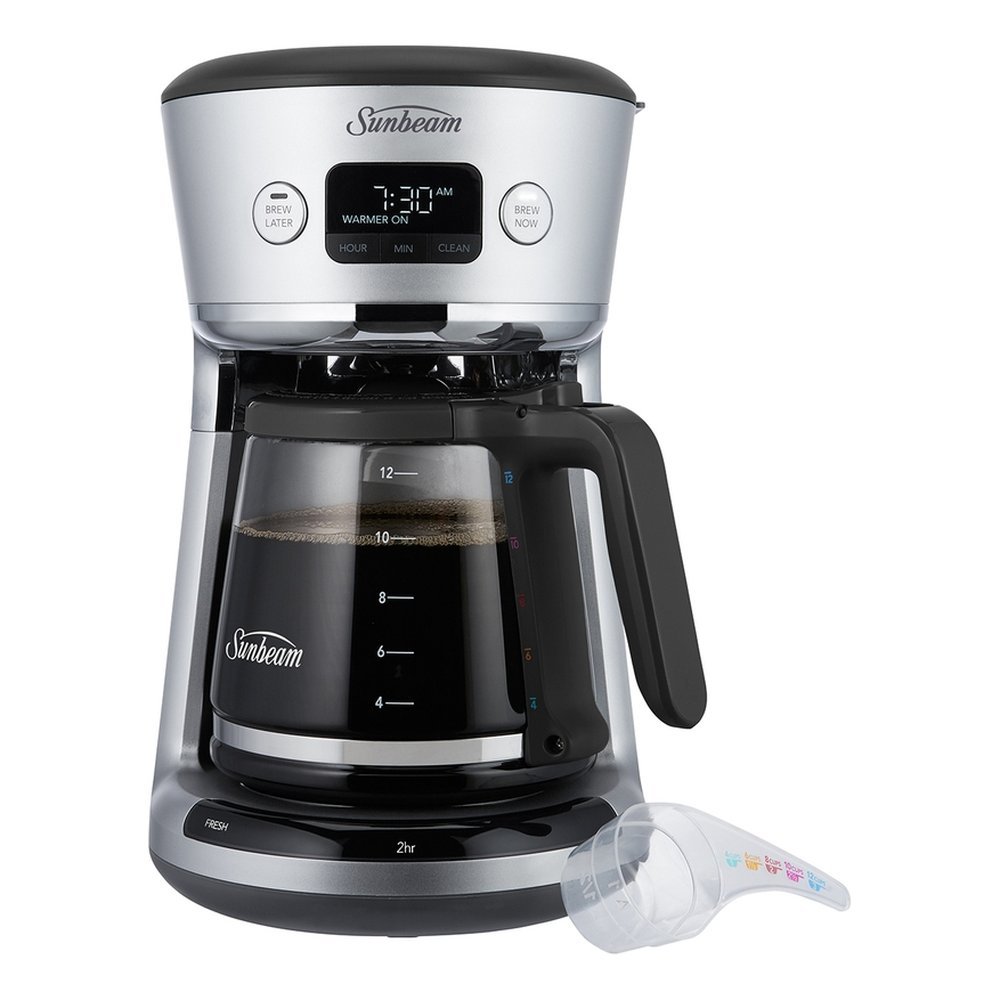
6. Sunbeam Specialty Brew PC8100 – Best for Small Benches
Sunbeam’s second entry on this list is a distinctly different product from the PC7900 above, not a rebadge, built around a slimmer footprint for kitchens where bench space is the actual constraint instead of price. It carries only 10 reviews on productreview.com.au at a 2.9-star average, a small enough sample that I would call this a live question instead of a settled verdict. It is worth re-checking before you buy instead of treating my number as final.
Owners who like it mention a quiet brew cycle, rated 4.5 out of 5 for noise specifically, and a four-hour warming plate that beats the PC7900’s shorter hold time. The complaints that do show up are electronic instead of mechanical: a handful of owners report specific error codes (EC2, EC5, EC6) with what they describe as unhelpful troubleshooting guidance in the manual, alongside units failing not long after the warranty period ends.
Pros
- Noticeably quieter brew cycle than the PC7900, and a longer 4-hour warming plate
- Slim enough to suit a narrow rental-kitchen bench
Cons
- Only 10 reviews found, so treat the rating as an early read instead of a settled one
- Owners report specific error codes with little troubleshooting guidance in the manual
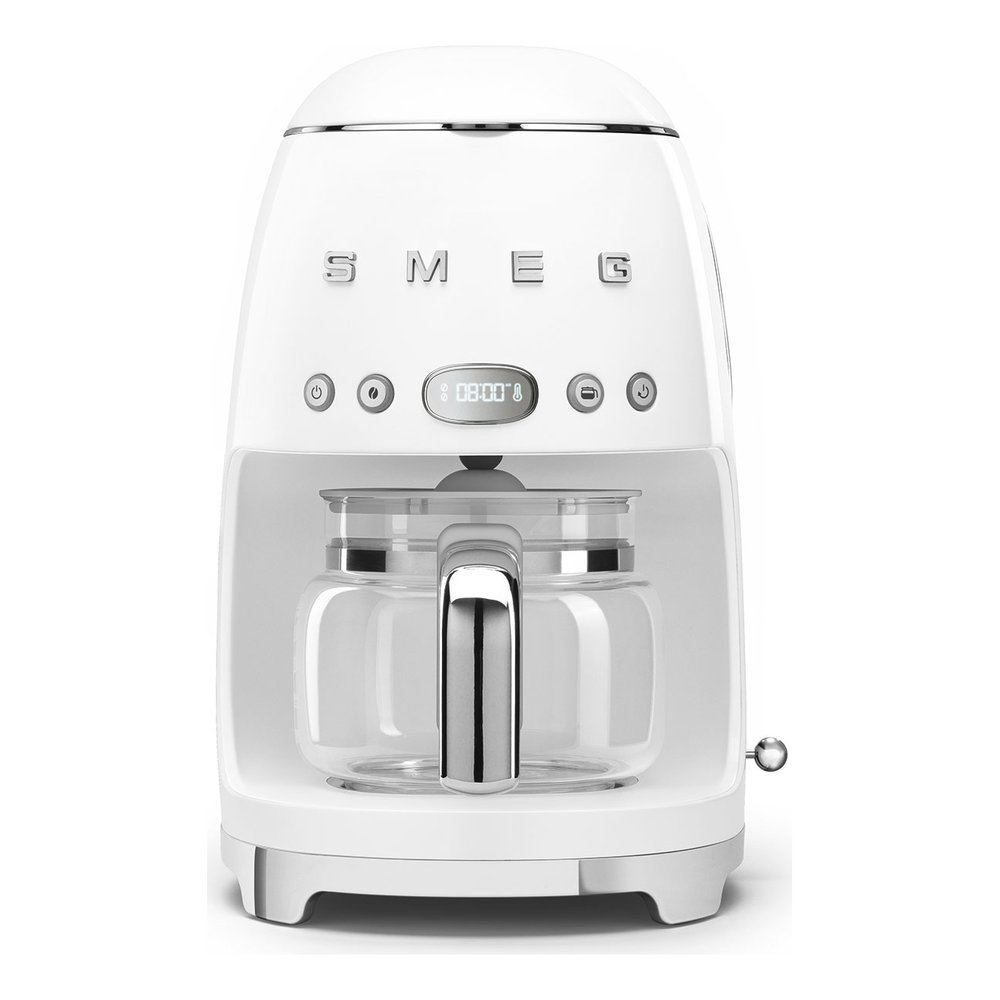
7. Smeg Drip Coffee Machine DCF02 – Best Retro Design
Smeg sells the DCF02 on looks first, and on that front it delivers: retro styling, a colour range that matches Smeg’s kettles and toasters, and a consistency score from owners of 4.5 out of 5 when the machine is actually working. The problem is the gap between that design premium and what current owners report living with. It sits at just 2.7 stars from 22 reviews on productreview.com.au, the lowest average of any model on this list, which is worth naming honestly instead of letting the Smeg badge carry the entry on reputation alone.
The specific, recurring complaint is the glass carafe handle, which multiple owners report breaking after two to five years of normal use, with a replacement part priced high enough that some owners say it approaches the cost of the machine itself. Add in reports of units failing entirely within as little as eight months and a lid design that makes refilling the tank more fiddly than it should be, and this is a clear hype-versus-reality gap: a design-led machine whose real-world durability trails its retail price.
If a Smeg is already on your bench, my descaling guide for a Smeg coffee machine is worth reading regardless of the durability concerns above, since a build-up of scale is what turns a slow leak into a full failure faster than it otherwise would.
Pros
- Consistency score of 4.5/5 from owners when the machine is running normally
- Distinctive retro design that matches Smeg’s other small appliances
Cons
- Lowest average rating of any model on this list, 2.7 stars from 22 reviews
- Carafe handle reported breaking after 2-5 years, with a replacement part costing nearly as much as a budget machine outright
Related maintenance: descaling schedule for a Smeg drip machine.
How to Choose a Drip Coffee Machine
The right filter coffee machine for an Australian kitchen comes down to four things: how many people you are actually brewing for, how much bench space you can spare, how hard your local water is, and whether you would rather buy from a specialty importer than a big-box retailer.
Capacity first, badge second. A 12-cup machine like the Sunbeam PC7900 or Breville Aroma Style makes sense for a share house or a family that all drink coffee at the same time. For one or two people, the Moccamaster’s smaller 10-cup carafe or the Clessidra’s six real-world cups avoids reheating coffee that has sat on a warming plate for an hour.
Decide how much you care about brew temperature. If your only complaint about a previous drip machine was lukewarm coffee, as it is for a lot of Sunbeam PC7900 and early-model owners above, that is a mechanical issue with a single-element hot plate, not something better beans can fix. Stepping up to a machine built around a dedicated heating element, the way Moccamaster is, solves it directly.
Factor in where you will actually buy it from. Everything on this list except the Moccamaster is sold through mainstream retailers like The Good Guys, Bing Lee or Harvey Norman, meaning an easy in-store exchange if something arrives faulty. Buying from a specialty importer instead usually means better build quality and support from people who only sell coffee gear, at the cost of a slower, courier-based warranty process instead of a shop counter.
Keep Your Machine Running
A drip coffee machine fails early almost every time for the same two reasons: scale buildup from hard tap water, or coffee oils left to go rancid inside a filter basket that never gets a proper clean. None of that is specific to one brand, so a bit of routine maintenance goes further here than on a pricier espresso machine.
If a Breville Aroma Style is the one on your bench, my guide to cleaning a Breville drip machine covers the descale cycle and the specific parts, like the non-drip valve, that trap coffee residue if they’re skipped during a normal clean.
For the DeLonghi Clessidra, my DeLonghi descaling guide walks through DeLonghi’s own descale mode and the signs that a clicking noise during brewing is scale, not a mechanical fault.
Smeg’s DCF02 needs the same attention, and given the carafe handle issues reported above, my Smeg descaling guide is worth following closely instead of skipping the recommended frequency to save time.
For the Auspure, either Sunbeam model, or the Moccamaster, none of which have a brand-specific guide on this site yet, this generic descaling method covers the same underlying process (dissolving descaling solution and running it through the water path) that applies to any pump-free drip machine.
Frequently Asked Questions
What is the difference between a drip coffee machine and an espresso machine?
A drip coffee machine pours hot water slowly over ground coffee sitting in a filter, using gravity instead of pressure, producing a lighter-bodied brew similar to what a pour-over device makes by hand. An espresso machine forces water through tightly packed, finely ground coffee at high pressure, producing a concentrated shot with crema on top. Neither is objectively better; they are different drinks with different equipment and different learning curves.
How often should I descale a drip coffee machine in Australia?
Roughly every two to three months in most Australian capital cities, but sooner, closer to every four to six weeks, if you live somewhere with harder tap water like Perth or Adelaide. Watch for a slower brew cycle or a machine that starts producing noticeably cooler coffee than usual; both are early signs of scale buildup inside the heating element well before any warning light appears.
Is a Moccamaster worth the price compared to a Sunbeam or Breville drip machine?
It depends what you value. A Moccamaster’s copper heating element holds a consistent brew temperature far better than a cycling hot plate, which enthusiast forums and its productreview.com.au reviews both point to, and every part carries a five-year warranty. A Sunbeam or Breville costs a fraction of the price and is easier to replace in-store if something goes wrong, which matters just as much for a lot of households.
Can I use ground coffee instead of paper filters in a drip machine?
Yes. Most of the machines on this list, including the Auspure, both Sunbeam models and the Breville Aroma Style, come with a reusable mesh filter built in, so paper filters are optional instead of required. The DeLonghi Clessidra is the exception worth checking before buying, since a permanent filter isn’t included on every version sold in Australia.
Why does my drip coffee come out lukewarm?
It is almost always the heating element cycling on and off to hold temperature instead of holding it continuously, which is the exact complaint that shows up repeatedly in Sunbeam PC7900 owner reviews on productreview.com.au. Scale buildup inside an overdue-for-descaling machine makes the problem worse over time. A machine built around a dedicated heating element, like the Moccamaster, largely avoids the issue from the start.
Do drip coffee machines need a special power point in Australia?
No. Every model on this list, including imported ones like the Technivorm Moccamaster, is supplied already wired for a standard 230-240V, 50Hz Australian power point. You will not need a voltage converter, transformer or plug adapter for any machine covered here, unlike some grey-import kitchen appliances.
Verdict
The Auspure AusBrew-1812 leads on evidence, while the Moccamaster leads on build quality
If you want the drip coffee machine with the strongest, most consistent owner satisfaction currently on the Australian market, the Auspure AusBrew-1812’s 4.4-star average makes it the pick, with the caveat that its sample size is still smaller than an established brand like Sunbeam. If brew temperature and long-term reliability matter more than upfront price, the Technivorm Moccamaster Classic is what enthusiast forums keep recommending, at the cost of buying through a specialty importer instead of a mainstream store. For the tightest budget, the Sunbeam PC7900’s 91-review track record makes it the safer bet of the two Sunbeam entries here, even though its 3.0-star average is nothing to get excited about.
